The Rochdale Storm1807 CE
In 1807, six years after Union, Ireland remained governed from Dublin Castle and Westminster amid war, restricted representation and unresolved Catholic claims. George III’s opposition defeated a limited Catholic military service measure, toppling Grenville ministry. The new lord lieutenant, Duke of Richmond, and chief secretary Arthur Wellesley pursued security, elections and renewed coercive powers, including insurrection and arms legislation. Michael Dwyer’s colonial trial illustrated repression’s imperial reach. Dublin gained a paving board amid wartime commercial pressures. In November, Rochdale and Prince of Wales were wrecked in Dublin Bay, killing about 400 and prompting later plans for a harbour at Dunleary.
Dateline
In 1807 Ireland was six years into the United Kingdom created by the Act of Union, yet the Union had settled remarkably little. Government was exercised through Dublin Castle and Westminster; most Irish people remained excluded from meaningful political power; and the war with Napoleonic France gave the state a permanent reason to regard Ireland as both a strategic base and a possible vulnerability. The year brought a new viceroy and chief secretary, renewed coercive legislation, an unresolved Catholic question, and, in November, a catastrophe in Dublin Bay which exposed the danger of the capital’s seaward approach with terrible clarity.
Union, War and Representation
Ireland sent one hundred members to the Westminster parliament, but this was not representative government in a modern sense. The franchise was narrow, borough influence was immense, and landlords, patrons and officeholders retained formidable electoral power. Catholics who met the property qualification could vote, but could not sit in parliament. The Church of Ireland was the established church, supported by tithes drawn from a population that was overwhelmingly Roman Catholic. Presbyterian communities, particularly in Ulster, occupied a position different from both the Anglican establishment and the Catholic majority, while also facing religious and political restrictions.
The Napoleonic War shaped policy and daily calculations alike. Ireland supplied food, linen, labour, recruits and military facilities to the wider British war effort. Its long coastline, ports and roads made it important to imperial defence; memories of the French landing at Killala in 1798 and of Robert Emmet’s abortive rising in Dublin in 1803 were still close. Officials consequently interpreted unrest through the lens of invasion and rebellion. That outlook did not mean that every locality was in revolt. Rather, it meant that the machinery of policing, magistracy, militia service, military recruitment and intelligence remained unusually important in Irish government.
A Catholic Measure Withdrawn
The year’s largest constitutional controversy began at Westminster but bore directly upon Ireland. On 5 March, Lord Howick introduced a bill intended to permit subjects of different religious persuasions, including Catholics, to serve in the army and navy on an appropriate oath. The proposal addressed an awkward anomaly. Since 1793, Irish Catholics had been able to hold army commissions in Ireland, though excluded from the highest commands; their legal position became uncertain or contradictory when a regiment served elsewhere in the United Kingdom.
This was not Catholic emancipation in its full later meaning. It would not have opened parliament or the principal civil offices to Catholics. Even so, it carried an unmistakable implication: the state might recognise Catholic loyalty and military usefulness without requiring political submission to Protestant ascendancy. In parliamentary argument, supporters stressed the need to unite the kingdom in wartime; opponents feared that any concession would endanger the Protestant constitution and create expectations of further relief.
George III opposed the measure, and the Grenville administration fell in March after the quarrel over Catholic policy. The bill was postponed and then dropped. For Irish Catholics, 1807 therefore contained a sharp change from expectation to disappointment. The episode demonstrated that a limited concession affecting Irish Catholics could still bring down a British ministry, and that royal resistance remained a decisive barrier. It also helped make the Catholic question a continuing test of the Union’s credibility.
Richmond and Wellesley at Dublin Castle
The incoming Portland ministry chose Charles Lennox, fourth Duke of Richmond, as lord lieutenant. He accepted the office on 1 April. Few leading aristocrats had wished to serve as viceroy after the Union, when the office had lost the setting of an independent Irish parliament but retained the burdens of an unequal and anxious country. Richmond’s first chief secretary was Sir Arthur Wellesley, appointed in March and serving under him from the spring. Wellesley was Irish-born, a soldier with Indian campaigning behind him, and not yet the Duke of Wellington of later fame.
The new administration was firmly hostile to further Catholic concessions. Wellesley’s central concern was security: defence against France, the prevention of armed conspiracy, and the reliable management of patronage and elections. The general election of 1807 was conducted under the new ministry’s direction. Its workings revealed the character of post-Union politics. Electoral contests could provide occasions for local popular pressure, especially where Catholic freeholders had votes, but government influence, family connection and borough control still set the limits within which that pressure operated.
Coercion Renewed
Security policy was given statutory force during the year. On 9 July Wellesley sought leave to introduce an Irish Insurrection Bill. He described it as a measure for suppressing insurrection and preventing disturbances, drawing upon earlier Irish legislation. In proclaimed counties, the system could require people to remain indoors between sunset and sunrise. Magistrates could arrest those found abroad in breach of the rules. The new bill proposed procedures involving quarter sessions and a law officer, but its basic premise remained exceptional executive power over ordinary inhabitants.
Related arms legislation aimed to regulate the possession, sale and movement of weapons and ammunition. Parliament also continued Irish measures concerning militia service, customs, excise, local taxation and administrative expenditure. These were not glamorous enactments, but they show how the Union worked in practice: Irish questions were processed at Westminster through a mixture of wartime finance, public order, offices and revenue. The government’s willingness to renew such powers underlines that the authorities did not regard the defeat of earlier rebellions as a complete settlement.
An Exile on Trial
Ireland’s unfinished political conflict also reached far beyond its shores. Michael Dwyer, the Wicklow insurgent leader who had surrendered after the 1798 rebellion and later been deported to New South Wales, was tried for sedition there on 11 May 1807. He was acquitted. Yet his acquittal did not immediately restore security or freedom: he was ordered away to Norfolk Island. The episode belongs to Irish history because transportation had made political repression imperial. A man shaped by the Wicklow war remained, nearly half a world away, an object of official suspicion. His case also shows that Irish political identities travelled with prisoners, families and soldiers into colonial society.
Town, Trade and Improvement
Dublin in 1807 was at once a capital diminished by the loss of its parliament and the administrative centre of an expanding wartime state. Its quays and harbour installations connected Ireland to Britain, the Atlantic and military movement, while its streets needed the ordinary services of a growing city: lighting, paving, cleansing, drainage and water. A new Dublin Paving Board was established in 1807 to light, cleanse and pave streets widely regarded as neglected and hazardous. The board could levy a rate, making improvement a practical question of local taxation as well as civic ambition.
The Dublin Society continued its work of encouraging agriculture, manufactures and useful knowledge; its proceedings for 1807–08 began in November. Such institutions reflected a reforming language of improvement, but their benefits were uneven. Most people still lived in rural communities dependent on small-scale cultivation, seasonal labour, rents and local markets. Wartime demand could strengthen parts of the agricultural and provisioning economy, while taxation, recruitment and insecure tenure imposed other pressures. The parliamentary abolition of the British slave trade on 25 March also touched Ireland’s commercial world. Irish ports had been constrained from direct participation in the trade, but Irish provisions, merchants and Atlantic connections had nevertheless been entangled with plantation economies. Abolition ended the legal British trade in enslaved people, not slavery itself.
The Disaster in Dublin Bay
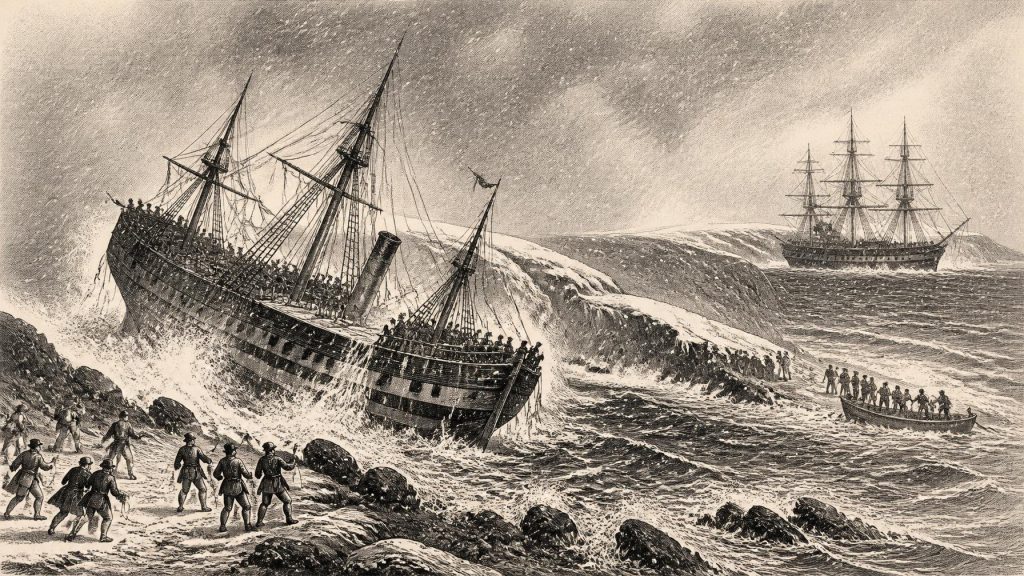
The defining Irish event of the year came in a November storm. On Wednesday 18 November, the troopships Rochdale and Prince of Wales left the Pigeon House harbour at Ringsend, bound across the Irish Sea. They carried soldiers and volunteers associated with the 18th and 97th Regiments, along with crew and, on the packet Prince of Wales, women and children. Their intended passage was part of the war’s routine movement of people and units between Ireland and Britain. The outcome was anything but routine.
A severe easterly gale, snow and heavy seas drove the ships back towards the south shore of Dublin Bay. Accounts differ over elements of the exact chronology, and the wrecks are commonly dated to 19 or 20 November; the essential sequence is secure. The Prince of Wales broke up near Blackrock. Her master, his wife and members of the crew escaped in the longboat, but more than a hundred people below deck died. The Rochdale, after its anchors failed, ran onto the rocks at Seapoint, near the site later marked by the Martello tower; no one aboard survived.
The total has often been given as about 400 dead, although contemporary and later reckonings vary with the number of passengers, crew and bodies recovered. What is beyond doubt is the scale of bereavement. Bodies came ashore along the bay. Victims of the Prince of Wales were buried near Merrion, while many of those recovered from the Rochdale were interred at Carrickbrennan graveyard in Monkstown; other burials occurred at Dalkey. The disaster made military mobilisation visible in the most intimate terms: not as a distant imperial campaign, but as families, recruits and sailors lost within sight of Dublin.
From Wreck to Harbour
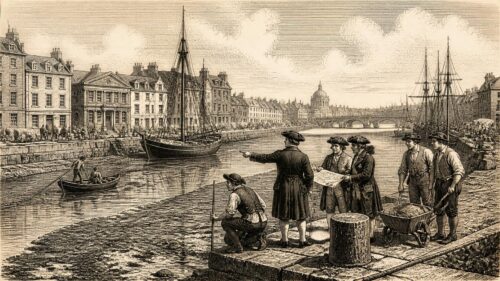
The calamity also strengthened the case for a harbour of refuge on the exposed coast at Dunleary, now Dún Laoghaire. Dublin Port’s entrance at the Liffey was difficult, and ships could be left exposed in the bay while awaiting tide or shelter. The 1807 wrecks did not produce an immediate completed harbour, and it would be wrong to date the later great construction to this year. They did, however, generate petitions and public pressure that helped prepare the way for the asylum harbour authorised and begun in the following decade.
Thus 1807 left Ireland with no constitutional resolution and no end to coercive government. It did leave a potent coastal memory. The wreck of the Rochdale and the Prince of Wales joined war, public safety, civic improvement and private grief in a single Dublin Bay disaster—one whose consequences would reshape the shoreline.
Primary Sources
- The Office of the Chief Secretary of Ireland: Select Chronology
- The Office of the Chief Secretary of Ireland: Officials
- Lennox, Charles
- Wellesley (Wesley), Arthur
- Irish Insurrection Bill, 9 July 1807
- List of Public Acts, 27 April 1807
- Roman Catholic's Army and Navy Service Bill, 5 March 1807
- Roman Catholics Army and Navy Service Bill, 18 March 1807
- Change of Administration, 26 March 1807
- Abolition of the Slave Trade, 12 January 1807
- Slave Trade Abolition Bill, 16 March 1807
- Dublin Paving, 12 April 1809
- Bicentenary of Dún Laoghaire Harbour
- Prince of Wales 1807
- Disaster at Sea
- Proceedings 1807
- Biography: Michael Dwyer
- Chronicle 1801–1810
- Clean Hands? Ireland, Slavery and the Slave-Trade
- RDS Legacies of Empire