
Napper Tandy’s Reprieve1801 CE
In 1801 the Act of Union abolished Ireland’s parliament and incorporated the kingdom into the United Kingdom, while Dublin Castle and local administration remained. Ireland received limited Westminster representation, dominated by property and borough influence. Catholic hopes of emancipation collapsed after George III’s opposition, strengthening the established Protestant church and prompting ministerial resignations. Lord Hardwicke became lord lieutenant amid fears after the 1798 rebellion. United Irishman James Napper Tandy, condemned for treason, was pardoned and spared execution. Food scarcity, high prices and uneven relief burdened households. Fiscal and trade integration proceeded gradually, while officials envisaged Ireland within an imperial framework.
Dateline
A State Remade
On 1 January 1801, the legislative Union of Great Britain and Ireland came into legal effect. The Kingdom of Ireland, which had shared a monarch with Great Britain but retained its own parliament, became part of the United Kingdom of Great Britain and Ireland. Ireland’s parliament at College Green had already passed the necessary legislation in 1800; 1801 was the year in which its abolition became an operating fact. This was not an event that altered every parish or household overnight, but it transformed the constitutional setting in which Irish politics, religion, taxation and trade would henceforth be argued. Ireland no longer possessed a domestic legislature capable of making or withholding laws for the kingdom.
The Union was framed as permanent, and it joined more than parliaments. It created a new imperial state, with a single crown, legislature and external identity. Yet its practical effect inside Ireland was more complicated than a simple transfer of all authority to London. Dublin Castle remained the seat of executive government; Irish courts, local grand juries, revenue arrangements and much administrative machinery continued. The change was therefore both abrupt and incomplete: the representative legislature disappeared at once, while the structures through which government reached counties, towns and estates remained recognisably Irish in form.
One Parliament, Narrow Representation
The first Parliament of the United Kingdom assembled at Westminster on 22 January. Ireland was allotted 100 members in the House of Commons. The arrangement was not a new democratic election. The members for the thirty-two counties and for Dublin and Cork continued automatically; one member was selected by lot in each of thirty-one boroughs whose representation was reduced from two seats to one, and one was selected for Dublin University. The arithmetic gave Ireland a presence at Westminster, but it also exposed the social limits of the settlement. Representation rested heavily on property, borough influence and a narrow electorate, rather than on the population at large.
In the Lords, twenty-eight Irish representative peers were elected for life, while four Church of Ireland bishops sat in rotation as Lords Spiritual. The old Irish peerage therefore survived, but only a small portion of it could sit in the united legislature. The institutional journey from Dublin to Westminster was substantial in every sense: legislation concerning Ireland would now be made across the Irish Sea, within a parliament in which Irish members were a minority. The Union’s defenders represented this as incorporation into a stronger common state; opponents saw the removal of the one legislature in which Irish interests could be debated on Irish ground. Both views would shape political language for generations.
Emancipation Deferred
The most damaging uncertainty in the new arrangement concerned Roman Catholic political rights. Catholics formed the great majority of the Irish population, had gained important relief in the late eighteenth century, and could vote if they met the property qualification. They still could not sit in parliament or hold the highest offices, because of the oaths required. Many Catholic supporters of Union had hoped that incorporation would be followed by further relief. It is important not to convert that expectation into a binding statutory promise: no Catholic emancipation clause appeared in the Union. But the expectation was politically powerful, encouraged by the known sympathies of William Pitt, Lord Cornwallis and Lord Castlereagh.
In January 1801 George III made his opposition unmistakable, treating Catholic emancipation as incompatible with his coronation obligations and the security of the established Protestant church. Pitt’s ministry then broke apart; Pitt left office in March and Henry Addington succeeded him. Cornwallis and Castlereagh also resigned from Irish office. For Irish Catholics, the year opened with a constitutional union presented by some as a route towards inclusion and quickly revealed the limits of that prospect. The failure did not create a mass national movement immediately, but it ensured that the Union began with a central grievance unresolved.
The Established Church and Dublin Castle
The Union did make a clear religious settlement for the established churches. Its fifth article joined the Churches of England and Ireland as the United Church of England and Ireland, preserving its Protestant episcopal character as a fundamental article of the Union. This was a constitutional strengthening of the Church of Ireland, whose bishops had been significant figures in the old Irish parliament and whose clergy received tithes in a predominantly Catholic country. The measure did not alter ordinary devotional life suddenly, but it reinforced the connection between state power, landed authority and the established church at precisely the point when Catholic hopes of political equality were postponed.
Personnel changed at the summit of Irish administration. Philip Yorke, third earl of Hardwicke, was appointed lord lieutenant on 17 March and arrived in Dublin on 25 May, the first viceroy appointed after the Union. He inherited an administration still marked by the 1798 rebellion, by wartime fears of French intervention, and by political obligations incurred while securing the Union. His appointment demonstrated an important continuity: although the Irish parliament was gone, the lord lieutenant, Dublin Castle and an Irish executive remained indispensable to the governance of the island. The question was not whether Ireland would be governed locally, but how far the local executive would be directed from Westminster and Whitehall.
Tandy and the Aftermath of Rebellion
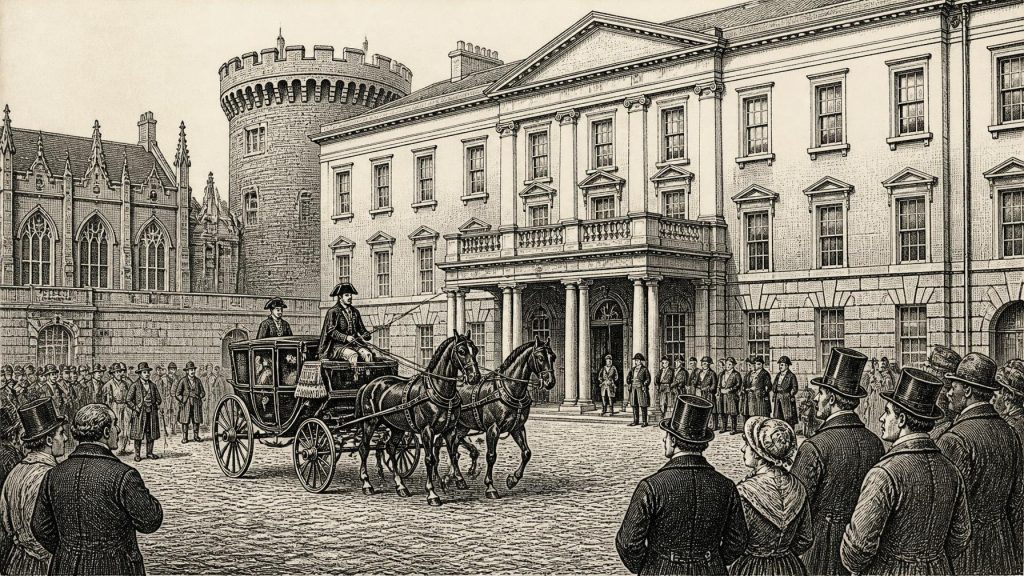
The fate of James Napper Tandy made the security legacy of the previous decade visible. Tandy, a leading United Irishman associated with the abortive French-supported expedition to Donegal in 1798, had been returned to British custody after arrest abroad. In 1801 he faced the Irish state’s judicial reckoning. Convicted of high treason, he received a death sentence in May. It was not carried out: Cornwallis had been instructed to preserve his life, and a pardon prevented the execution. The episode was not a fresh rebellion, but it showed that the Union had not ended official anxiety about republican conspiracy, French connections or the memory of 1798.
For contemporaries, Tandy’s survival could convey several messages at once. The government remained capable of prosecuting a celebrated opponent, yet it also exercised calculated restraint. That restraint should not be mistaken for a general political reconciliation. The emergency conditions and coercive habits generated by the rebellion still cast a long shadow, and the new administration’s priority was stability rather than constitutional reform. The Union had been defended partly as a safeguard against renewed revolution; in 1801, the treatment of prisoners and former insurgents remained one test of what that safeguard would mean in practice.
Dear Food and Uneasy Trade
Constitutional change unfolded amid serious material pressure. Poor harvests in 1799 and 1800 produced high food prices and widespread distress that continued into 1801. Potatoes and oatmeal were vital foods for poorer households, and their prices rose sharply. This was a subsistence crisis rather than a simple prelude to the catastrophe of the 1840s: recent scholarship stresses that Ireland avoided mass famine in 1800–01 through a mixture of relief, intervention, market responses, charity and household strategies. Nonetheless, to families dependent on small plots, casual work or uncertain wages, the price of food was likely more immediate than the new constitutional title of the state.
The crisis also warns against treating 1801 as a year in which Union alone determined social conditions. Harvest failures and war had causes wider than the constitutional settlement. Yet the timing mattered. The first months of the United Kingdom asked people to judge a remote new political order while they faced scarcity. Relief was uneven and often local; there was no modern national welfare system. The experience made clear that the Union’s promises of security and prosperity would be measured in kitchens, markets and rents as much as in parliamentary speeches.
Fiscal Union, Uneven Integration
The Union created a shared fiscal framework but not an instant economic merger. For twenty years, Great Britain and Ireland were to meet general United Kingdom expenditure in proportions of fifteen parts to two. Their pre-existing debts and revenue systems retained separate features, while Irish revenue formed a distinct consolidated fund. Trade provisions placed subjects of both countries on the same footing for many privileges and bounties, but customs and fiscal arrangements involved transitional rules, exceptions and detailed administration. Ireland entered a larger imperial market, yet the terms under which particular goods moved, and the taxes paid within Ireland, still required constant legislation.
That continuing legislative work can be seen in an 1801 Act facilitating trade and intercourse between Ireland and the United States during the relevant Anglo-American treaty. Such measures were technical, but they mattered to merchants, shippers, producers and revenue officers. The Union did not abolish Irish economic interests; it changed the political arena in which they were pursued. Nor should Dublin’s subsequent economic difficulties be projected too mechanically onto this first year. The disappearance of the parliament removed an important centre of patronage and political life, but a single calendar year cannot demonstrate an immediate, uniform decline in the city or the country.
An Imperial Future
One small but revealing document belongs to 1801. At Hardwicke’s request, the traveller and writer Isaac Weld prepared advice favouring Canada over the United States as a destination for emigrants. The paper did not amount to a mass migration scheme, but it shows officials thinking about Irish movement within an imperial rather than merely Atlantic frame. In a year when Ireland lost its separate parliament, the possibilities open to Irish people were increasingly discussed through the geography of the United Kingdom and empire.
Thus 1801 was above all a year of constitutional commencement and political disappointment. The Union formally bound Ireland into the United Kingdom, supplied it with Westminster representatives, preserved Dublin Castle’s executive role and united the established churches. At the same time, Catholic emancipation was deferred, old rebellion cases remained unfinished, and food scarcity tested ordinary households. Napper Tandy’s reprieve captured the ambiguity of the moment: the new order could be stern, cautious and conciliatory at once, but it had not resolved the fundamental question of how a predominantly Catholic Ireland would find equality and influence within the state created on 1 January.
Primary Sources
- Act of Union 1800
- Number of seats in the House of Commons since 1801
- House of Lords Bill: 'Stage One' Issues
- The relationship between church and state in the United Kingdom
- Catholic emancipation
- Cornwallis, Charles | Dictionary of Irish Biography
- Stewart, Robert | Dictionary of Irish Biography
- Yorke, Philip | Dictionary of Irish Biography
- Tandy, James Napper | Dictionary of Irish Biography
- FitzGibbon, John | Dictionary of Irish Biography
- Pratt Manuscripts | The National Archives
- Irish House of Lords—Commons
- An Act to facilitate the Trade and Intercourse between Ireland and the United States of America, during the Continuance of the Treaty of Amity, Commerce and Navigation between His Majesty and the said States
- The Famine That Wasn't? Ireland, 1799–1801
- The Famine That Wasn't? Ireland, 1799–1801
- Scarcity and poor relief in eighteenth-century Ireland: the subsistence crisis of 1782–4
- Some Repercussions of the Act of Union on the Church of Ireland, 1801–1820
- History of William Pitt 'The Younger'
- Weld, Isaac | Dictionary of Irish Biography
- Part 8 of History of the Commercial and Financial Relations between England and Ireland from the Period of the Restoration
- Acts of Union: the causes, contexts, and consequences of the Act of Union
- Letters of Col. John Wolfe M.P. of Forenaughts, Co. Kildare, concerning the Act of Union