

Power Sovereignty
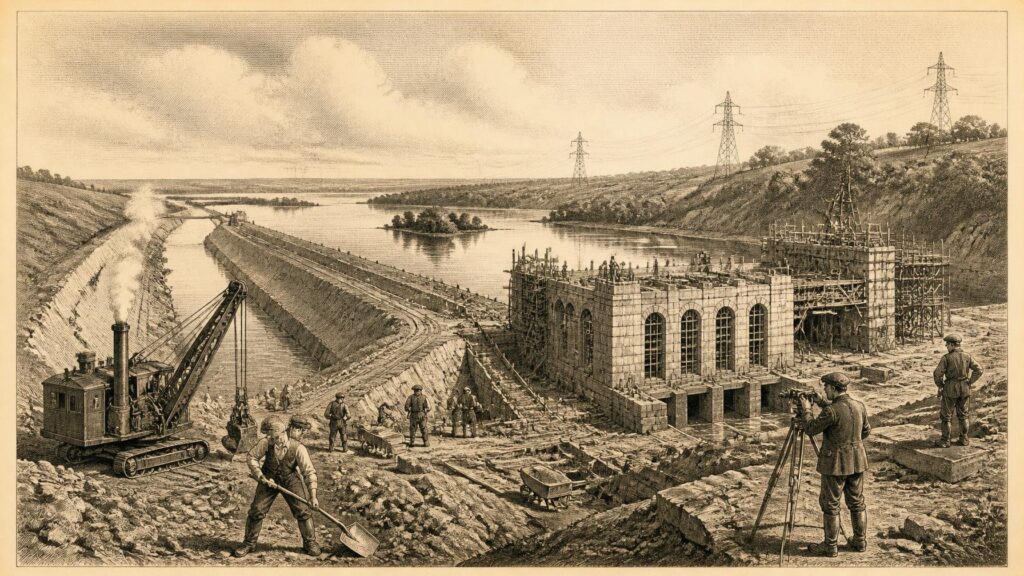
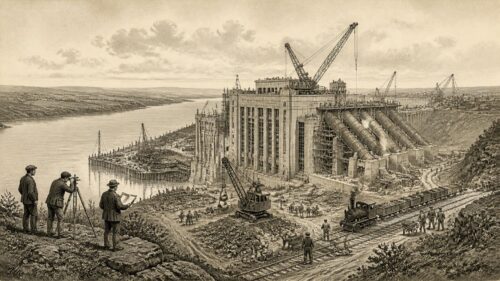
AI generated historical illustration, not a contemporary photograph.
At a Glance
Ireland’s energy history is a history of constrained choices. An island on Europe’s western edge, with limited conventional fossil-fuel reserves, a dispersed rural population and abundant wind, water and peatlands, it has repeatedly sought security through a mixture of indigenous resources, public infrastructure and external links. The meaning of security has altered over time: it has meant light in homes, fuel during wartime scarcity, industrial employment in the Midlands, protection from price shocks, and, increasingly, a lower-carbon electricity system capable of withstanding severe weather and changing patterns of demand.
Energy Before
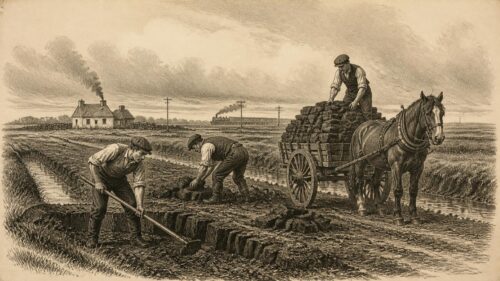
Before the modern electricity system, energy in Ireland was overwhelmingly local. Human and animal labour, firewood, coal, turf, watermills and, in coastal places, wind and tide supplied heat and motive power. This was not an age of energy independence in any simple national sense. Coal was imported in substantial quantities, especially into the ports and towns of the nineteenth century, while many rural households depended upon turf cut from nearby bogs. The availability of fuel was consequently uneven. A household with access to turbary rights possessed an important practical resource; an urban family was more exposed to commercial fuel markets and transport costs.
Turf acquired an enduring place in Irish social memory because it linked domestic labour, common rights, local landscapes and winter survival. Yet historical memory can turn that dependence into an uncomplicated story of self-sufficiency. Turf was never merely a free national inheritance. Cutting, drying, saving and carrying it required labour, weather and access to land. Its heat varied; its smoke affected dwellings and towns; and the more intensive industrial extraction later associated with peat was quite different from household cutting with a sleán. Folklore and family recollection are valuable evidence of how turf was lived with, but they should not be treated as a complete measure of national energy supply.
By the late nineteenth century, electricity had begun to appear in particular Irish towns, institutions and businesses. Supply was fragmented. Municipal undertakings and private firms generated and distributed power for limited areas, often from small stations using imported coal or oil. Electricity was a service for particular streets, factories, tramways and affluent premises rather than a universal public utility. The technical limitations were as consequential as the financial ones: a generating station served only what its local wires could reach, and a breakdown could not readily be compensated by distant plant.
This dispersed beginning matters because it explains the ambition of later national schemes. Energy security is often discussed as if it concerns only the origin of fuel. In the early twentieth century, it also concerned the shape of institutions and networks. A country with hundreds of small suppliers, inconsistent voltages and uneven standards could not easily provide reliable power to new industries or scattered farms. The political change that followed independence therefore created not merely a desire for national control but an administrative opportunity to reorganise generation, transmission and public expectations.
Free State
The Irish Free State inherited a damaged and uneven economy after revolution, civil conflict and partition. It also inherited an electricity sector whose organisation did not correspond to the new State’s aspirations. Industrial development, social improvement and administrative authority became closely associated with electrification. This association should not be mistaken for inevitability: public money was scarce, and a large hydroelectric project was contentious. Nevertheless, electricity offered an unusually visible demonstration that the State could coordinate engineering, finance and territorial development.
Thomas A. McLaughlin, an Irish engineer working with Siemens-Schuckert in Germany, was central to the proposal that the River Shannon should be harnessed on a scale sufficient to serve a national system. The proposal drew upon contemporary European electrical engineering, rather than arising from an isolated Irish technical tradition. That international origin is important. The Shannon Scheme was intended to use an indigenous river, but it depended upon foreign expertise, machinery and capital arrangements. Its historical significance lies not in pure autarky, but in the Free State’s ability to make a large international engineering partnership serve a domestic public project.
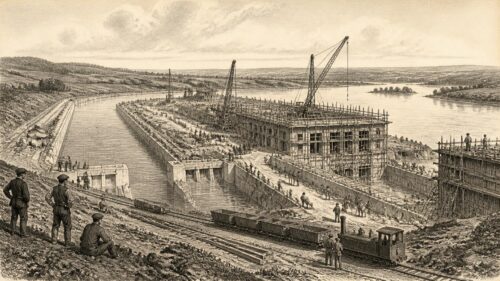
The project was approved in 1925. Construction brought a major workforce to the Shannon corridor, including Irish and German workers, and created camps, workshops, rail connections and material supply systems. It was one of the State’s first immense construction sites. The scale remained remarkable in public memory because it compressed into a few years an extraordinary transformation of landscape and technology: Parteen Weir, the headrace canal, the generating station at Ardnacrusha, transmission lines and the apparatus of a new national undertaking.
The decision had risks. Concentrating such a great share of prospective generating capacity at one scheme created obvious exposure to drought, technical failure or attack. The very importance of the undertaking led officials to consider its protection. It also drew criticism from those who favoured more immediate development near Dublin or who questioned the cost. These were reasonable concerns, not mere resistance to progress. The State’s eventual choice shows that energy security was already understood as a balance between diversity and decisive infrastructure. The Free State accepted the concentration risk because a coordinated system promised an escape from fragmentation.
Shannon Ambition
Ardnacrusha entered operation in 1929, alongside a new high-voltage national grid. At the time its 86-megawatt capacity was sufficient, in broad terms, to meet the country’s electricity demand. This fact later gave the scheme a near-mythic status. It is more precise to say that it was a foundational achievement rather than a permanent solution. Demand rose, generation diversified, and the station’s proportional role declined. Yet the project changed what Irish governments, engineers and consumers could imagine electricity to be: not an urban amenity or factory adjunct, but a national service.
The physical design demonstrated both ingenuity and limitation. Rather than constructing one immense storage dam, engineers diverted water from the Shannon at Parteen through a long headrace canal to the station at Ardnacrusha, before returning it by tailrace towards the river below. The arrangement exploited the fall available in the landscape. It also permanently affected river conditions, fisheries, navigation and adjacent communities. A historical account that celebrates electrification without acknowledging these consequences repeats the language of development too easily. Hydroelectricity was renewable in the sense that river flow continued, but it was never impact-free.
Ardnacrusha’s promise was political as well as mechanical. The scheme became a symbol of modern statehood: a monumental station, engineered landscape and network of pylons serving a country that had recently achieved independence. Promotional material naturally emphasised progress. Such publicity did not simply deceive; electric light, labour-saving appliances and industrial power were real changes. But publicity also performed a task essential to the economics of the system. Generating capacity alone could not justify the investment. Consumers had to be persuaded to connect, purchase appliances and alter domestic routines.
The Electricity Supply Board, created by legislation in 1927, provided the institutional mechanism for this transformation. It gradually absorbed or superseded the patchwork of earlier suppliers and took responsibility for development of the network. The creation of ESB established a public utility whose influence would extend well beyond generation. It organised planning, billing, consumer advice, technical standards and the practical work of bringing wires to homes and businesses. In doing so it made energy security a public administrative function, rather than a collection of local commercial arrangements.
Later commentators have sometimes described the Shannon Scheme as an assertion of Irish energy independence. That phrase captures part of its meaning, particularly its use of a domestic river and its role in reducing reliance on imported fuel for electricity. It becomes misleading if it implies isolation. The scheme used German technical knowledge and equipment, operated in a world market, and did not eliminate imported fuels from Irish life. Its better historical lesson is that national capacity can be built through international exchange without surrendering public purpose.
Rural Transformation
The benefits of the first national system were initially distributed unevenly. Towns, cities and larger settlements were easier to connect than isolated farms and small rural communities. Rural electrification after the Second World War was therefore not merely an extension of existing wires. It was a major social and engineering campaign requiring surveys, poles, transformers, local negotiation, new generating capacity and sustained labour. The Irish government identified the programme as a post-war priority, and ESB began the scheme in 1946.
Its results were profound. By the completion of the programme in 1979, more than 468,000 rural homes, farms and businesses had been connected to the national network. The figure conveys scale, but not the variety of consequences. Electricity changed illumination, water pumping, milking, food storage, domestic work and the rhythms of farmyards. It enabled appliances but also created new bills and dependencies. The arrival of power did not by itself end rural hardship, emigration or unequal access to services; it did, however, alter the material conditions in which those problems were experienced.
Oral histories frequently present the switching-on of rural electricity as a moment of astonishment. Those memories deserve respect, particularly where they preserve the experience of people absent from engineering records. Still, they often blend individual events, later improvements and national narratives. The historian’s task is not to dismiss such accounts, but to read them alongside ESB records, local newspapers, photographs and household evidence. A newly wired house could still be unable to afford every appliance promoted in showroom displays. Connection was a beginning rather than the instant achievement of modern prosperity.
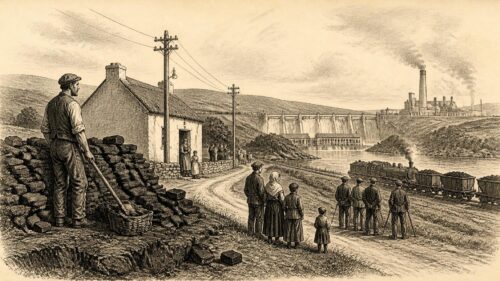
Rural electrification also reshaped the meaning of energy security. A family once reliant upon a supply of turf, oil lamps and manual labour now depended upon a far-reaching system of power stations, lines, repair crews and administrative offices. This dependence was not necessarily a loss. Central networks brought reliability and capabilities that individual fuels could not provide. But the change is a reminder that security is relational. Local fuel may offer autonomy in one respect while imposing severe physical burdens; a grid may offer shared resilience while making households vulnerable to faults beyond their sight.
The programme helped establish electricity as a normal expectation of citizenship. That expectation has endured. Modern arguments about the siting of transmission lines, wind farms, gas infrastructure or data centres take place in a society shaped by the assumption that electricity should be continuously available. The political force of that assumption is part of rural electrification’s legacy. It turned supply security from an industrial aspiration into an everyday public obligation.
Emergency Fuels
The Emergency of 1939–45 exposed the fragility of fuel systems dependent on trade. Ireland’s neutrality did not protect it from shortages. Shipping risks, disrupted markets and the demands of war reduced access to coal, oil and other imported commodities. The period gave fresh urgency to domestic fuel production, particularly turf. It also strengthened the view that energy was a matter of national survival and state organisation, not simply commercial choice.
Emergency policy should not be romanticised. The expansion of turf supply responded to a real predicament, but the fuel was labour-intensive and of uneven quality, while the conditions of wartime scarcity were harsh. The experience showed the value of indigenous resources, yet it did not prove that Ireland could or should sever itself from external trade. Rather, it demonstrated the danger of relying upon narrow supply routes and the importance of having alternatives, stocks, institutions and the capacity to adapt demand.
Hydroelectric development continued to matter. The Liffey schemes, approved in the later 1930s and developed through the following decades, added storage and generating capacity. They complemented rather than replaced the Shannon installation. The development of several sites reduced reliance on one station and illustrated a basic security principle: diversity of assets can improve resilience even where each asset depends on changing natural conditions. River flows vary by season and weather; hydroelectric power is renewable, but not infinitely controllable.
During and after the war, Irish policy makers increasingly treated indigenous fuels as instruments of economic as well as strategic policy. Domestic resources could reduce import bills, provide employment and support regional development. That logic would shape the post-war peat programme. It had considerable appeal in a country still seeking industrial expansion and improved living standards. Yet the later environmental cost of intensive peat extraction means that its history cannot be reduced to a simple success story.
Peat Republic
The Turf Development Act of 1946 established Bord na Móna to organise the production, distribution and supply of turf in the national interest. The wording of the legislation reveals the period’s priorities. Turf was not treated simply as a household fuel or local custom, but as a resource requiring a statutory body, capital works, transport systems and industrial planning. Bord na Móna became one of the most distinctive semi-state institutions of post-war Ireland.
Mechanised extraction transformed parts of the Midlands. Drainage, narrow-gauge railways, processing works, workers’ settlements and power-station supply chains altered bog landscapes on a vast scale. Peat-fired stations formed an important part of ESB’s post-war generating expansion. Between 1950 and 1965, ESB installed more than 400 megawatts of capacity through eleven peat stations. At one point, peat accounted for roughly one third of the Board’s total generating capacity. Such figures explain why peat occupied a central place in official accounts of national energy development.
The programme addressed several objectives at once. It created employment in regions with limited alternatives, used a domestic fuel, helped meet rising electricity demand and supported a vision of balanced national development. In that context, peat was widely represented as a secure national resource. The term was not wholly false. Unlike imported oil or coal, it did not depend upon sea lanes or foreign exchange in the same direct way. Its extraction, however, relied on machines, transport networks, public investment and markets. Nor did domestic origin make it environmentally benign.
Irish peatlands are environmentally and archaeologically important. Raised bogs preserve distinctive habitats and, in some cases, wooden trackways and other traces of human activity spanning long periods. The industrial development of bogs therefore brought a collision between immediate economic policy and irreplaceable natural and cultural inheritance. Earlier generations did not possess today’s full climate science or conservation framework, but the historical record permits neither condescension nor absolution. They acted within pressing circumstances; their decisions also produced consequences that later Ireland must manage.
The decline of peat generation in the twenty-first century has consequently been more than a technical fuel switch. It has affected employment, local identity, industrial landscapes and memories of public service. A just transition cannot mean treating Midlands communities as incidental to a new national energy story. The history of Bord na Móna and the peat stations shows that energy systems are embedded in places. Their closure, rehabilitation and replacement require social as well as environmental planning.
It is also necessary to distinguish hand-cut turf from industrial peat electricity. They overlap in cultural symbolism but differ greatly in scale, ownership, technology and impact. Collapsing them into one timeless national practice obscures the twentieth-century transformation of bogs into an industrial fuel province. Conversely, treating all turf users as representatives of industrial policy overlooks domestic traditions and the uneven availability of alternative heating. Historical precision matters because public arguments about climate and heritage often draw power from these conflations.
Oil Dependence
From the post-war decades onward, petroleum reshaped Irish energy use. Oil was convenient, energy-dense and adaptable: it heated homes, powered road vehicles, supplied industry and fuelled electricity generation. Economic growth and motorisation deepened this dependence. Imported oil enabled mobility and development, but it also linked Irish households and businesses to distant producers, shipping routes, refineries and volatile international prices. Security increasingly meant exposure to events beyond the State’s control.
The oil crises of the 1970s brought that exposure into sharp relief. Price shocks and uncertainty reminded policy makers across Europe that cheap petroleum could not be assumed. Ireland’s situation was especially acute because its broader energy system had few domestic conventional fuels capable of replacing oil quickly. The response included attention to conservation, fuel diversification, electricity generation and exploration. It also encouraged renewed interest in resources that were domestic or potentially domestic, including peat, hydroelectricity and later natural gas.
Natural gas altered the picture but did not remove vulnerability. The discovery and development of the Kinsale Head gas field provided a significant indigenous supply for a period and contributed to the conversion of electricity generation and industrial energy use. However, gas fields decline, infrastructure requires constant investment, and an island system cannot assume that one source will meet all contingencies. Over time Ireland became increasingly reliant on imported gas, much of it arriving through connections with Great Britain.
The broader lesson of the petroleum era is that energy security cannot be measured by electricity alone. Electricity is conspicuous because lights go out visibly, yet transport heating and industry may rely on different fuels, networks and storage arrangements. Ireland’s total energy requirement remained heavily dependent on oil and gas even as the electricity sector began to incorporate more renewable generation. A country can make rapid progress in wind electricity while still being exposed through cars, aircraft, home heating and industrial processes.
This distinction also tempers claims that modern renewables instantly restore national self-reliance. Wind and solar can displace fossil fuels in electricity, and electrification can extend their influence into transport and heat. But the transition requires grids, batteries, cables, metals, skilled labour, imported equipment, interconnectors and flexible demand. Security has become less about finding one perfect indigenous fuel than about managing a complex system of domestic generation, international exchange and reduced consumption.
Wind Revival
Wind power emerged as a major element of Irish electricity generation in the late twentieth and early twenty-first centuries. Ireland’s Atlantic location gives it a substantial wind resource, especially along western and southern coasts and on upland sites. The resource was long apparent in everyday life, but turning it into large-scale electricity required modern turbines, planning processes, market arrangements, grid reinforcement and support policies. Nature supplied the wind; institutions made large-scale generation possible.
The rise of wind is historically significant because it reverses the direction of an older energy pattern. For much of the twentieth century, Irish modernisation meant moving from dispersed local fuels towards centralised thermal stations supplied by peat, coal, oil or gas. Wind generation introduced numerous geographically distributed generators, many privately developed but linked to a coordinated public grid. It is neither a return to pre-industrial locality nor simply a continuation of the old central-station model. It is a new configuration in which local landscapes, national networks and European markets meet.
Public debate has often framed wind farms as a contest between national climate objectives and local amenity. That framing catches a real conflict but is incomplete. Communities may raise questions about landscape, biodiversity, noise, roads, ownership, consultation and the distribution of benefits. These are not necessarily objections to renewable energy as such. They are questions about who bears disruption and who receives value. The historical experience of hydro schemes, transmission lines and peat extraction suggests that legitimacy matters as much as technical potential.
Wind’s contribution has grown to a level that would have seemed improbable during the oil-dominated decades. Government reporting records a sharp increase in renewable capacity since the early 2000s, while wind has become the largest renewable component of the electricity system. Solar photovoltaic generation has also expanded rapidly from a very small base, adding a resource with a different daily and seasonal pattern. Hydro remains useful but relatively limited in national terms. The combination is more diverse than any single technology, though each has distinct constraints.
Renewability should be described carefully. Wind and sunshine are not depleted by use in the way fossil fuels are, and renewable generation can reduce fuel-import exposure and carbon emissions. Yet weather-dependent output varies. A secure renewable system therefore needs flexibility: interconnection, dispatchable backup during transition, storage, demand response, forecasting, transmission and operational rules that maintain frequency and stability. The historical novelty lies not merely in generating power without burning fuel, but in learning to operate a system whose principal energy flows are variable.
Grid Challenges
The grid is the often invisible protagonist of Ireland’s energy history. Ardnacrusha mattered because its builders simultaneously created transmission infrastructure capable of moving its electricity to consumers. Rural electrification mattered because distribution lines carried power beyond towns. Wind and solar matter only insofar as the grid can connect, balance and deliver their output. Energy security is therefore inseparable from pylons, substations, cables, control rooms, maintenance crews and planning decisions.
Interconnection has added another layer to this history. Electrical links with Great Britain allow imports and exports, creating mutual support at times of tight supply and enabling participation in a wider market. They also demonstrate why self-sufficiency is not the only form of security. A system connected to neighbours can be more resilient than one that stands alone, provided its links are diverse, maintained and governed well. At the same time, interconnection cannot substitute for adequate domestic capacity, because regional shortages or cable faults can limit its availability when it is most needed.
Modern policy recognises this mixed character. Ireland’s energy-security strategy describes a future electricity-led system based on indigenous renewables, flexibility and integration with European energy systems. It therefore rejects two false choices: that security requires permanent dependence on fossil fuels, or that it can be achieved by renewable generators without networks and backup arrangements. Storage, interconnectors, demand reduction and responsive consumption are presented as parts of the same system.
Extreme weather gives this question an additional urgency. Storms can damage lines and disrupt access for repair crews; drought can constrain hydroelectric output; calm periods can reduce wind generation; heat and cold can alter demand. Climate change does not simply strengthen the case for low-carbon energy. It changes the hazards against which the system must be designed. Resilience now includes the capacity to restore power quickly, protect critical infrastructure, manage vegetation near lines and maintain communications during severe events.
Demand is also changing. Electrified heating, electric vehicles, new housing and large electricity users can increase or alter peak requirements. Efficiency and demand response are consequently security measures, not only environmental virtues. The cheapest unit of energy to secure is often the unit not required. This insight has historical roots. Every period of Irish energy development has involved demand as well as supply: ESB had to persuade consumers to use electricity in the 1920s, while contemporary policy must encourage households and businesses to use it more intelligently and waste less of it.
Historic Lessons
Ireland’s energy past offers no simple blueprint. The Shannon Scheme cannot be copied because its circumstances were unique; peat cannot be revived as a climate-neutral symbol of sovereignty; imported gas cannot provide an indefinitely secure foundation; and wind alone cannot meet every hour of demand. What the record does provide is a set of disciplined lessons about institutions, diversity, place and time.
First, major transitions require public capacity. The State did not merely announce electrification: it established ESB, regulated supply, financed and coordinated networks, and developed expertise over decades. The same applies to the present transition. Ambitious targets are meaningful only where planning, grid construction, skills, consumer protection, environmental assessment and local engagement can deliver them. The history of electricity in Ireland is in large part the history of administrative endurance.
Second, indigenous resources are valuable but not automatically secure or just. Hydroelectricity altered river systems. Peat supported employment and domestic supply but damaged bog landscapes and intensified carbon emissions. Wind can reduce imported-fuel dependence but raises questions of siting, community benefit and ecological care. A mature account of energy security must weigh these effects rather than treating ‘Irish’ resources as beyond criticism.
Third, diversity has repeatedly mattered. The early system became more secure as it moved beyond scattered local stations, yet over-concentration at one scheme had risks. Later hydro, peat, oil, gas and interconnection each reduced one dependency while creating another. The emerging system of wind, solar, storage, demand response, interconnection and lower energy use continues this pattern. Its strength will lie less in any individual technology than in how well the components work together.
Finally, historical sovereignty is not the same as isolation. The Free State’s great hydroelectric project used international engineering; the modern grid benefits from cross-border and international links; renewable technologies are made through global supply chains. The relevant question is whether Ireland has sufficient democratic control, technical competence, diversity and resilience to make those connections serve the public good. In that sense, the most durable form of power sovereignty is not complete separation from the world. It is the capacity to choose, adapt and endure within it.
Sovereignty Recast
Power sovereignty has never meant that Ireland could meet every energy need from resources found within its own borders. The history of electricity instead suggests a more demanding definition: the capacity to make durable public choices about energy, to organise the institutions and networks required to carry them out, and to retain room for action when external conditions become hostile. The Shannon Scheme represented this ambition in an early and dramatic form. It used a domestic river and gave the new State an electricity system of national scope, but it did so through international engineering knowledge, imported equipment and an economy still connected to foreign trade. Its importance was therefore not isolation from the world. It was the creation of Irish public capacity within it.
This distinction remains useful because the language of independence can conceal practical dependencies. An electricity system depends on materials, specialised machinery, finance, technical training and communications as well as on fuel. A wind turbine is not made sovereign merely because the wind that turns it crosses an Irish field or sea. Equally, an interconnector is not necessarily a surrender of control simply because it carries electricity across a border. Its significance depends on ownership, rules, alternatives, maintenance and the ability of public institutions to manage risk. Sovereignty, in this sense, is best understood as the ability to avoid being trapped by any one dependency.
The semi-state model was one of the principal means by which Ireland attempted to build that ability. ESB did more than own generating stations. It accumulated engineers, linesmen, planners, accountants, appliance advisers and operating knowledge. It developed standards across a country formerly served by hundreds of separate suppliers. The same pattern appeared in the Turf Development Act of 1946. By establishing Bord na Móna and assigning it duties to produce, market, encourage the use of and develop turf, the State transformed a dispersed resource into an object of national administration. The Act also gave the Board significant powers over land, rights of way and water. Energy policy could thus alter who exercised authority over landscape as well as how homes and factories were supplied.
That history makes clear that state capacity has costs and must be accountable. A national system can distribute benefits more widely than isolated private ventures, but it can also impose its priorities on particular places. The diversion of water for hydroelectric generation, the building of transmission corridors and the industrial working of bogs all demonstrate that security is experienced unevenly. Communities living beside infrastructure may receive employment, connection or investment, but they may also bear environmental change, construction disturbance and restrictions on familiar land uses. Consent cannot be reduced to a single planning decision. It depends on whether affected people can obtain information, challenge proposals, share in benefits and see long-term obligations honoured.
Peatlands give this question unusual depth. They were treated in the twentieth century as a domestic fuel reserve and an industrial resource, yet they are also archives of environmental and human history. Waterlogged conditions have preserved timber trackways, tools, leather, plants and other fragile remains that would ordinarily disappear. Extraction sometimes revealed those records, but it also exposed them to damage or destruction. The point is not that earlier development should be judged only by present priorities. Post-war policy addressed real needs for fuel, employment and regional development. It is that no claim of energy sovereignty can be complete if it ignores the inheritance over which sovereignty is exercised. Control of a resource includes responsibility for what cannot be replaced.
For that reason, a transition away from peat generation is not simply a matter of substituting one source of electricity for another. It raises a question familiar from every earlier phase of Irish energy development: how should national advantage be distributed among regions and generations? Midlands communities were not incidental locations for a fuel policy made elsewhere. Their labour, railways, workshops and altered landscapes formed part of the national system. Rehabilitation of cutaway bogs and the development of new employment, heat, transport or renewable-energy opportunities should therefore be treated as elements of energy security. A system that lowers emissions while abandoning places that supplied it for decades may be cleaner, but it is less secure politically and socially.
The contemporary strategy for energy security points towards an electricity-led system built around indigenous renewable resources, reduced and more responsive demand, resilient infrastructure and integration with European energy systems. This is a substantial change from the older pursuit of a single national fuel. It accepts that security requires both domestic capability and external connection: more renewable generation, but also imports where needed; more storage, but also diversified fuels during transition; greater electrification, but also efficiency and the capacity to reduce demand at times of stress. Such an approach is less visually simple than a great dam, a peat station or a gas field. Its strength lies in refusing to make one technology carry every burden.
Demand deserves particular attention. The first electricity system had to create consumers for the power it generated, using showrooms, demonstrations and advertising to make electric light and appliances part of ordinary aspiration. The present challenge is almost the reverse. Electricity is indispensable and demand may grow with electrified transport, heating, industry and digital services, but consumption must also become more flexible and efficient. Households and businesses are asked not merely to buy power but, at certain times, to shift or reduce its use. This does not make consumers responsible for failures of planning. It does mean that energy citizenship now includes a more active relationship with the system: insulation, efficient equipment, informed tariffs and, where feasible, the timing of demand can reduce both costs and vulnerability.
The continuity with earlier periods is striking. Ireland has repeatedly confronted the limits of a favoured solution: hydroelectric concentration could not meet all later demand; turf could not provide an uncomplicated national future; oil and gas brought convenience but exposed the State to external shocks. Renewable electricity will have limits of its own, including variable weather, contested infrastructure and the need for materials and skilled workers. The appropriate historical lesson is neither nostalgia for self-sufficiency nor confidence that technology alone will remove dependence. It is that power sovereignty is a collective practice. It rests on diverse supplies, capable institutions, protected landscapes, fair treatment of affected communities and a public willing to regard the grid not as a hidden utility, but as shared national infrastructure.
The article’s changing definition of energy security is especially thought-provoking. Ireland’s major schemes, from Ardnacrusha and rural electrification to peat generation, expanded national capacity while creating fresh dependencies on foreign expertise, centralised networks, ecological systems and imported fuels. This complicates any simple opposition between self-sufficiency and reliance on others. The discussion of wind, solar, storage and interconnection suggests that power sovereignty may mean balancing resources rather than pursuing isolation. How should Ireland fairly assess the trade-offs between local control, international cooperation, regional employment, affordability, resilience and environmental protection when shaping its future electricity system in a changing climate and economy?