

Tenants Ascendant
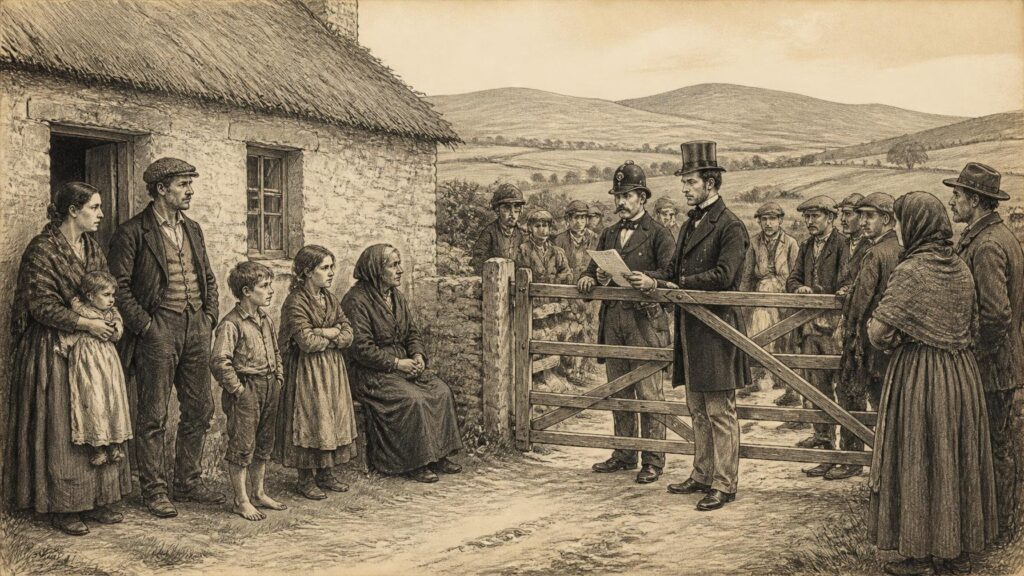
AI generated historical illustration, not a contemporary photograph.
At a Glance
Irish tenancy rights were not granted in a single reforming moment. They emerged from long contests over land, homes, rent, eviction, customary entitlement and political power. In the countryside, tenant farmers turned precarious occupation into a claim for security, fair rent and eventual ownership. In towns and cities, working people confronted overcrowding, absentee ownership, weak standards and fluctuating rent controls. The resulting history is neither a simple tale of landlord oppression nor an uninterrupted advance of rights. It is a record of hard-won protections, significant exclusions and continual adaptation to changing forms of property.
Historical Scope
“Renters and tenancy rights” covers more than one Irish history. A tenant cultivating a small farm in nineteenth-century Mayo occupied a very different legal and social world from a family in a Dublin tenement, a commercial tenant in an inter-war town, or a private renter under the Residential Tenancies Act 2004. Yet all encountered the central imbalance inherent in renting: one party possessed the property and the other depended upon continued access to it. The terms on which that dependence could be ended, priced, inherited, improved or transferred have shaped Irish society with unusual force.
For much of the nineteenth century, land was the principal productive resource and farming households were the largest group of tenants. Their arguments over tenure therefore touched hunger, marriage, inheritance, local authority and national politics. The later growth of public housing and owner occupation did not make tenancy unimportant. Instead, it altered the places in which insecurity was most visible: from rural holdings to city rooms, flats, houses and a private rental sector that again became central to many households.
This is principally a history of the territory now forming the Republic of Ireland, while recognising that the nineteenth-century land system and several early statutes operated across Ireland before partition. Northern Ireland subsequently followed its own housing and tenancy legislation, so its later legal history cannot simply be folded into that of the State. The common pre-partition past matters, but precision requires that later arrangements be distinguished rather than treated as identical.
There is also a necessary distinction between evidence and memory. Court records, statutes, parliamentary papers, estate papers and official returns establish much about law and administration. They are less reliable guides to the private calculation of a landlord, the fear within an evicted household or the solidarity of neighbours. Folk memory, songs, family stories and political commemoration preserve those experiences, but can compress events, elevate representative episodes into universal ones, and attach later meanings to earlier struggles. Both kinds of source are valuable when their limits are made clear.
Customary Claims
Before the modern land acts, the Irish tenant’s position was generally governed by contract, common law and local practice rather than by a broad statutory right to remain. A landlord owned the estate; the tenant held an interest defined by a lease, a yearly arrangement or a more informal agreement. The difference was decisive. A lease could provide a term and written conditions, but many poorer occupiers held from year to year or on still less secure terms. Their continuing occupation could depend upon payment, landlord approval and local power.
Tenant right was the great challenge to that legal simplicity. It did not initially mean a uniform right recognised everywhere. In Ulster, a body of customs commonly described as the Ulster tenant-right gave many tenants an expectation that they could sell their interest in a holding to an incoming occupier, subject to the landlord’s approval, and receive payment reflecting the value of their improvements and goodwill. Its precise content varied between estates and districts. It was not an egalitarian rural constitution, nor did it remove the landlord’s authority, but it gave practical protection that was absent or weaker elsewhere.
The custom rested upon an economic fact as much as a moral claim. Tenants had often drained ground, built houses and outbuildings, fenced fields, reclaimed land and improved stock or cultivation. If a landlord could take the improved holding back without compensation, the tenant’s labour might enlarge the value of someone else’s estate while leaving the family insecure. Tenant-right advocates therefore argued that improvement created a legitimate stake. Landlords who accepted the custom could see advantages too: an incoming tenant might pay a substantial sum, the estate gained settled occupiers, and the practice could reduce conflict.
Outside Ulster, comparable usages existed but were less consistently recognised. The language of custom could also conceal sharp inequalities. A tenant with capital, a larger holding or local influence was better placed to profit from a saleable interest than a cottier, labourer or subtenant. Women’s work was fundamental to household survival and farm improvement, yet formal dealings were usually conducted in male names. Thus tenant right was important without being universal, and protective without delivering equal security to all who lived on the land.
Older popular accounts sometimes depict an unbroken, ancient Irish communal entitlement to land, later swept away by conquest. Such accounts express a powerful sense of dispossession, but they should not be used as a substitute for evidence about particular tenures. Ireland contained varied systems of lordship, customary practice and legal change over many centuries. The modern tenant-right movement was shaped above all by the property relations, commercial agriculture and state institutions of the eighteenth and nineteenth centuries. Its participants could invoke a deeper past, but their demands addressed contemporary rent, eviction and improvement.
Colonial Estates
By the nineteenth century the relationship between proprietor and occupier was entangled with the history of conquest, plantation, confiscation, inheritance and credit. Estates ranged enormously in size and management. Some owners lived near their tenants, invested in roads, drainage or buildings, and granted longer leases. Others were absentee or managed through agents and middlemen. No single description fits every estate, but the ownership structure made the land question a national political issue as well as a series of local bargains.
Subdivision intensified pressure. In areas of dense rural population, especially before the Great Famine, small holdings could be divided among sons or sublet to labourers and relatives. A holding that supported one household poorly could become the basis of several precarious occupations. The potato enabled survival on tiny plots but did not make that survival secure. Rent might be paid in cash, labour or a mix of obligations; the legal tenant could be several steps removed from the people living and working on the land.
This complexity matters because “the tenant” was not a single class. Large grazing farmers, prosperous leaseholders, smallholders, cottiers, labourers, subtenants and lodgers could all be connected to rented land but had different interests. A farmer might resent a head landlord’s rent while collecting rent from an under-tenant. A leaseholder could be vulnerable to the expiry of a lease but relatively powerful within a locality. Later nationalist rhetoric often united these groups under the banner of the tenantry, yet legislation and agitation did not affect them equally.
The state’s legal framework initially favoured the enforcement of property contracts. The Landlord and Tenant Law Amendment Act (Ireland) 1860, widely known as Deasy’s Act, consolidated and altered parts of landlord and tenant law. Its long title itself showed the dual character of the measure: it addressed recovery of premises from absconding, overholding and defaulting tenants, while also offering protection against undue distress. In practice, it is remembered principally for strengthening clear contractual remedies in a period when many tenants lacked the bargaining power needed to negotiate freely.
That reputation should be handled carefully. The Act was not simply a short instruction to evict; it contained detailed provisions concerning leases, rents, possession and procedure. Nonetheless, its logic was recognisably contractual. It did not convert local expectation into a comprehensive right to a holding. The contrast between formal equality of contract and the unequal conditions under which contracts were made became a lasting criticism. A family dependent on a plot for subsistence could not bargain as an equal with the owner or agent controlling access to it.
Famine Crisis
The catastrophe of the Great Famine exposed the dangers of a rural economy in which occupancy, subsistence and rent were intertwined. Potato failure began in 1845, but the disaster that followed cannot be explained by crop disease alone. Poverty, dependence on a narrow food base, inadequate relief, administrative choices and patterns of landholding all shaped the scale of suffering. Tenancy arrangements affected whether a household had a plot, whether it could pay rent, and whether eviction or emigration followed distress.
Eviction has an enduring place in Irish historical memory, often represented by the roofless cottage and the family at the roadside. Such scenes are grounded in abundant evidence of removals, assisted emigration and clearance, but individual causes varied. Some landlords and agents sought to reduce rates or consolidate small holdings; some assisted tenants to emigrate; some provided relief; some became insolvent. The Encumbered Estates legislation of 1849 enabled the sale of heavily indebted estates through a special court. It changed ownership on a large scale, but it did not establish security for tenants. New proprietors could pursue more commercially minded management.
The Poor Law system also bore on tenancy. Relief administration, workhouse admission and local rating created grim incentives and pressures. The Gregory clause, associated with the Poor Law Extension Act of 1847, limited outdoor relief to occupiers of more than a quarter acre unless they surrendered their holding. Its operation encouraged the relinquishment of small plots at precisely the moment when families had least capacity to absorb further loss. It remains one of the clearest examples of public policy linking relief to dispossession.
It would be inaccurate, however, to portray every eviction as a direct state command or every landlord as acting from the same motive. Historical explanation must retain agency and variation. What can be said firmly is that the existing legal order supplied landlords with potent remedies, offered small occupiers little enforceable security, and allowed the consequences of arrears to fall upon households whose alternatives were starvation, the workhouse, migration or dependence on kin.
The famine altered the countryside demographically and psychologically. Population fell through death and emigration; holdings became larger in some regions; marriage was delayed; remittances became important; and the assumption that a family could divide a minute plot among children weakened. Yet the central issue did not disappear. Indeed, post-famine agricultural change made the value of land, grazing and improvements more visible. The tenant who had survived no longer necessarily accepted a purely temporary interest in the place on which the household had rebuilt its life.
Tenant Politics
From the 1850s, tenant-right politics acquired wider organisation and a more articulate public language. Campaigners did not all seek the same end. Some wanted compensation for improvements; others sought security of tenure, fairer rents or a recognised right to sell an interest in the farm. Still others looked beyond reform towards peasant proprietorship. These aims could work together, but they were not interchangeable. Compensation could leave rent-setting intact, while ownership would remove the landlord-tenant relationship altogether.
The Tenant Right League of the early 1850s drew support across denominational lines and connected land reform to parliamentary representation. Its fortunes were limited by electoral divisions and the priorities of established political leaders, but it helped make tenant claims a national question. In Ulster, Presbyterian, Catholic and other farmers could find common ground in defence of custom, although political and religious differences remained potent. The notion that land reform was merely a later nationalist invention is therefore misleading; its roots lay in varied rural grievances and alliances.
Economic arguments strengthened moral ones. If tenants paid for buildings and reclamation, reformers reasoned, they needed confidence that they would enjoy the return. If rent rose whenever the tenant improved, improvement could be punished rather than encouraged. This was the familiar complaint of the “unearned increment” passing to the landlord. Landlords replied that ownership entitled them to rent, that estate investment also mattered, and that compulsory restrictions threatened credit and order. The debate was not only about sentiment. It concerned competing accounts of property, risk and agricultural development.
Violence formed part of the background to reform, but it should not eclipse constitutional organisation. Secret societies, threats and assaults had a long history in agrarian Ireland, especially where grazing, tithe, rent or access were contested. They could intimidate victims and communities, and cannot be romanticised as automatic expressions of popular justice. At the same time, petitions, meetings, newspaper campaigns, elections, legal cases and tenant associations were essential vehicles through which grievances became programmes for legislation.
The 1860 Act did not settle these arguments. If anything, its contractual language sharpened the case for statutory intervention. The demand increasingly became known as the “three Fs”: fair rent, fixity of tenure and free sale. The phrase was compact, memorable and politically useful. Fair rent meant that rent should be assessed rather than imposed without limit; fixity meant protection against arbitrary removal while obligations were met; free sale meant the tenant could realise the value of the interest and improvements. Together they challenged the conventional hierarchy of landlord and tenant.
First Reforms
William Ewart Gladstone’s government addressed the land question in the Landlord and Tenant (Ireland) Act 1870. The statute did not abolish landlordism, nor did it make every tenant secure. Its importance lay in recognising that the existing relationship required correction. It declared the Ulster tenant-right custom legal where it could be proved, provided for compensation in specified circumstances, and extended forms of compensation for disturbance and improvements to tenants outside Ulster.
The distinction between compensation and security was critical. A tenant might receive money after being disturbed, but money did not necessarily preserve a home, a livelihood or a place in the community. There were exclusions and qualifications, including provisions related to holdings of higher value and written agreements. The practical burden of claiming compensation could be considerable. Nevertheless, the Act breached the principle that landlord and tenant were bound solely by whatever bargain had been made. It accepted that a tenant’s improvements and established occupation deserved legal recognition.
It also introduced a limited system of state-assisted purchase. This pointed towards a future in which tenants might buy holdings, but the early purchase provisions were insufficient to transform the structure of ownership. Purchase required willingness and finance. Many tenants could not raise the necessary sums, and many landlords had no immediate reason to sell. The Act was therefore a beginning rather than a settlement.
Interpretation has sometimes turned the 1870 legislation into either a generous liberation or a futile gesture. Neither extreme is persuasive. It was a substantial constitutional acknowledgement of tenant interest, especially in its recognition of Ulster custom and compensation. But the agricultural depression of the late 1870s revealed its limits. When prices fell and harvests disappointed, a tenant with a compensation claim still faced arrears and the immediate fear of losing the holding.
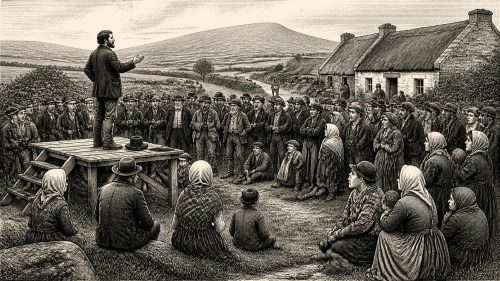
The later Land War grew from that conjuncture. Economic strain, the legacy of insecure tenure, the organisational talents of local activists and national political currents all mattered. It did not arise because one statute mechanically failed, nor can it be reduced to a single event. The Irishtown meeting in County Mayo in April 1879 acquired symbolic prominence, but the movement was built through many local disputes, newspapers, clergy, organisers and tenant networks. Its strength lay in making separate rent conflicts appear as parts of one national cause.
Land War
The Irish National Land League, founded in 1879, made tenant demands inseparable from mass politics. Its public programme concentrated on the three Fs, while many activists saw ownership as the ultimate remedy. Meetings mobilised crowds; branches linked parishes; newspapers spread reports and instructions; women organised, communicated and resisted process servers; and political leaders connected rural agitation to parliamentary obstruction and Home Rule. The League’s reach was real, though uneven. Local initiative remained indispensable.
The word “boycott” entered international vocabulary through the conflict surrounding Captain Charles Boycott, land agent for Lord Erne in County Mayo. The documented core of the episode is clear: after rent disputes, Boycott and those dealing with him were isolated by a locally enforced social and economic campaign in 1880. Press coverage made his name famous. Later retellings have often simplified the event into a tidy origin story in which a central organisation issued a perfect command and an entire community obeyed. The historical reality was more contingent, with local tenants, women, clergy, labourers, police and journalists playing distinct parts.
Boycotting was a formidable method because it avoided direct purchase of the landlord’s legal power. Rather than seize an estate, it made routine management socially costly. It could be non-violent in form, yet its coercive potential was plain when communities enforced ostracism or when threats accompanied it. The history should acknowledge both the ingenuity of collective action and the pressure it placed on dissenters. A movement for tenant freedom could itself impose demanding obligations on neighbours.
Evictions became the emotional centre of the Land War. An eviction was not merely a civil remedy; it was a public demonstration of power, often involving sheriff, bailiffs, police and a crowd. The removal of a roof, whether immediately or later, acquired special symbolic force because it made return difficult. Relief committees, priests, Land League branches and neighbours sometimes aided evicted families. The famous “Land League hut” became an emblem of resistance and hardship. Yet not every displaced family received support, and the capacity of voluntary aid was limited.
Government repression, including coercion measures and the imprisonment of League leaders, intensified the confrontation. Parnell’s arrest and the “No Rent Manifesto” of 1881 are familiar landmarks, but the political strategy shifted repeatedly. The so-called Kilmainham Treaty of 1882 marked a moment of accommodation between Parnell and the government, even as agrarian violence continued in some places. The Land War was therefore not a single uninterrupted campaign but a series of struggles, bargains and recalculations.
Judicial Rents
The Land Law (Ireland) Act 1881 was the decisive legislative answer to the first Land War. It established a Land Commission and gave many tenants the opportunity to obtain judicially determined rents and statutory security, subject to the Act’s conditions. The three Fs were not implemented without qualification, but the balance of power changed dramatically. Rent was no longer always what a landlord could obtain or demand; it could be assessed within a legal system.
The judicial rent system sought to translate political conflict into adjudication. Courts and commissioners assessed holdings, evidence and local circumstances, then fixed rents for statutory periods. This did not eliminate disagreement. Valuation involved judgement, and both landlords and tenants could regard decisions as inadequate. Still, the existence of a forum in which a tenant could seek a reduction represented a profound departure from the earlier doctrine of unrestricted contract.
The Act also made the Land Commission an enduring institution in rural life. Officials, surveyors, solicitors and commissioners became part of the machinery through which the countryside was re-ordered. This bureaucratic dimension is sometimes lost in dramatic accounts of meetings and evictions. Reform depended not only on national leaders but on files, maps, valuations, applications and local inquiries. Rights became meaningful, or remained delayed, through administration.
Not all tenants benefited. Eligibility depended on the type and value of holding; labourers without farms were not made secure by a fair-rent system; and the legal process could be intimidating or expensive. Moreover, a statutory rent was still rent. A bad season, debt, illness or family crisis could place a household under pressure. The legislation reduced one kind of insecurity without ending rural poverty.
It is tempting to call 1881 the moment when Irish tenant farmers won their rights. A more exact formulation is that they won an enforceable, though incomplete, set of protections that altered the relationship between landlord and tenant. The shift mattered politically as much as economically. The state had conceded that property in land carried social obligations and that tenants possessed interests the law should defend. Later reforms would move from regulating tenancy towards ending much of it through purchase.
Ownership Transition
Land purchase became the central route through which rural tenancy was transformed. Earlier measures had provided loans, but later legislation enlarged the scale and attractiveness of purchase. The Ashbourne Acts of the 1880s assisted voluntary sales. The Irish Land Act 1903, often called the Wyndham Act after the Chief Secretary George Wyndham, made a far more ambitious scheme possible by offering landlords financial inducements and facilitating state-backed purchase by tenants.
The 1903 Act did not simply hand land to tenants. Sales required negotiation, valuation, legal conveyancing and long-term repayment through annuities. The State became financier and administrator, while the Land Commission supervised transactions. Landlords received compensation and bonuses designed to encourage them to sell; tenants exchanged rent for an obligation of purchase. The arrangement was politically significant because it enabled a transfer on a scale that voluntary private transactions had not achieved.
For many farming families, ownership meant security, status and a new relationship to the farm. The monthly or annual payment did not vanish, but it was understood differently from rent: it led towards a title rather than an indefinitely renewable claim by a superior owner. This distinction has enormous cultural weight in Ireland. The memory of paying an annuity to acquire “one’s own place” helped make ownership a dominant ideal during the twentieth century.
That outcome was not universally benign or complete. The land acts tended to privilege tenants of recognised holdings. Agricultural labourers, rural servants, the landless and those on very marginal plots did not all share equally in the transition. Congestion in western districts remained a problem; resettlement and enlargement could disrupt established patterns; and women’s legal access to land was mediated by inheritance and family structures. The transformation of tenure did not abolish hierarchy or solve rural deprivation.
The Irish Land Act 1909 and subsequent measures extended the process, while the revolutionary years and the establishment of the Free State gave land policy new political meaning. The Land Act 1923 provided for further acquisition and redistribution. By the mid twentieth century, the landlord-dominated system that had defined nineteenth-century rural Ireland had largely been dismantled. That was an immense achievement of tenant mobilisation, state policy and political compromise, but it also meant that the word “tenant” increasingly evoked urban rather than agricultural life.
Labourer Housing
Rural labourers reveal the limits of a history told only through farm purchase. Many did not rent viable farms and could not become proprietors through the land acts. Their homes might be tied cottages, cabins on a small patch, rooms in another household or unstable accommodation near seasonal work. Their interests were partly addressed through the Labourers Acts, which enabled local authorities to provide cottages and plots for agricultural labourers.
These schemes were important because they acknowledged housing as a public responsibility. Cottages built under local authority auspices could give families a level of security and sanitary improvement unavailable in private cabins. The surrounding plot, often called an allotment, could support a garden, pig or hens. Yet the scheme did not turn labourers into independent farmers, and access depended on local decisions, finance and eligibility. There were also tensions between labourers, farmers, ratepayers and local political interests.
In towns, the housing problem assumed another form. Dublin’s nineteenth-century tenements became notorious for overcrowding, poor sanitation and high mortality. The decline of former Georgian houses into multi-family dwellings did not arise simply because tenants were careless or landlords uniquely malicious. It reflected urban poverty, low wages, population movement, inadequate building and weak enforcement. But ownership and management practices plainly mattered. A landlord receiving rent room by room could have little incentive to maintain a building if regulation was ineffective.
Municipal housing gradually supplied an alternative to the private landlord. Dublin Corporation’s housing initiatives, and later those of other local authorities, were shaped by public-health concerns as well as social reform. The new houses and estates did not erase need, and allocation could be politically contested, but they shifted the idea of housing from a private commodity alone towards an element of civic welfare. A council tenant had obligations and could face arrears procedures, yet the landlord was now a public body subject to political scrutiny.
This was not a straight path from slum to security. Local authority tenants could experience poor maintenance, restrictive rules and rent disputes. The rent strikes that occurred in different local-authority settings later in the twentieth century show that public provision did not remove conflicts over affordability and power. Still, the expansion of public housing altered the balance of Irish tenure more fundamentally than any private reform could have done.
Urban Controls
The First World War brought rent restriction to Irish urban tenants as it did elsewhere in the United Kingdom. Housing shortages and wartime pressures made unregulated increases politically difficult to sustain. Controls limited rent increases and restricted recovery of possession for classes of dwelling. Their importance lay in recognising that market scarcity could give landlords a power requiring exceptional restraint.
Rent control was never a neutral technical device. It helped protected tenants remain in their homes and could moderate sudden increases, but it could also divide those inside the controlled system from new seekers of housing. Owners argued that controls reduced returns and discouraged maintenance or new supply. Tenants pointed to the practical impossibility of finding another affordable home. These arguments recurred through successive generations and remain recognisable in later debates, even when the statutory machinery has changed.
After independence, the Irish Free State inherited a complex body of landlord and tenant law. The Landlord and Tenant Act 1931 addressed, among other matters, the renewal rights of certain business tenants. This is a reminder that tenancy law was not solely residential or agricultural. Shopkeepers, publicans, workshop occupiers and other commercial tenants could invest labour and capital in premises whose location and goodwill were essential to their livelihood. The law increasingly recognised that occupation could create interests deserving protection even without ownership.
Residential rent restrictions continued in changing form. The Rent Restrictions Act 1960 consolidated controls for certain dwellings, limiting increases and regulating recovery of possession. Its reach was shaped by dates, rent levels and categories of property, creating a patchwork rather than a universal right. Long-standing tenants in older dwellings might be protected, while households seeking newer accommodation faced the ordinary market. A right that applies only to a diminishing stock can be powerful for those within it yet insufficient as general housing policy.
The constitutional position complicated reform. In Blake v Attorney General, decided in 1982, the Supreme Court held that aspects of rent restriction and security legislation imposed an unjust attack on landlords’ property rights because it did not provide compensation. The decision did not make all tenant protection unconstitutional. It did, however, demonstrate that the social objective of security of tenure had to be reconciled with constitutional property protections and the common good. That balance would influence later legislation.
Postwar Tenures
From the mid twentieth century, Ireland’s tenure pattern increasingly favoured owner occupation and local-authority housing. Private renting contracted markedly. Several forces contributed: rent controls discouraged some investment; public housing expanded; land purchase and a cultural commitment to owning a home remained strong; and postwar policy often treated private renting as a residual sector rather than a long-term mainstream tenure.
The decline mattered because it reduced political attention to renters who remained. Many private tenants lived in older housing, while standards and enforcement could be uneven. The Housing Acts gave local authorities responsibilities relating to minimum standards, but legal rights are only as effective as inspection, enforcement and the tenant’s ability to complain without risking homelessness. A renter whose landlord could decide not to renew a letting might hesitate to report disrepair, whatever the formal rulebook said.
Decontrol in the early 1980s marked another turning point. The ending of controls on much of the remaining regulated stock reflected the belief that the inherited system was outdated and constitutionally vulnerable. Some tenants affected by decontrol could receive rent allowance if a rise caused hardship, an acknowledgement that legal change could impose severe personal costs. Yet income support and tenure security are different safeguards. The former helps meet a price; the latter protects the continuing right to occupy.
The language of rights also changed. Nineteenth-century tenant campaigners had often invoked custom, improvement and moral economy. Twentieth-century urban tenants increasingly framed claims through housing standards, family welfare, consumer protection, equality and access to public services. This was not merely rhetorical. It reflected the changing nature of the rented home: less often a productive farm and more often a dwelling tied to employment, education, transport and family life.
At the same time, the distinction between tenant and owner was not always absolute. Leasehold arrangements, long occupations, shared family property and informal letting complicated the picture. Irish law developed separate protections for certain long-occupation residential tenants and for business tenants. The resulting system could be difficult to understand, a legacy of layers of statutes enacted for different eras and problems.
Modern Renting
Private renting grew again from the late twentieth century, particularly during and after the economic expansion associated with the Celtic Tiger. High house prices, population growth, migration, changing household formation and investment patterns all increased the sector’s importance. The old assumption that renting was a short transitional stage for students or young couples became less tenable. Families with children and older households increasingly depended on private tenancies.
The Residential Tenancies Act 2004 was a major attempt to make the sector more coherent. It set out core rights and obligations, provided a measure of security of tenure, required registration for covered tenancies, and established a specialist body for dispute resolution, originally the Private Residential Tenancies Board and now the Residential Tenancies Board. The statute’s stated purposes included security, clearer rights and obligations, registration, and a cheaper and faster means of resolving disputes than ordinary court proceedings.
Its importance should not be overstated as a complete solution. The Act did not guarantee a home regardless of circumstance, nor did it cover every living arrangement. Owner-occupied house shares, some social housing arrangements and other categories could fall outside or be treated differently under the regime. Nevertheless, it replaced a fragmented situation in which many private renters relied heavily on general contract law and ordinary courts. Registration also created data and an administrative relationship between landlord, tenant and regulator that earlier systems lacked.
Part 4 security of tenure became a central feature. After a qualifying period, a tenant acquired a right to remain for a statutory cycle unless the landlord relied on specified grounds or the tenant breached obligations. The law regulated notices and termination procedure. This changed the character of private renting: a tenant was no longer necessarily exposed to termination at the end of every short agreement without reason. Amendments later expanded and adjusted the protection.
Dispute resolution made rights more usable, though not automatically easy to enforce. A tribunal or adjudication system can be less costly and intimidating than litigation, but tenants still need information, documents, time and confidence to bring a case. Landlords too require accessible procedures when rent is unpaid or property is damaged. The historical significance of the modern system lies partly in this institutionalisation: tenancy became a regulated social relationship, not merely a private bargain or a matter for eviction proceedings.
Rent Pressures
Rising rents and shortages brought renewed intervention in the 2010s. Rent Pressure Zones, first designated in December 2016, sought to limit rent increases in areas of acute pressure. Their introduction echoed earlier rent-control history while operating through a different legal and economic environment. The aim was not to recreate wartime controls across all dwellings but to moderate increases in designated markets and to improve predictability for sitting tenants.
The recurrence of rent regulation demonstrates a persistent tension. Governments have repeatedly judged that unrestrained rent movement can create hardship and displacement, particularly where supply is limited. Yet regulation must contend with property rights, investment incentives, variations between existing and new tenancies, and the practical problem of enforcement. Historical precedent offers warning rather than a simple recipe: controls can protect current tenants, but their design determines who is protected, how long, and with what effects on the wider market.
Modern debate sometimes reaches too readily for nineteenth-century analogies. A renter facing a no-fault termination is not in the same legal position as a tenant farmer confronting a nineteenth-century estate system; a landlord with one mortgaged house is not identical to an absentee proprietor owning thousands of acres. The differences in credit, planning, welfare, constitutional law and the meaning of home are substantial. Yet comparison is not useless. In both periods, tenants sought stability in the face of a power they could not easily escape, and governments struggled to define the social obligations attached to property.
There are also continuities of exclusion. The people least securely housed may not have a conventional tenancy at all. Those in emergency accommodation, informal arrangements, overcrowded homes or owner-occupied house shares may have weaker protections or face practical barriers to asserting them. Migrants, Travellers, lone parents, disabled people and low-income workers may encounter discrimination or a restricted choice of accommodation. A history focused only on successful statutory rights would miss the continuing importance of who is able to enter a tenancy on fair terms.
The evidence supports a measured conclusion. Irish tenancy rights have expanded greatly from the age when rural occupiers could be displaced with little recognition of their improvements, and from the urban world in which tenants often endured unhealthy housing with scant remedy. But rights have never been self-executing. Their effectiveness depends on supply, enforcement, legal knowledge, public administration and the wider distribution of wealth. Security of tenure without affordable rent can be hollow; rent restraint without a habitable home is inadequate; and formal rights without accessible redress remain fragile.
Remembered Struggles
The land struggle occupies a special place in Irish remembrance because it appears to offer a clear narrative: tenants resisted landlords, won reform and became owners. There is truth in that account. Tenant mobilisation was indispensable, and land purchase changed the social structure of rural Ireland. But the polished story leaves out conflict among tenants, the persistence of labouring poverty, the role of the British state in financing purchase, and the fact that political settlement involved compromise as well as victory.
Folklore and commemoration have often attached particular dramas to named places: a heroic priest at an eviction, a courageous family refusing to leave, a cruel agent, a roof burned or removed, a miraculous act of neighbourly rescue. Such narratives can preserve emotional truths and direct historians towards local evidence. They should not be dismissed merely because they were transmitted orally. But neither should they be repeated as documentary fact without checking newspapers, estate correspondence, court records, census material and contemporary accounts.
One lesson of the subject is that tenancy rights are made in more than legislatures. They are shaped in estate offices, parish halls, district courts, local-authority housing departments, regulatory bodies and the private spaces where tenants decide whether it is safe to complain. Irish history shows that the law changes most decisively when private insecurity becomes a public political question. The form of that question has moved from land to housing, but the underlying demand remains recognisable: that a person who makes a home, pays rent and sustains a community should not live entirely at another’s discretion.
The history of Irish renters is therefore not an appendix to the history of property. It is central to the history of democracy, migration, family life, public health and national politics. From customary tenant right to modern registration and adjudication, the direction of travel has been towards acknowledging the tenant as a rights-bearing participant in society. The route was uneven, and its destination remains contested. That unfinished quality is precisely why the past continues to matter.


The article shows that Irish tenancy rights grew through conflict, but legal protections often depended on eligibility, enforcement and housing supply. Its movement from rural holdings and Dublin tenements to today’s private rentals suggests insecurity can change form rather than vanish. Particularly significant is the distinction between compensation after displacement and meaningful security: payment may acknowledge loss without preserving a household’s home, livelihood or community. The article reveals that tenants were never a uniform group, since class, gender and tenure shaped access to protection. How might Ireland’s past shape fairer protections for today’s more diverse private renters and their families?