

Remembering Absence
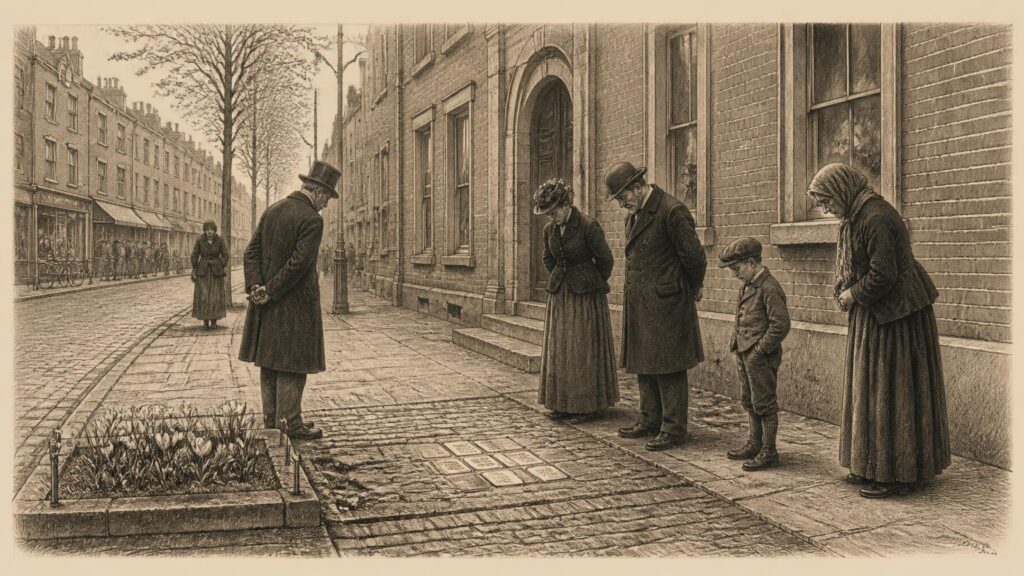
AI generated historical illustration, not a contemporary photograph.
At a Glance
Holocaust memory in Ireland is the history of an event that took place principally elsewhere but which cannot honestly be treated as foreign to the island. It is found in the decisions of Irish officials during the Emergency, in the lives of Jewish families in Dublin and Belfast, in letters and postcards preserved by relatives, in the later arrival of survivors, and in the deliberately modest public rituals that have grown since the beginning of the twenty-first century. Its central difficulty is not a shortage of moral language, but the task of connecting universal remembrance to particular Irish histories without claiming either innocence or a burden of responsibility that Ireland did not bear in the same way as the Nazi state and its collaborators across occupied Europe.
Irish Context
The Holocaust was the systematic persecution and murder of six million Jews by Nazi Germany and its collaborators, alongside the persecution and murder of Roma and Sinti people, disabled people, political opponents, homosexual men, Jehovah’s Witnesses, prisoners of war and others. Its geographical centres were Germany and Nazi-occupied Europe. Ireland was not occupied by Germany, did not enact Nazi racial legislation, and did not have death camps, ghettos or a deportation apparatus. Those facts matter. They establish limits on analogy and prevent an inaccurate account of Irish history.
Yet geographical distance did not equal historical separation. Jewish people lived throughout Ireland before the Second World War, with especially important communities in Dublin, Belfast, Cork and Limerick. Many Dublin Jewish families had roots in Lithuania and other parts of eastern Europe. Their businesses, religious institutions, schools, charities and family networks formed part of Irish urban life. The Dublin district often remembered as Little Jerusalem, around the South Circular Road and the Portobello area, was a living social world rather than a museum-piece label. News from Europe therefore travelled through kinship, correspondence, newspapers, synagogues, emigrant links and communal organisations. The Nazi assault on European Jewry was understood not as an abstract continental catastrophe but as a danger to named relatives and former neighbours.
Memory has consequently developed along several overlapping paths. One is the history of the Irish state’s response to people seeking refuge from Nazi persecution. Another concerns Irish citizens and residents who became victims abroad, among them Ettie Steinberg and her family. A third lies in the post-war settlement of survivors and former child refugees. A fourth is cultural: poetry, documentary film, museum collections, family testimony and school programmes. Finally, there is official remembrance, including the annual national commemoration and Ireland’s participation in international Holocaust-remembrance structures.
These paths should not be collapsed into a comforting national story. There were Irish people who offered help, raised funds, gave practical assistance or worked in relief and rescue abroad. There were also restrictive policies, indifference, prejudices and a lack of political urgency in the face of Jewish persecution. The historical record supports neither the claim that Ireland was wholly detached from the Holocaust nor the claim that it was centrally implicated in the genocide. Holocaust memory in Ireland is strongest when it holds those propositions together.
Wartime Distance
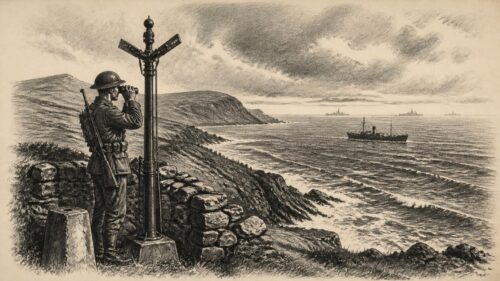
The Irish state remained neutral during the Second World War, a period known in the Republic as the Emergency. Neutrality was shaped by sovereignty, the recent struggle for independence, partition, military weakness, domestic security and the fear that active participation in the conflict could bring invasion or deepen internal division. It was not a simple expression of sympathy for either belligerent. Nonetheless, the neutrality of the state has sometimes encouraged a retrospective impression that the war’s moral emergencies were remote from Irish life.
That impression is misleading. Wartime Ireland was not outside Europe’s political weather. Reports of Nazi persecution appeared in the press; diplomats, churches, Jewish organisations and individuals made representations; refugees applied for visas; and the German legation in Dublin was a visible reminder that normal diplomatic relations continued with the Reich. The practical effect of distance, however, was considerable. The country had no large population of refugees from central Europe, no major military role on the European mainland and no immediate post-war reckoning comparable to that of occupied states. The Holocaust could therefore be registered as terrible news without becoming a dominant element of public life.
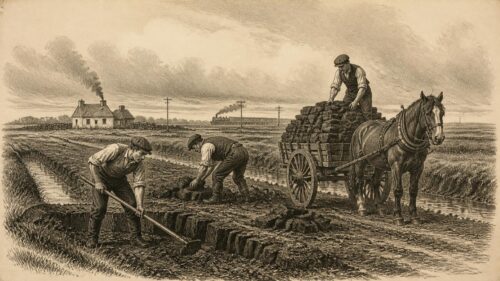
The language of the Emergency also framed Irish recollection. The term evokes shortages, censorship, turf cutting, air-raid precautions and the precariousness of an independent state rather than the destruction of European Jewish communities. Such memories are real, but they can narrow perspective when they become the whole story. A state preoccupied with its own survival could still make choices about whom it admitted, how it described persecution, and whether it treated Jewish flight as a humanitarian emergency.
There is a further distinction to make between the Republic of Ireland and Northern Ireland. Northern Ireland was part of the United Kingdom and was at war from September 1939. Belfast suffered devastating air raids in 1941, and its wartime experience was therefore materially different from that of the neutral state south of the border. Its government also considered refugees from the Third Reich, frequently through the economic lens of industry and employment. A history of Holocaust memory on the island must acknowledge this difference rather than treat “Ireland” as a single wartime jurisdiction.
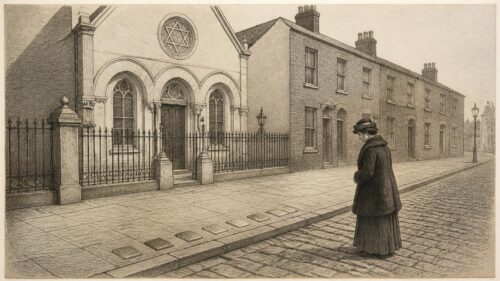
Distance nevertheless left an enduring mark on commemoration. In countries invaded or governed by Nazi allies, the Holocaust is often bound to local sites of arrest, deportation, collaboration, resistance and massacre. In Ireland, memorial practice has more often begun with names, testimony, objects and ethical reflection. That does not make it unreal. It means that the principal sites of memory are dispersed: a former school, a synagogue, a museum display, a pavement stone, a survivor’s home, a classroom or a civic hall.
Refugee Limits
The most difficult strand in this history concerns immigration and refuge. The evidence shows that the Irish state admitted only a small number of Jewish refugees fleeing Nazi Europe. The precise totals vary according to the categories used: some accounts distinguish permanent residents from temporary visitors, adults from children, or refugees from people admitted for employment and family reasons. A later United States government report placed the number at approximately thirty Jewish refugees, including four Holocaust survivors. However counted, the number was small when set against the scale of persecution and the desperate demand for sanctuary.
The restrictive outcome did not arise from one uncomplicated cause. Irish officials were concerned about unemployment, housing, public resources, security and the possibility that admissions might create continuing obligations. The country was economically poor by western European standards and had only recently emerged from civil conflict and difficult state-building. But material scarcity does not erase moral agency. A policy may be understandable in context without being exonerated by context. The later history of remembrance has increasingly treated this distinction as essential.
Irish Jewish leaders and other advocates made appeals on behalf of those facing persecution. The former Chief Rabbi Yitzhak HaLevi Herzog, Robert Briscoe and members of the Jewish community were among those who sought admissions or interventions. Some refugees did reach Ireland, occasionally creating businesses and adding to communal life. Their presence complicates any account of a completely closed country. It does not, however, overturn the broader conclusion that refuge was limited and cautious when the need was most acute.
Interpretation is important here. It would be inaccurate to say that Ireland alone failed European Jews; many states, including powerful democracies, erected restrictive barriers. It would be equally inaccurate to use the failures of others as a defence. The Irish case belongs to a wider history in which states treated refugees as administrative, economic or political problems at the very moment when persecution made ordinary migration impossible. That wider pattern explains the value of examining Ireland’s record, but it does not dissolve its particularity.
Public acknowledgement came slowly. At the first national Holocaust memorial commemoration in 2003, the Minister for Justice, Equality and Law Reform, Michael McDowell, referred directly to failures in Irish state and society: failures of refuge, failures to challenge prejudice and failures to confront arguments that excused racial hatred. The significance of that statement lay less in the idea that it revealed a previously unknown past than in the fact that an official ceremony placed moral self-examination within public remembrance. It made clear that commemoration need not merely honour victims; it can also ask what contemporaries did, failed to do, or chose not to see.
Personal Traces
Ettie Steinberg has become the best-known Irish-connected victim of the Holocaust, in part because the archive preserves an unusually intimate trace of her final journey. Born Esther Steinberg in 1914 in what was then Czechoslovakia, she came to Dublin with her family in 1925. They lived near the South Circular Road, and she attended St Catherine’s School in Donore Avenue before working as a seamstress. Her life was rooted in the social world of Dublin Jewry even though the persecution that destroyed her family took place elsewhere.
In 1937 she married Wojteck Gluck, a Belgian goldsmith, at Greenville Hall Synagogue in Dublin. The couple lived first in Antwerp and later in Paris, where their son Leon was born in 1939. As Nazi power extended across western Europe, the family went into hiding and moved south. In 1942 they were arrested, held at Drancy transit camp near Paris and deported to Auschwitz. They were murdered shortly after arrival. Her Dublin relatives had managed to secure visas that might have enabled the family to reach Northern Ireland, but those documents arrived too late.
A postcard thrown from the deportation train and eventually delivered to her family in Dublin became the most haunting object associated with Steinberg’s story. The message used Hebrew references understood by her relatives as an announcement of destruction rather than safety. The postcard is preserved through the Irish Jewish Museum’s collections. Its power lies not in sentiment alone but in its material specificity: paper, handwriting, family knowledge and delayed delivery connect Dublin directly to a deportation train heading east. It rebukes any tendency to speak of Irish memory only in generalities.
For many years Steinberg was commonly described as the sole Irish victim of the Holocaust. Later research, including work presented by David Jackson, demonstrated that this was incomplete. Isaac Shishi, born in Dublin in 1891 to a Lithuanian Jewish family, was murdered with his wife and daughter in Vieksniai, Lithuania. Ephraim Saks and his sister Jeanne, also known as Lena, were Dublin-born victims. Research associated with Holocaust Education Ireland subsequently extended the known list connected to the 2022 Stolpersteine project to six people: Ettie, Wojteck and Leon Gluck; Isaac Shishi; Ephraim Saks; and Jeanne Saks.
The changing number is itself historically revealing. It shows the danger of treating commemoration as a completed ledger. Digitised civil registration records, family histories, Holocaust databases and local research can reconnect names separated by migration, altered spellings, borders and murder. “Irish victim” is not a self-explanatory category. It may describe citizenship, birth, residence, family affiliation or a life shaped by an Irish community. Rather than weaken the record, such complexity makes the work of remembrance more honest.
Postwar Arrivals
Memory in Ireland was also made by people who arrived after the genocide. Survivors did not come merely as symbols of suffering; they became neighbours, spouses, parents, workers, business people and members of communities. Their ordinary lives were part of the aftermath of catastrophe. The post-war Irish Jewish community was shaped both by established families and by those whose earlier homes, relatives and languages had been destroyed.
Dr Bob Collis occupies a notable place in this story. An Irish doctor who volunteered with the British Red Cross at Bergen-Belsen after liberation, he encountered children who had survived conditions of extraordinary deprivation. Collis and his wife brought orphaned Jewish children to Ireland, including Zoltan and Edith Zinn, whom they raised. Other children connected with this episode also made homes in Ireland. The story is a documented instance of post-war humanitarian action, but it should not be used to erase the earlier limitations on refuge. It belongs to a different moment, after liberation, when the conditions and political possibilities had changed.
Survivors who settled in Ireland included Tomi Reichental, Suzi Diamond, Jan Kaminski, Inge Radford, Doris Segal, Walter Sekules, Joe Veselsky and others whose experiences have been recorded by Holocaust Education Ireland and related institutions. Their biographies vary greatly. Some survived camps, some survived hiding, displacement or forced movement; some came as children and some later in life. The category “survivor” is essential, but it should not flatten the distinctive histories carried by individuals and families.
Tomi Reichental became especially prominent in Irish public life through his patient work speaking to school pupils. Born in what is now Slovakia, he survived Bergen-Belsen as a child and later settled in Ireland. His testimony connected large historical processes to the language of family, hunger, fear, separation and survival. It also demonstrated how living memory changes the character of education. A classroom encounter with a survivor could make the past immediate without making it simple. The witness did not replace historical study; rather, testimony created a responsibility to study carefully.
Survivor settlement also complicates the idea that Ireland has only borrowed Holocaust memory from elsewhere. The events occurred across Europe, but their consequences took root in Irish lives. The children of survivors inherited stories, silences, photographs, names and absences. Grandchildren and later generations have become important carriers of memory as the survivor generation diminishes. This transition is not merely biological. It changes the form of testimony from direct recollection to family history, archival recovery and reflective interpretation.
Public Silence
It is tempting to describe the decades after 1945 as a period of total Irish silence about the Holocaust. That would overstate the case. The genocide was known, discussed in newspapers, addressed within Jewish communities and present in the lives of refugees and survivors. Irish writers, clergy, diplomats, educators and ordinary citizens did not inhabit a world without information about Nazi crimes. Yet the Holocaust did not initially occupy a central place in the Republic’s public culture, school curriculum or national commemorative calendar.
Several factors help explain this relative marginality. Ireland’s own recent past demanded attention: the revolutionary period, partition, civil war, economic migration, the dominance of Catholic social institutions and, later, Northern Ireland’s conflict. The state’s official historical culture was often organised around nationhood and independence. European Jewish catastrophe did not easily fit narratives structured around Irish self-determination. The small size of the Jewish population also meant that fewer institutions possessed the resources to press the issue into mainstream public debate.
There was also discomfort. A sustained public confrontation with the Holocaust risked raising questions about Ireland’s refugee policy, domestic antisemitism, clerical attitudes, neutrality and the conduct of politicians. These questions did not need to be entirely suppressed in order to have limited public presence. Silence can be partial: a matter of emphasis, curriculum, ceremonial absence or the decision to treat an event as belonging principally to others.
Folklore and simplified anecdotes can distort this period in opposite directions. One version imagines a uniformly hospitable wartime Ireland, drawing broad conclusions from genuine acts of individual kindness. Another imagines a country uniquely sympathetic to Nazism, often using isolated incidents as if they define an entire society. Neither is adequate. Historical evidence shows a state that did not adopt Nazi racial policy and a society containing both sympathy and prejudice, alongside a restrictive record on Jewish refuge. The task is to preserve proportions rather than choose a consoling legend.
The growth of memory from the 1980s onward should therefore be understood as an opening rather than a sudden discovery. It brought material long present in family and communal archives into wider civic circulation. It also coincided with a broader Irish willingness to revisit difficult histories: institutional abuse, emigration, famine, war, sectarian division and the complexity of the revolutionary era. Holocaust remembrance entered this changing culture of commemoration while retaining its own European and Jewish historical specificity.
Official Recognition
Ireland’s annual National Holocaust Memorial Day commemoration has been held since 2003. Its establishment marked an important change in public practice. A national ceremony does not create memory from nothing, but it gives remembrance a recurring civic form, involving government, the Jewish community, survivors, educators, diplomats, faith representatives and young people. The date is associated with 27 January, the anniversary of the liberation of Auschwitz-Birkenau in 1945, although ceremonies may be held on a nearby Sunday.
The commemoration is significant partly because it does not rest upon a single Irish killing site. Instead, it creates a shared space in which names, testimony, music, readings and reflection make visible an ethical relationship to a European catastrophe. This can appear modest beside the monumental memorials of Berlin, Warsaw, Paris or Vienna. Yet modesty is not necessarily weakness. In the Irish context, an annual public act has helped establish continuity where the historical connection was dispersed across households, communities and archives.
Irish membership of the International Holocaust Remembrance Alliance, formalised in 2011, placed the state within an international framework dedicated to education, remembrance and research. Ireland also established a Standing Committee on Holocaust Education, Research and Remembrance involving state representatives, the Irish Jewish Museum, Holocaust Education Ireland and academic participants. Such bodies matter because they move remembrance beyond ceremonial declarations towards coordination, professional development and access to international expertise.
Official recognition has an unavoidable tension. It can broaden knowledge and provide resources, but it can also risk turning memory into a formula: an annual statement against hatred, detached from the history of Jewish persecution or from the evidence of local choices. The best ceremonies resist this by naming victims, including survivor voices and confronting the Irish record on refuge. Formal recognition is most credible when it leaves room for discomfort.
The national framework has also widened attention to victims persecuted by the Nazis beyond the Jewish people, including Roma and Sinti victims, disabled people, political prisoners and those targeted because of sexuality, religion or perceived racial identity. Such inclusion is historically necessary. It must not, however, obscure the Nazi regime’s central project of annihilating Europe’s Jews. Good commemoration can recognise the breadth of Nazi persecution while remaining precise about the Holocaust as the genocide of the Jewish people.
Living Witnesses
For several decades, survivor testimony was the most powerful bridge between Irish audiences and Holocaust history. Testimony gives historical events a human voice, but its value is not simply emotional. Survivors describe how persecution entered daily life through laws, insults, exclusions, confiscations, separations and forced movement before reaching camps and killing centres. Their accounts counter the false impression that genocide arrives only as sudden, incomprehensible violence.
In Ireland, public talks by survivors became especially associated with secondary schools. Tomi Reichental spoke to thousands of pupils over many years. Suzi Diamond and other survivors similarly contributed to public understanding. The encounter was often memorable because it joined Irish young people to someone who had made a life in their own country after surviving events that seemed almost unimaginably distant. The local setting did not domesticate the Holocaust; it made the survivor’s continuing presence impossible to ignore.
There are limits to testimony, and responsible educators recognise them. No survivor can represent every victim, every country, every camp or every Jewish experience. Memory may be vivid but it is not identical to a complete historical archive. It can contain uncertainty, retrospective understanding and understandable gaps. These are not defects that discredit testimony. They are features of human recollection, particularly recollection formed in childhood, terror and loss. Historical teaching should place testimony alongside documents, maps, scholarship and attention to chronology.
As the survivor generation becomes smaller, Irish remembrance faces the same transition experienced internationally. The question is not whether later generations can speak “for” survivors in the same manner; they cannot. It is whether they can preserve recorded testimony faithfully, identify their relationship to it and refuse the indifference that disappearance can encourage. Holocaust Education Ireland’s Living History work, involving second- and third-generation speakers and people with family connections, is one answer to this problem. It makes inheritance visible without pretending that inherited testimony is first-hand memory.
This transition also places greater weight on archives. The postcard of Ettie Steinberg, oral-history recordings, photographs, school records, immigration papers, synagogue material and museum objects will increasingly carry stories that once could be told in person. Their interpretation requires care. An object should not be made to bear more than it can prove, but neither should its intimate scale diminish its historical importance. One family document can illuminate a transnational structure of persecution, migration and failed rescue.
Educational Work
Education has become the most sustained element of Holocaust memory in Ireland. Holocaust Education Ireland, founded in 2005 as an independent non-profit organisation, has developed programmes for schools, teachers and the wider public. Its work includes lectures, exhibitions, survivor testimony, teacher training and the organisation of the national commemoration. The organisation’s emergence reflected recognition that a once-off ceremony could not substitute for informed historical learning.
The Crocus Project is among the most visible educational initiatives. Pupils plant yellow crocus bulbs in memory of the 1.5 million Jewish children murdered in the Holocaust and the many other children who suffered under Nazi persecution. The flowers are intended to bloom around late January, near International Holocaust Memorial Day. Their colour recalls the yellow badges and stars imposed upon Jews under Nazi rule. The project began in Ireland and has expanded to schools in other European countries.
The project’s strength is its accessibility. Planting and tending a garden gives younger people a concrete, seasonal act of remembrance. It encourages pupils to explain the flowers to visitors and therefore turns commemoration into conversation. But its symbolism requires historical framing. The yellow crocus is not a substitute for learning how Nazi antisemitism operated, how states and institutions participated, or how Jewish children lived before persecution. Without that context, a moving emblem can become vague sentiment.
Teacher education is equally important. Holocaust history is difficult to teach because it includes mass murder, ideology, bureaucratic systems, war, antisemitism, moral choice and trauma. An approach based solely on shocking images may overwhelm pupils while explaining little. A better method begins with Jewish life before persecution, traces the gradual radicalisation of policy, examines individual and institutional choices, and distinguishes camps, ghettos, shootings, deportations and killing centres. It also avoids turning the subject into a generic lesson in kindness detached from the targeted destruction of Jews.
Irish education has particular opportunities. The history of Ettie Steinberg can introduce the relationship between local life and European events; the story of Bob Collis and child survivors can open discussion of liberation and displacement; Irish refugee policy can prompt evidence-based debate about borders and responsibility. These connections should be used carefully. They illuminate Ireland’s relationship to the past, but they do not make the Holocaust primarily an Irish story. The murdered Jews of Europe must remain at the centre of the history.
In January 2026, the Irish government announced funding intended to make virtual educational resources from Auschwitz-Birkenau available to every secondary school in Ireland. The announcement illustrates the continuing expansion of official support. Its future value will depend on how teachers integrate resources into historical study, whether pupils encounter Jewish voices and whether virtual access is treated as preparation for learning rather than as a replacement for thoughtful teaching.
Stones Streets
The installation of Ireland’s first Stolpersteine in Dublin in June 2022 represented a new form of public memory. Stolpersteine, or stumbling stones, are small brass-topped blocks set into pavements to commemorate individuals murdered by the Nazis. Created by the German artist Gunter Demnig, the project has spread across Europe. Its logic is deliberately decentralised: instead of requiring a visitor to enter a grand monument, it returns a name to the street.
The six Dublin stones were placed outside St Catherine’s National School in Dublin 8. The site is meaningful because Ettie Steinberg attended the school and because the area was connected to the former Jewish neighbourhood of Little Jerusalem. They commemorate Ettie, Wojteck and Leon Gluck, Isaac Shishi, Ephraim Saks and Jeanne Saks. The choice of six individual stones corrects the older habit of reducing Irish connection to a single name. It also resists the abstraction that can arise when the Holocaust is remembered only through immense numbers.
Such memorials do not claim that the victims died on the pavement where the stones lie. Their purpose is different: they mark a point in a life before deportation, murder and disappearance. In Ireland this is especially resonant, because the relevant histories often begin in local streets but end in France, Lithuania, Poland or elsewhere in occupied Europe. The stones map a network of migration rather than a single national narrative.
There is an interpretative risk in any transnational memorial form. Stolpersteine can be received as proof that a country has adequately faced the past when in fact they are only an invitation to further inquiry. A passer-by may see a name without knowing the history of refugee policy, family separation or the Jewish community from which the person came. Their value therefore depends on accompanying research, school work, public explanation and the maintenance of the physical site.
Nevertheless, the Dublin stones alter the city’s landscape. They make it harder to imagine that the Holocaust had no Irish human geography. A person can stand in an ordinary street and understand that a child, a seamstress, a family and Dublin-born citizens belonged to a story of European destruction. That encounter is neither melodramatic nor complete. It is a small, factual interruption of forgetfulness.
Cultural Responses
Holocaust memory in Ireland has also developed through literature, film, music and visual culture. These forms do not replace historical research, but they can address questions that official ceremony handles imperfectly: the limits of language, the relation between distant suffering and local conscience, and the danger of using victims as symbols for someone else’s political purpose.
Poet Michael Longley is one of the most significant Irish literary figures to engage with the Holocaust. His poems, including work connected with Buchenwald and the commemoration of Jewish victims, have prompted scholarly discussion of how an Irish poet might remember an event outside Ireland without appropriating it. Longley’s work is notable for restraint and for attention to names, objects and the material remnants of lives. It invites reflection on remembrance while warning against easy possession of another people’s trauma.
Documentary has carried similar weight. Films associated with Tomi Reichental brought a survivor’s recollections to audiences who might never attend a public talk. The camera can preserve gesture, accent, silence and landscape, all of which can deepen a viewer’s encounter with testimony. Yet documentary too is constructed: it selects journeys, edits speech and creates narrative emphasis. Viewers should understand it as mediated testimony, not transparent access to the past.
The Irish Jewish Museum is especially important because it situates Holocaust-related objects within a longer history of Jewish life in Ireland. This setting prevents two distortions. The first is the reduction of Jews to victims alone. The second is the treatment of Holocaust memory as disconnected from Irish society. Museum artefacts, synagogue history, family records and local stories reveal a community with its own religious, social and cultural life before, during and after the war.
Cultural work can also create difficult comparisons. Irish history contains famine, colonial rule, forced migration, political violence and institutional abuse; these experiences may generate genuine empathy with persecution. But empathy is not identity. The Holocaust should not be absorbed into an undifferentiated catalogue of suffering, nor should other histories be measured against it competitively. A mature culture of remembrance permits comparison where it clarifies mechanisms such as racism, exclusion or state power, while retaining the distinct historical character of each event.
Northern Perspectives
Northern Ireland’s place in this history deserves separate attention. As part of the United Kingdom during the Second World War, it experienced mobilisation, bombing and wartime administration in a manner unlike the neutral Republic. Belfast’s Jewish community had longstanding roots, and Northern Irish institutions confronted questions about refugees from the Third Reich before the war. Scholarly research has shown that the Northern Ireland government considered Jewish refugees partly through the prospect that industrialists might bring employment and investment to an economically troubled region.
This approach was selective and instrumental. It did not amount to a broad humanitarian refuge policy, but it demonstrates that different administrations on the island considered Jewish flight through different legal and political frameworks. The contrast is useful because it complicates generalisations about “Irish” responses. Partition created divergent state systems, even when family, communal and cultural ties crossed the border.
Contemporary commemoration in Northern Ireland is also shaped by a society in which public memory is often entangled with unionist and nationalist identities. Holocaust remembrance can offer a different kind of civic occasion, involving Jewish communities, churches, schools, museums and rights organisations. Yet it should not be imagined as automatically free from local politics. Any act of public memory occurs within existing relationships of power, identity and conflict.
Church participation has been visible in recent commemorations, including events associated with Holocaust Memorial Day in Armagh and Belfast. Such involvement can be valuable when it acknowledges the long history of Christian antisemitism and makes clear that remembrance requires more than general appeals to goodwill. Religious institutions have a particular responsibility to learn how theological prejudice contributed to the conditions in which modern racial antisemitism could flourish, even though Nazi ideology was not simply a product of religious teaching.
Across the island, the most constructive approach is neither to force a single all-Ireland narrative nor to isolate the two jurisdictions completely. Shared Jewish histories, transnational refugee routes, family connections and educational partnerships justify island-wide attention. Different wartime contexts and political structures require precision. Both truths can be maintained at once.
Memory Ethics
The ethics of Holocaust remembrance begin with accuracy. This means resisting denial, distortion and trivialisation, but it also means refusing embellishment. Ireland did not rescue vast numbers of Jews; it did not have a central role in the machinery of genocide; it was not untouched; and it did not respond as generously as later national self-image might suggest. These are not competing slogans. They are propositions that can be supported, qualified and understood through evidence.
Accuracy also means distinguishing evidence from folklore. Family stories can preserve vital information unavailable in official files, but they should be approached as testimony requiring corroboration where possible. Legends of escape, secret assistance or political intervention may contain a core of truth, may have altered through retelling, or may express a family’s need to make sense of loss. Respect for those who tell such stories does not require historians to treat every remembered detail as settled fact.
There is a parallel danger in using the Holocaust only as an instrument for present causes. Its history can illuminate contemporary antisemitism, racism, refugee exclusion and the fragility of democratic institutions. Those lessons are legitimate. But the dead should not be recruited as props in arguments that ignore the history of Nazi antisemitism, the destruction of Jewish communities and the specificity of genocide. Universal meaning is strongest when it grows from particular knowledge.
Irish remembrance has sometimes employed the language of tolerance and diversity. This language has practical value, especially in schools, but it can be too mild if it suggests that the Holocaust resulted merely from interpersonal intolerance. The genocide involved a modern state, law, police, bureaucracy, propaganda, occupation, economic theft, military power and collaboration. It began with prejudice but was carried forward by institutions and decisions. Education should therefore teach both moral responsibility and historical structures.
The shrinking number of survivors makes these responsibilities more urgent. When a witness is present, audiences may feel directly answerable to a person. When the witness is gone, the temptation is to preserve only an inspirational version of the story. Ireland’s archives, museums and schools will need to retain complexity: survival alongside murder, refuge alongside exclusion, personal courage alongside bureaucratic refusal, and commemoration alongside the recognition that remembrance came late.
Continuing Questions
Holocaust memory in Ireland has grown markedly since the early 2000s. National ceremonies, survivor testimony, the Crocus Project, teacher training, museum displays, scholarship, film and the Dublin Stolpersteine have given it forms that are visible in public life. This development should not be mistaken for completion. Memory is a practice, not an achievement once secured. It depends on institutions, resources, historical literacy and the willingness to revisit established stories when new evidence appears.
The rediscovery of additional Irish-connected victims is a reminder that research remains unfinished. Civil records, family papers and international databases may yet reveal further links. The goal should not be to inflate an Irish connection for reasons of national pride or shame. It is to identify people truthfully and return them, where evidence permits, to the histories of the places in which they were born, lived, studied, worshipped or were remembered.
Future remembrance will also be tested by changing social conditions. Ireland is more diverse than it was when the first national commemoration was held in 2003. New residents bring family histories of genocide, displacement, colonial violence and refuge. Their experiences may enrich public discussion, but they should not dilute Jewish memory of the Holocaust into a generic ceremony about suffering. The challenge is to build solidarity through precision rather than through the erasure of difference.
There is no single correct emotional response to this past. Grief, shame, anger, admiration and unease all have their place, provided they do not outrun the evidence. The most valuable Irish contribution may be an attentive form of remembrance that accepts distance without hiding behind it. Ireland was not the place where the Holocaust was organised and carried out. But Irish people were connected to those who were murdered, to those who sought safety, to those who survived, and to the difficult question of what a small state and society did when Europe’s Jews needed help.
That is why the history matters. The postcard from a deportation train, the survivor addressing pupils, the yellow flowers planted by children and the brass stones in a Dublin pavement do not offer redemption. They offer a demand: to know what happened, to name whom it happened to, to recognise Ireland’s place in the story without exaggeration, and to guard against the habits of indifference through which persecution becomes possible.

The article suggests that Irish Holocaust memory is shaped not by direct perpetration, but by connections formed through refugee policy, family networks, survivor settlement and fragile personal archives. The evolving list of Irish-connected victims, particularly alongside Ettie Steinberg’s postcard, shows that remembrance can change as research uncovers lives previously obscured by migration, altered names and borders. This raises an important question about how national memory accommodates uncertainty without losing moral clarity. How should Ireland’s schools, local memorials and national ceremonies balance universal Holocaust remembrance with the specific histories of restricted refuge, Jewish community life and newly recovered Irish-connected victims alike?