

Buried Dublin
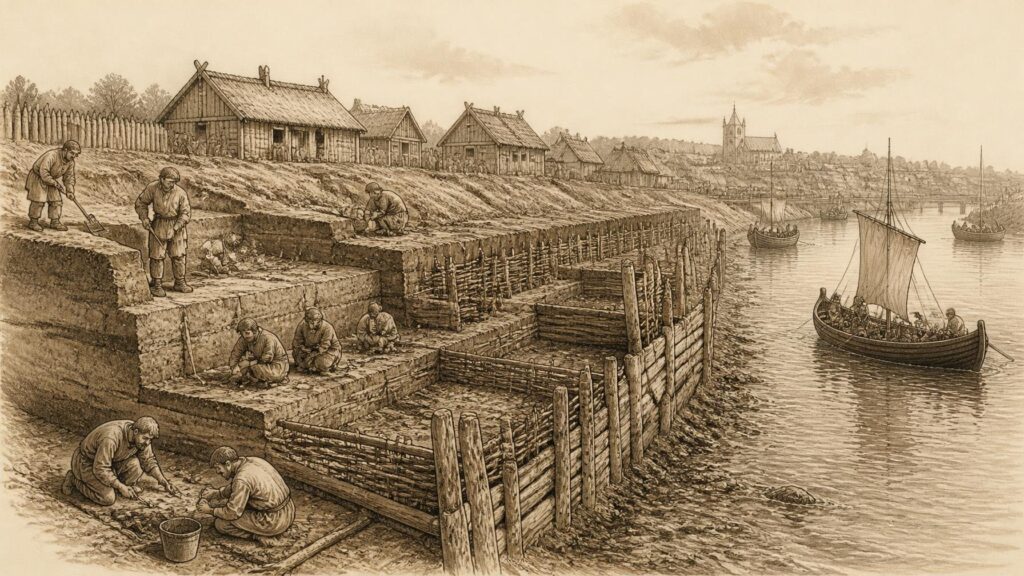
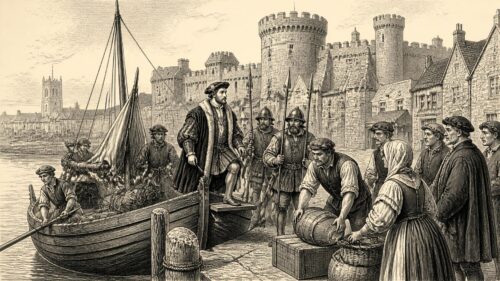
AI generated historical illustration, not a contemporary photograph.
At a Glance
Wood Quay was not merely a construction site beside the Liffey. In the 1970s it became the place where buried timber, mud, walls and everyday objects forced Dublin to reconsider the depth of its own past. The excavation revealed an exceptionally preserved portion of the early medieval waterfront, while the subsequent battle over its survival became one of the most consequential public arguments about heritage in modern Ireland.
River Beginnings
Modern Wood Quay lies on Dublin’s south quays, immediately west of the river crossing at O’Donovan Rossa Bridge and beneath or beside the present Civic Offices. Its name evokes timber and waterfront labour, but its historical force derives from a much older landscape. The ground excavated in the 1970s had once stood at the shifting edge of a tidal Liffey. Centuries of reclamation, building and street making had pushed the river northwards, leaving earlier shorelines sealed below the modern city.
That physical setting explains both the richness and the difficulty of the site. Waterlogged deposits, deprived of oxygen, can preserve wood, leather, textiles, bone and other organic materials that normally vanish from archaeological records. At Wood Quay such conditions preserved evidence that masonry ruins alone could never provide: fences, revetments, drains, household equipment, animal remains and the traces of a working waterfront. The archaeologist was not dealing simply with isolated Viking objects but with layers of a town continually adjusting its edge to the tide.
Dublin had older associations than the Viking settlement. Early Irish place names, Dubh Linn, commonly rendered as the Black Pool, and Áth Cliath, the ford of hurdles, point towards a landscape of water, crossing and settlement before Scandinavian raiders arrived. Archaeological and historical interpretation has suggested rural and ecclesiastical activity in the vicinity before the town emerged. Yet it is important not to allow that older background to blur a major historical distinction. The urban settlement whose plan, defences, commerce and waterfront became so influential was principally a Viking-age development.
The National Museum of Ireland places the first recorded Viking raids on Ireland in 795. Raiding fleets later moved along major river systems, and fortified bases, or longphuirt, are recorded from about 840. Dublin is recorded as one such base in 841. The word longphort is sometimes casually translated as a permanent town, but it need not imply that from the outset. It described a defended naval encampment, capable of supporting raiding, exchange, political negotiation and the movement of people. The precise position of the earliest Dublin longphort remains uncertain; it should not simply be equated with the later settlement exposed around Wood Quay.
The evidence instead suggests movement and transformation. Ninth-century burials at Kilmainham and Islandbridge demonstrate a Scandinavian presence in the Dublin area. Documentary and archaeological syntheses indicate that the Viking settlement was expelled in 902 and that returning Scandinavians established themselves again in 917, with the principal urban focus developing on the ridge and river frontage near Christ Church, Fishamble Street, Winetavern Street and Wood Quay. This was a strategically compelling place: near the Liffey and the Poddle, connected to Dublin Bay, beside a ford, and close to routes extending into Leinster and beyond.
It is tempting to present this sequence as a simple story of foreign invaders founding a city where none existed. That is too blunt. Vikings came to Ireland through violence, and enslavement was part of the wider Viking economy; Irish annals preserve the instability, conflict and shifting alliances of the period. But the settlers in Dublin were soon woven into Irish political life. By the later tenth and eleventh centuries the town was neither culturally sealed nor adequately described as wholly Scandinavian. The more useful historical term is often Hiberno-Norse: a recognition of Scandinavian inheritances, Irish connections and a society shaped by long contact across the Irish Sea.
Urban Foundations
Wood Quay did not reveal the entire Viking town in one clean exposure. It formed part of a much wider archaeological zone explored over decades at High Street, Winetavern Street, Fishamble Street, Dublin Castle, Essex Street, Parliament Street and elsewhere. This wider pattern matters. A town is not made only of houses, nor only of defences. It is formed by routes, boundaries, waterfront facilities, burial grounds, market activity, workshops, authority and relationships with a surrounding countryside. The separate excavations, when read together, made it possible to reconstruct parts of an urban organism.
The town occupied a defensible ridge south of the Liffey. Its raised ground offered security, while the river gave access to the Irish Sea and to maritime connections reaching Britain and continental Europe. Archaeological surveys have identified deep stratigraphy in parts of Viking Dublin, with as many as twelve successive phases recognised. That depth is a warning against tidy snapshots. The settlement altered repeatedly. Houses were rebuilt, plots were retained or redefined, banks were enlarged, shorelines advanced, and later medieval construction overlaid early levels.
By the middle of the tenth century the town had earthen defences. The surviving archaeological evidence elsewhere around the circuit indicates that banks enclosed the settlement and, in places, were accompanied by palisades. These were serious works of communal labour and political purpose, not a casual accumulation of soil. At Ross Road a later embankment was measured at almost four metres high and five metres wide, with a timber palisade. Sections found at several points around the old town demonstrate that the enclosure was extensive, even though much has long since disappeared beneath later streets and buildings.
The waterfront was equally important. Wood Quay showed how protection, drainage, access and trade could merge in a single engineered margin. An early bank along the high-water line, dated by excavators to around the middle of the tenth century, had a post-and-wattle core and protection against tidal erosion. It may have helped keep houses and gardens dry, but it also had an evident defensive function. A ditch beyond it could have contributed to defence, but excavators rightly allowed a second possibility: it may have served ships at low tide. That uncertainty is instructive. Medieval structures often had more than one purpose.
A further embankment was raised farther into the river around the turn of the eleventh century, using earth, mud, gravel, stones and reused timber. Such work enlarged usable ground and testified to an active waterfront rather than a settlement passively accepting the river’s limits. Excavators traced several stages in which the medieval shoreline was advanced from the tenth to the fourteenth century. The sequence moved from earthen banks to a late eleventh-century stone wall, then to wooden quay revetments in the thirteenth century and a later stone quay wall. Wood Quay therefore connects Viking Dublin not only to an episode of settlement but to a long history of port building.
The stone wall dating from about 1100 is especially significant. It replaced earlier earthen works and enclosed a larger defended area. Its construction occurred in the Hiberno-Norse period, when Dublin was increasingly embedded in Irish kingship and Irish Sea politics. A section remains visible in the basement of the Civic Offices. It is often called a Viking wall in popular description, but Hiberno-Norse is more exact, because the city and its population had developed through generations of contact and adaptation. The wall is material proof that the town was investing in durable civic defence before the Anglo-Norman capture of Dublin in 1170.
Waterfront Evidence
The archaeology of Wood Quay has special value because it brought daily life into view. Stone buildings and monumental walls can dominate public imagination, yet towns are maintained by ordinary routines: cooking, shoe repair, fishing, butchery, spinning, trade, play, waste disposal, animal keeping and the continual repair of timber structures. Waterlogged archaeology preserves unusually direct evidence of those routines. The catalogue of recovered material includes wooden troughs, bowls and boxes; bone and wooden combs; gaming pieces; bronze personal items; leatherwork; animal and fish bone; pottery; tools and craft debris.
These objects must be treated cautiously. An artefact can establish that an object was deposited at a site; it does not automatically explain the identity, wealth, gender, language or beliefs of the person who used it. Nevertheless, large groups of finds, interpreted alongside their location and context, provide stronger evidence than a single spectacular discovery. Combs, for example, can speak to grooming, manufacture, trade and discard. Their raw material and form may indicate connections extending beyond Dublin. The National Museum has noted that more than two thousand combs were recovered in its Dublin excavations, including a smaller Scandinavian group whose types, materials and wear offer evidence for origin and use.
Wood Quay also demonstrated the importance of environmental evidence. Animal bones and botanical samples do not carry the romance of weapons or jewellery, but they are indispensable for understanding food supply, husbandry and urban surroundings. The remains help historians approach the lived economy of the town: what was eaten, what animals were brought in, how refuse was managed, and how the river edge changed under pressure from people, tides and building. Such evidence complicates the old image of Viking Dublin as a place occupied only by warriors, merchants and kings. It was a town of households and labour as well as power.
Imported pottery is another important category. Finds of French grey wares, including glazed Andennes ware and Normandy red-painted wares, from deposits associated with the early stone wall indicate commercial links with the Continent before the Anglo-Norman invasion. This does not mean that every Dubliner participated equally in long-distance commerce, nor that the town’s economy depended entirely on foreign goods. It does show that Dublin belonged to trading networks broader than Ireland and the immediate Irish Sea. Scandinavian routes, English connections and continental exchange overlapped here.
The evidence for ships and shipbuilding is similarly suggestive. No complete Viking ship has been found in Ireland, a necessary corrective to illustrations that place flawless longships at every Irish waterfront. Yet reused ship timbers, wooden ship sketches, model or toy vessels and ship-shaped fishing weights from Irish contexts show the importance of maritime culture. At Wood Quay, reused timbers appeared in waterfront structures and drains. This was practical reuse rather than a picturesque survival. Timber was costly, useful and available from dismantled vessels or older constructions; its second life in the town’s fabric records a working economy.
Property boundaries were another striking discovery. Successive fences appeared to follow earlier lines, suggesting a continuing respect for divisions between plots over a long period. The conclusion should not be overstated: archaeology cannot always reveal the legal arrangements behind a fence line. But continuity of boundaries is meaningful. It implies that space in the town was organised, remembered and defended through custom or authority. The small-scale evidence of fences can thus illuminate an urban society in which claims to land, access and waterfront space mattered deeply.
Changing Identities
“Viking Dublin” remains a convenient phrase, but it can conceal as much as it reveals. The term Viking originally describes activity associated with raiding and seaborne expeditions rather than a fixed ethnic identity. The people who lived in tenth- and eleventh-century Dublin included Scandinavian newcomers and descendants, Irish inhabitants, people from Britain and visitors or settlers from wider trading worlds. Their cultural affiliations cannot be read directly from every buckle, comb or pot sherd. Nor should modern national categories be projected backwards onto an early medieval port.
The historical records themselves show a volatile political setting. Dublin’s rulers fought Irish kings, made alliances with them, suffered expulsion and returned. Norse dynasties connected the town to the Isles, York and Scandinavian political worlds, while Irish dynasties sought control of Dublin because its port, tribute and commercial resources were valuable. The town was a prize precisely because it was not an isolated colony. Its relationships with Leinster and the wider island were fundamental to its survival.
The designation Hiberno-Norse recognises this interweaving. It is not a claim that cultural differences vanished. Scandinavian artistic forms, burial customs and certain artefact types are well attested, while Irish political and ecclesiastical contexts remained powerful. Rather, the term signals a historical process: a community in Ireland, shaped by Scandinavian migration and maritime networks, that developed distinctive local forms. The stone wall at Wood Quay, built around 1100, belongs to that process. So does the town’s coinage, trade and defensive landscape.
Dublin’s contribution to urbanisation is hard to overstate. The National Museum describes Viking bases such as Dublin, Waterford, Limerick, Cork and Wexford as Ireland’s first towns during the tenth century. That statement does not deny earlier Irish settlement, monasteries, royal centres or market activity. It identifies a change in scale and form: more concentrated population, intensified exchange, specialised crafts, port facilities and durable urban institutions. Dublin was not the whole of Ireland, which remained overwhelmingly rural, but it became a crucial point at which local production, seaborne commerce and political power met.
The story also has a darker side. Viking raiding in Ireland involved killing, plunder and captivity; monasteries were targeted partly because people as well as portable wealth could be taken. Early Dublin’s growth was not detached from that violence. An honest historical account cannot polish the Vikings into benign founders of commerce. Equally, later residents cannot be reduced to raiders. The material record at Wood Quay shows a settled community whose members made homes, maintained boundaries, ate, worked and traded. The difficulty of holding both truths together is precisely why archaeology matters.
Unearthed Conflict
The modern history of Wood Quay began with redevelopment. Dublin Corporation planned a major Civic Offices complex on land at the riverfront. Earlier archaeological work in the surrounding area had already indicated the historical importance of medieval Dublin, but extensive excavation became necessary as demolition and construction advanced. National Museum excavations at Wood Quay ran from 1974 to 1981, following earlier investigations nearby. The scale of the work was exceptional: the National Museum later described the waterlogged excavation as one of the largest urban archaeological sites in Europe.
The dig produced a difficult paradox. Archaeology is often prompted by the very development that threatens the evidence. Without clearance and construction plans, large areas might have remained unknown; once exposed, however, the deposits became vulnerable to weather, time and machinery. Rescue excavation can preserve knowledge through records and recovered finds, but it cannot fully replace preservation of a site in place. Wood Quay made that tension public in an unusually dramatic way.
As the scale and quality of the discoveries became clearer, archaeologists, historians, writers, students and citizens challenged the decision to proceed with the offices as planned. The Friends of Medieval Dublin became central to the campaign. The issue was not merely whether a few objects should enter museum cases. Campaigners argued that a substantial portion of the early town, with its streetscape and waterfront evidence, should survive as a public archaeological monument. Dublin Corporation maintained the need for the civic development and pursued the project.
On 23 September 1978, a major march in support of Wood Quay travelled through Dublin. Contemporary archival description from Trinity College Dublin records approximately 20,000 demonstrators. The exact scale has become emblematic, and any crowd estimate requires caution, but there is no serious doubt that it was among the largest heritage demonstrations in the history of the State. The campaign brought archaeology from specialist journals and museum stores into public conversation. It made citizens ask who possessed the authority to decide what a city could sacrifice.
The dispute continued through legal action, public meetings, protest and occupation. In June 1979, campaigners led a three-week sit-in known as Operation Sitric. The name deliberately invoked Sitric, the Hiberno-Norse ruler associated with Dublin’s return after 917, binding modern protest to the city’s early medieval past. Such symbolism was powerful, though it should not be mistaken for archaeological evidence. It was a political language of heritage: an effort to insist that the buried town belonged to the public rather than only to planners or property holders.
Ultimately, the campaign did not secure the preservation in situ that many advocates wanted. A surviving section of the Hiberno-Norse wall was incorporated within the Civic Offices, while much of the excavated archaeology was removed, recorded or destroyed during redevelopment. The result was neither total oblivion nor the archaeological park hoped for by protesters. Vast quantities of material entered public collections; specialist reports, drawings, photographs and environmental records preserved knowledge; yet the spatial wholeness of the site was irrecoverably diminished. The distinction is crucial. A museum collection can conserve objects and information, but not fully recreate a place.
Public Legacy
Wood Quay’s legacy lies partly in the material recovered and partly in the change it produced in public expectations. The controversy helped establish archaeology as an urgent issue in planning and development. It demonstrated that medieval and later urban deposits were not expendable rubble beneath the modern city. The next generation of excavations in Dublin took place in a climate more alert to the need for assessment, recording, mitigation and, where possible, preservation.
This should not be romanticised into a claim that Wood Quay solved heritage politics. Development pressure remains powerful, excavation remains destructive by nature, and archaeologists still must decide what can be sampled, preserved or recorded within limited time and resources. Nor is every buried deposit capable of being retained in place. What changed was the moral and civic visibility of the problem. Wood Quay showed that streets, offices and foundations could stand above deposits of national and international importance, and that the consequences of construction could not be left to private technical judgement.
The site is also a lesson in the value of archaeological archives. The physical excavation ended decades ago, but its documentary afterlife continues. Site records, artefact catalogues, environmental samples, photographs, drawings and later analysis can generate new questions. Improved methods may refine identifications, sourcing and dating. A comb, scrap of leather or timber fragment that seemed routine in 1978 may later contribute to a wider study of trade, diet, craft or environment. Excavation is therefore not a single event but the beginning of a long obligation to curate, analyse and communicate.
Visitors to Wood Quay today encounter an altered landscape. Civic Offices dominate the site; a remnant of the wall may be viewed within the building; public art and pavement markers recall Viking finds and urban memory. These commemorations are valuable, but they are interpretative devices rather than substitutes for the archaeological levels once exposed. The lesson is not that commemoration is insincere. It is that a city has to distinguish between marking what was lost and preserving what remains.
Folklore and popular imagery have attached themselves readily to Viking Dublin: helmeted warriors, dragon-prowed ships, a uniform Scandinavian colony, and a city born overnight in 841. Wood Quay offers a more compelling, if less theatrical, account. The documented evidence points to a settlement that changed location, built banks and walls, reshaped a tidal shore, handled imported goods, recycled timber, organised plots and became embedded in Irish political life. It was violent in origin and cosmopolitan in development. It was Scandinavian-connected, Irish-grounded and European-facing.
That complexity is why Wood Quay continues to matter. The site was a remarkable archive of urban formation, but it also became an archive of modern Ireland’s relationship with its past. Its excavation revealed the material foundations of Dublin; its partial destruction revealed the limits of preservation under pressure from redevelopment. Neither achievement nor loss should eclipse the other. Together they explain why the name Wood Quay still carries such emotional and historical weight.
Enduring Questions
Many questions remain open. The exact location and character of the 841 longphort are not securely established. The evidence cannot assign a neat ethnic identity to every inhabitant or object. Archaeologists can infer functions for banks, ditches and waterfront structures, but some may have served overlapping practical and defensive purposes. Nor can the excavated area provide a complete social census of Viking-age Dublin. Its survival was exceptional, but it was still only part of a larger town.
Those uncertainties do not weaken Wood Quay’s importance. They define responsible historical practice. Documentary sources, material remains and later interpretation must be kept in dialogue, rather than forced into a single uncomplicated narrative. The Irish annals describe political events; archaeology supplies evidence of built space and daily activity; environmental remains reveal elements of diet and landscape; modern archives document the struggle over preservation. Each form of evidence has different strengths and silences.
Wood Quay therefore deserves remembrance not as a lost Viking theme park, nor as a simple conflict between progress and the past. It was a real early medieval waterfront, transformed over centuries and exposed in a modern capital. It was a place where archaeological evidence made urban history tangible. And it was a turning point at which thousands of people asserted that the buried fabric of Dublin was part of the common inheritance of Ireland.
Wood Quay’s waterlogged layers reveal a town that repeatedly remade its shoreline, defences and property boundaries, while its inhabitants were connected to Irish, Scandinavian and continental worlds. This challenges any simple image of Viking Dublin as either a foreign enclave or a static settlement. The article also highlights a lasting dilemma: excavation rescued evidence and records, yet redevelopment destroyed the setting that gave those remains their meaning. How should we interpret Wood Quay’s legacy when weighing the value of preserved artefacts and documentation against the loss of an irreplaceable urban landscape, and what might this comparison suggest for city-centre archaeology?