Clondalkin’s Burned Fortress867 CE
In 867, Cennétig mac Gaíthéne of Loígis and Máel Ciaráin son of Rónán burned Amlaíb’s fort at Clondalkin, near Viking Dublin, reportedly killing one hundred foreign leaders. The attack, recorded with chronological variation in Irish annals, followed or coincided with dynastic division among Dublin’s Scandinavian rulers after Auisle’s killing. It checked, but did not end, Viking power; Dublin remained active and any subsequent assault is uncertain. Clondalkin’s monastic setting illustrates competition for resources and communications. The year also saw Gaelic succession conflicts and clerical deaths, while churches, literacy, trade, craft production and maritime networks endured amid political fragmentation and warfare.
Dateline
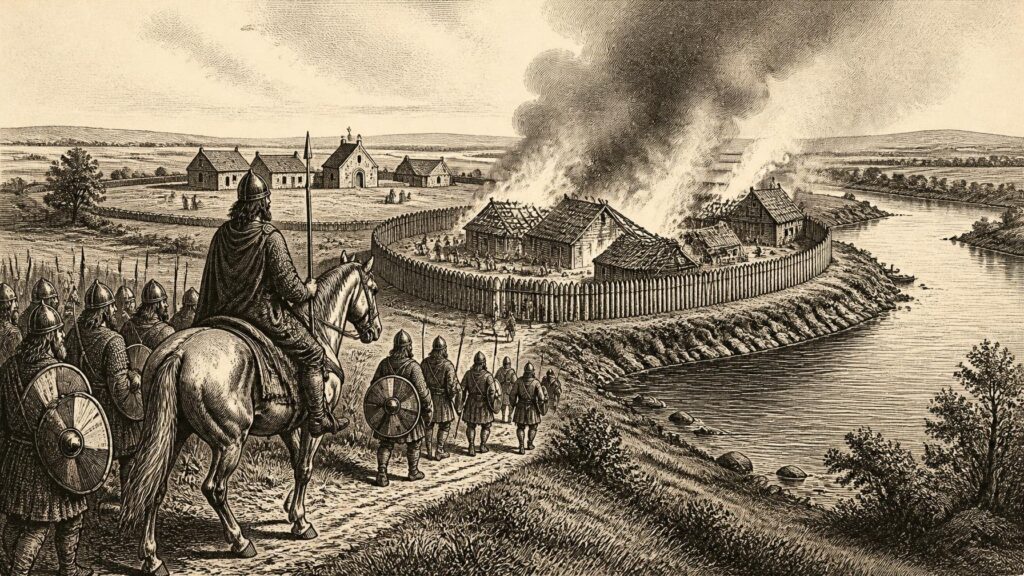
In 867, the most striking Irish event securely associated with the year was a blow against the Viking regime centred on Dublin. A force from Loígis, in the Irish midlands, burned the fort of Amlaíb at Clondalkin and killed a reported hundred leading foreigners nearby. The attack mattered because Clondalkin lay close to Dublin, the principal Scandinavian longphort in Ireland, and because Amlaíb was one of the dominant figures in its ruling partnership. It was not a final expulsion of the Vikings. Rather, it exposed the vulnerability of their power at a moment of internal dynastic violence.
The evidence nevertheless requires care. Irish annals did not always reckon years in precisely the same way. The Annals of Ulster place the Clondalkin episode under their entry numbered 867, although their internal chronological heading is offset; the later Annals of the Four Masters place comparable notices two years earlier. The Fragmentary Annals explicitly connect the attack with 867. Modern accounts conventionally discuss the episode as belonging to 867, but it is wiser not to pretend that a month, season or day can be recovered. What survives is a strongly attested sequence of related events, not a modern campaign diary.
A Dublin Dynasty Divided
The immediate background was turmoil among the rulers called by Irish writers the “foreigners” or “heathens”. Auisle, one of three kings of the foreigners, was killed by his own kinsmen “in guile and parricide”, according to the Annals of Ulster. Its language is deliberately condemnatory and does not identify the killer. A more expansive, much later narrative in the Fragmentary Annals makes Amlaíb responsible for his brother’s death. That claim may preserve older tradition, but it cannot be treated as certain proof of the murderer’s identity. What is firm is that Auisle’s killing revealed a divided leadership in the Dublin-based Scandinavian polity.
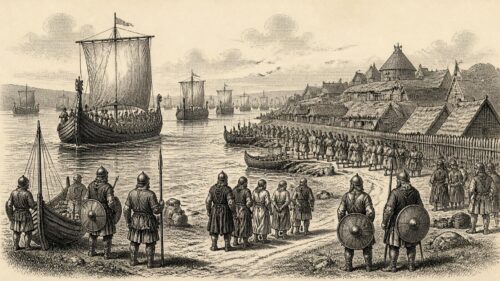
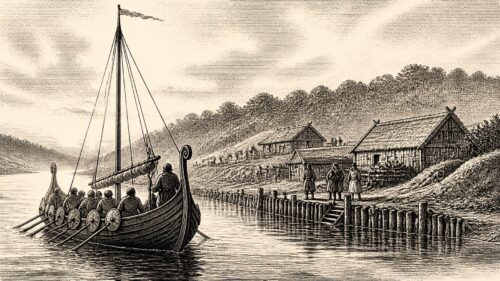
Amlaíb, Ímar and Auisle had, for a time, operated as a formidable group. Their authority was mobile, naval and opportunistic: it rested on ships, armed followers, tributary demands and fortified bases, rather than on a settled territorial kingdom in the later medieval sense. Dublin was their central Irish station, linked through the Irish Sea to western Britain, northern England and Scotland. Its rulers could negotiate and ally with Irish kings as well as raid them. The death of one of the three therefore had consequences beyond a family quarrel. It may have made an Irish attack more practicable, although the annals do not explicitly state that this was Cennétig’s calculation.
Fire at Clondalkin
The Annals of Ulster name the attackers as the son of Gaíthíne and Máel Ciaráin son of Rónán. The first is generally identified as Cennétig mac Gaíthéne, king of Loígis. The entry says that Amlaíb’s fort at Cluain Dolcáin, modern Clondalkin, was burned, and that the commanders caused the slaughter of one hundred leaders of the foreigners in its vicinity on the same day. This is unusually precise annalistic reporting: a named base, named commanders, a stated outcome and a casualty figure. Yet “hundred” should be read as the annalist’s figure, not as a number that archaeology can independently verify.
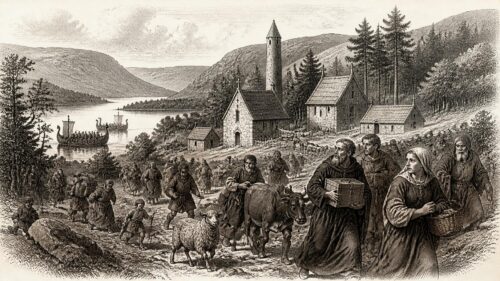
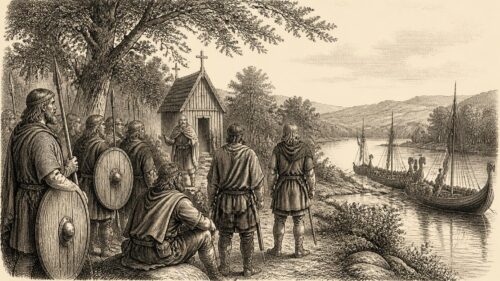
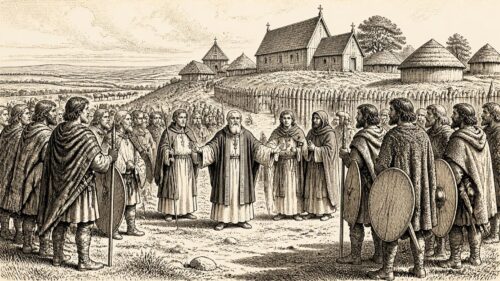
Clondalkin was not an anonymous military site. It was an old ecclesiastical settlement, traditionally associated with Mochua or Crónán and founded in the seventh century. The surviving round tower is later than 867, so it should not be imagined as the landmark of this attack. But the monastery’s enclosure and location on the approaches to Dublin made it valuable. Amlaíb’s fort seems to have appropriated, or stood in relation to, the monastic place. That conjunction was characteristic of the period’s harsh political geography: churches possessed land, food renders, skilled people and routes of communication, while forts and longphuirt sought command of the same resources.
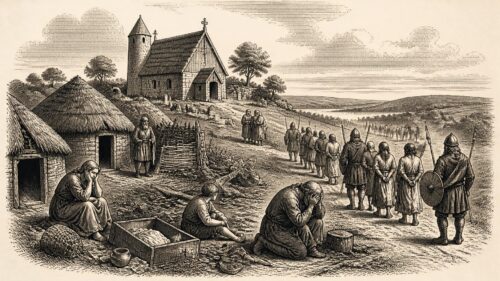
The fire at Clondalkin was thus more than a raid on an outpost. It carried a double significance. It struck men attached to Amlaíb, and it disrupted a site where military power and an established Christian community met. The Fragmentary Annals gives the encounter a heroic shape, portraying Cennétig as a renowned enemy of the Norwegians who turned on pursuers and drove them back. Such prose was written with literary and moral purposes as well as historical ones. Still, it supports the basic point shared with the shorter annal: the Irish attack was successful enough to burn the base and inflict serious losses.
No Permanent Liberation
Later material reports that Cennétig also defeated the foreigners of Áth Cliath, Dublin itself. This may preserve a second phase of the same offensive, and modern historians have often accepted that an attack on Dublin followed the Clondalkin action. The evidence is less straightforward than for the burning of the fort, however, and it does not demonstrate that Dublin was captured or abandoned. Amlaíb remained an active and dangerous ruler afterwards. The episode should therefore be understood as a check on Viking power, not a national victory that removed it from Ireland.
That distinction matters. “Irish” and “Viking” were not two united blocs facing each other. Cennétig was a regional king from Loígis; Máel Ciaráin was a military leader whose later annalistic obituary remembered him as a champion of eastern Ireland and plunderer of foreigners. Their success reflected local power and local opportunity. Elsewhere, Irish dynasties competed against one another, hired or allied with Scandinavian forces, and pursued cattle, tribute, hostages and status. Nor were the inhabitants of Dublin a simple invading army. By this stage the settlement included warriors, traders, craftworkers and, increasingly, households with women and children, although the evidence cannot tell us who precisely was present at Clondalkin in 867.
Rival Kingships
The annals also record the killing by fire of Abán son of Cinaed, heir designate of Connacht, by Sochlachán son of Diarmait. This was a reminder that succession was a matter of danger across Gaelic Ireland, quite independently of the Scandinavian presence. An heir designate was not a guaranteed successor: he was a recognised candidate whose position could be contested through kin rivalry and force. Muiredach son of Cathal, king of Uí Chremthainn in the north-east, died after prolonged paralysis, while Guaire son of Dub dá Bairenn also died. Such brief notices show a political map made up of many peoples and dynasties, each with its own kings and ambitions.
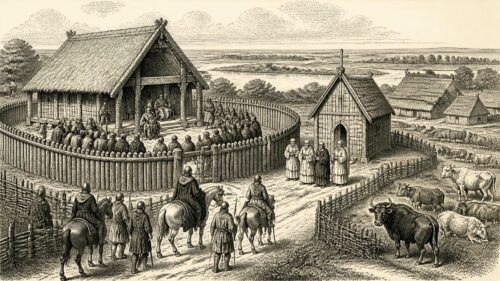
Over-kingship did exist, but it was negotiated rather than automatic. Áed Findliath of the northern Uí Néill was then king of Tara in annalistic terminology and had recently campaigned hard against Scandinavian forces in the north. His influence did not turn the Clondalkin raid into a centrally directed all-Ireland operation. Indeed, the very need for local commanders to seize opportunities near Dublin demonstrates the limits of island-wide rule. Political power was personal, dependent upon kin, clients, church connections, movable wealth and a leader’s ability to assemble an armed following.
Churches, Writing and Survival
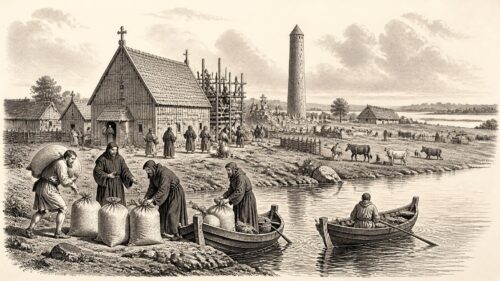
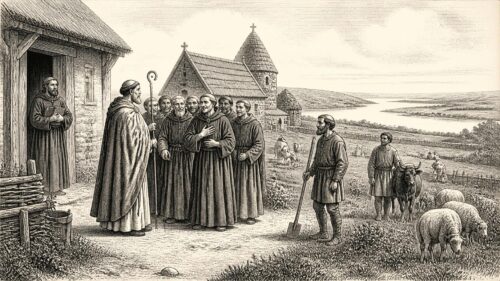
Religion remained deeply entangled with politics, but ecclesiastical life cannot be reduced to victimhood. The Annals of Ulster record the deaths of Robartach of Finglas, described as bishop and scribe; Conall, bishop of Cell Scíre; Coscrach, a scribe of Tech Telle; and Oegedchar, abbot of Condaire and Lann Ela. Máel Tuile, abbot of Ára Airthir, also died. These compressed obituaries reveal a dense network of churches whose leaders could be bishops, abbots, scribes and teachers. Monasteries were centres of worship, literacy, farming, hospitality and political influence. Their communities recorded the deaths of learned men with the same seriousness as the fall of kings and war leaders.
The attack at Clondalkin therefore belongs in a landscape of resilient religious institutions. Raiding endangered people and portable wealth, especially metalwork and livestock, but churches continued to organise land and learning. Irish scribes of the ninth century were capable of sophisticated Latin scholarship and of writing Old Irish glosses beside Latin texts. The annual notices do not prove that a particular manuscript was copied at Clondalkin in 867. They do show that, amid warfare, the island still possessed the clerical personnel and institutional memory required to sustain a written historical record.
Life Around a Longphort
Archaeology supplies the wider material setting, though it must not be mistaken for a photograph of one year. Excavations in Dublin have recovered houses, workshops, walkways, boat timbers, fishing gear, tools, weights, scales, textiles and objects made from wood, bone, antler, leather and metal. These finds demonstrate that Scandinavian settlement in Ireland was not solely a matter of raiding. Commerce, craft production, food supply and seaborne transport were essential to its survival. Silver, often weighed rather than counted as coin, connected Irish Sea communities with Britain, the Continent and routes extending ultimately to the Islamic world.
In 867, ordinary people near Dublin and Clondalkin would have experienced this world through its demands: labour on fields and estates, obligations of food-rent, fear of armed bands, travel by river and road, and access to new goods and markets. The burning of a fort could mean disrupted supply, displaced dependants and heightened danger for neighbouring communities as much as a tactical success for its victors. The annals preserve the names of commanders; archaeology better hints at the lives of those whose names were not written down.
Clondalkin’s burned fortress captures the uncertainty of Ireland in 867. A Scandinavian ruling house was fractured by killing within its own kin group. A local Irish force exploited, or at least coincided with, that weakness and struck close to Dublin. Yet neither side possessed a permanent solution. The island’s politics remained plural, its churches continued to write and organise, and its growing maritime settlements tied conflict to trade. The year is memorable not because it settled the contest for Ireland, but because it shows how swiftly power could be damaged when a fort, a dynasty and a monastic landscape converged in flame.
Primary Sources
- The Annals of Ulster
- CELT Project: The Annals of Ulster
- Fragmentary Annals of Ireland
- CELT Project: Fragmentary Annals of Ireland
- Annals of the Four Masters
- Part 70 of Annals of the Four Masters
- Annals of Inisfallen
- CELT Project: Annals of Inisfallen
- Vikings in Ireland and Scotland
- General Vikings in Ireland
- The Vikings in Ninth-Century Ireland: Sources and Settlements
- Viking
- Early Medieval
- The 9th-Century Latin to Irish Translation App
- Guide to the National Museum of Ireland
- Clondalkin Round Tower
- Monastery Road Commission Artist Brief
- Church-Raiding And Politics In The Era Of Amlaíb And Ímar
- Exhibition Galleries
- Wood Quay 50 – What’s It All About?
- An Interesting Point
- Wooden Plank with Viking Ship and Weathervane Graffiti
- Annals of Inisfallen to Go on Public Display in University College Cork