

Surrey at Wood Quay1520 CE
In 1520 Henry VIII appointed Thomas Howard, earl of Surrey, lieutenant of Ireland, replacing the influence of detained earl of Kildare. Landing at Wood Quay with English troops, Surrey repaired Dublin Castle, defended the Pale and pursued negotiated submissions from Gaelic and Anglo-Irish rulers. His campaigns, truces and oaths brought gains, but depended on allies, coercion and shifting interests. Disease disrupted government, while troop concentrations caused shortages and coign and livery burdened communities. Insufficient revenue, poor logistics and warfare restricted policy. Annalistic evidence reveals lordships, succession disputes and learned institutions. Surrey’s expedition exposed the limits of crown authority beyond Dublin.
Dateline
A Lieutenant Arrives
In 1520, Ireland became the setting for Henry VIII’s most ambitious intervention of his reign to that point. On 10 March the king appointed Thomas Howard, earl of Surrey, as lieutenant of Ireland: the first holder of that high viceregal office to serve in person for many decades. His appointment was a rebuke to Gerald FitzGerald, ninth earl of Kildare, whose long dominance of the Dublin administration had attracted accusations of misgovernment. Kildare was retained in England while Surrey was sent to discover whether the lordship could be made more orderly, more obedient and, crucially, less expensive to the crown.
This was not yet a full Tudor conquest. Henry’s government had no settled programme for overthrowing every Gaelic lordship, and it had neither the money nor the soldiers for one. Rather, Surrey arrived with a large force by Irish standards, instructions to repair administration and revenue, and authority to obtain the obedience of neighbouring rulers. The expedition nevertheless exposed a central problem that would recur throughout the century: English officials claimed a jurisdiction extending across the island, but their effective power rested chiefly on Dublin, the Pale and a web of negotiated local relationships.
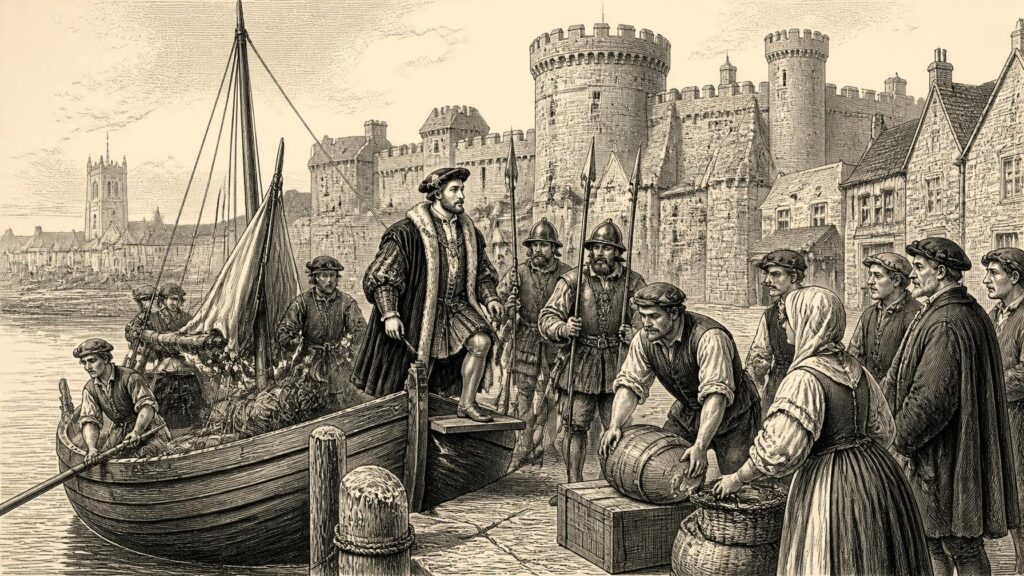
The Dublin Chronicle dates Surrey’s landing at Wood Quay, beside the Liffey, to 24 May. He came with his wife, many of the king’s guard and northern English spearmen, then proceeded to Dublin Castle. The choice of residence was revealing. The castle, seat of royal government, was in serious disrepair. Building work soon repaired rooms, stables and a tower, while a new parlour and chamber were made for the lieutenant’s household. Such works made Surrey’s authority visible in the city, but they also showed that an expedition meant to restore rule had begun from a fragile administrative base.
Command Without Kildare
Surrey’s arrival did not bring instant security. Kildare’s personal alliances had helped to manage the Pale’s dangerous borders, even while they had enlarged his own power. With the earl absent, earlier submissions and private understandings could no longer be relied upon. Within a week of Surrey’s landing, reports reached Dublin that Conn Bacach Ó Néill, lord of Tír Eóghain, was advancing with a strong force to harm the English settlement. Dublin’s mayor and citizens were ordered out, and Surrey followed. By the time his force reached Slane, however, the immediate threat had vanished. The episode demonstrated both the alarm that raiding could cause and the difficulty of chasing mobile forces through a landscape of woods, bogs and dispersed lordships.
The lieutenant’s troops were ill matched to that environment. English foot soldiers could guard towns and crossings, but they were less useful in rapid operations than Irish horsemen and kern. Surrey therefore recruited locally, though he was wary of dependence on men whose allegiances were shaped by kinship, patronage and local rivalry. The original expedition had envisaged a formidable mixed force of English troops, Irish horse, kern and artillery. In practice, men arrived late, mounts were poor, units were dismissed or redistributed, and the garrisons needed for Pale defence consumed manpower. Military strength on paper did not automatically become control on the ground.
July was especially troubled. Surrey later reported being so occupied by wars in several places that he could not convene the councils through which he hoped to reform government and recover revenue. Yet campaigning and diplomacy proceeded together. On 23 July he informed Henry VIII that a truce between the competing powers of Desmond and Ormond was to last until Candlemas, 2 February 1521. He also reported oaths taken by Lord Barry and others, a foray into Ó Mórdha country in Leix, and the submission of Ó Carroll. These arrangements were not signs of a unified kingdom accepting a modern state; they were conditional bargains, backed by force and calculated self-interest.
Oaths, Raids and Submission
Conn Bacach Ó Néill’s position captures the ambiguity of the year. He had succeeded as lord of Tír Eóghain in 1519 and was associated with the Kildare interest. His incursion towards the Pale made him an immediate concern for Surrey. In July 1520, however, Ó Néill met the lieutenant and promised loyalty. Henry VIII responded favourably, sending him a gold collar, while the archbishop of Armagh urged him to honour his pledge. This was diplomacy in the language of personal honour, gifts, hostages, oaths and service, not a permanent settlement of sovereignty. Ó Néill remained a powerful ruler in Ulster, with his own alliances and conflicts.
Surrey sought similar accommodations more widely. Contemporary government correspondence and later biographical evidence indicate fresh submissions from the Ó Néills, Ó Domhnaills and MacCarthys during the summer. In the south, Cormac Óg Láidir MacCarthy of Muskerry was brought before Surrey at Waterford through Piers Butler’s influence. Cormac’s willingness to seek recognition from the crown did not mean that Munster had become governable from Dublin. It instead shows how local rulers could use royal favour to improve their standing against regional competitors. Surrey, for his part, hoped to turn such dealings into rents, legal obligations and dependable political service.
By mid-August Surrey had entered the lordships of Ó Néill and Mac Mahon, inflicting damage and receiving professions of obedience. He could therefore represent the campaign as a success. But the method mattered: a submission obtained after a hosting could be renewed, evaded or overturned as soon as the balance of advantage changed. The crown’s authority depended on continued negotiation, credible military pressure and the cooperation of magnates such as Piers Butler, who was Surrey’s principal ally but also Kildare’s developing rival.
Munster meanwhile remained volatile. In September, at the battle of Mourne in County Cork, Cormac Óg MacCarthy helped Thomas fitz Thomas defeat James fitz Maurice FitzGerald in a struggle connected with the contested leadership of Desmond. Surrey’s council reported the defeat to Henry on 25 September. This was a regional conflict rather than a straightforward contest between crown and rebellion. It underlines why the English administration could not treat ‘Ireland’ as a single political field: rival branches of great Anglo-Irish and Gaelic families pursued their own claims, hired allies and settled scores independently of royal plans.
Illness, Cost and Daily Strain
The year’s most immediate burden may have been disease. Surrey described a great sickness as widely spread through the English Pale. His soldiers were dispersed in small groups through towns thought free from infection, and he told Cardinal Wolsey on 3 July that three members of his household had fallen sick and died in Dublin within a week. The government’s normal business suffered too: plague prevented the king’s courts, except the exchequer, from sitting in Trinity term. These reports do not permit a precise modern diagnosis, but they firmly establish a serious epidemic affecting administration, campaigning and ordinary communities.
For townspeople and rural households, an army enlarged existing pressures. Surrey complained that the unexpected concentration of soldiers in Dublin created scarcity and dearth: bread and ale became so dear that footmen could not subsist on their daily wage. Mounted men were permitted to take coign and livery, the customary exaction of food, lodging and fodder from local people. It was an old practice, but its use by the king’s troops made clear that the costs of defence were being passed on to subjects and neighbours. The complaint also gives a rare glimpse beyond high politics, towards crowded markets, strained supplies and the practical business of feeding people and horses.
Money was the expedition’s persistent weakness. Surrey had arrived too late in the season to secure the revenue expected for his force, while the crown’s Irish income was far lower and harder to collect than optimistic planners had imagined. By autumn, wages were exhausted, credit was unavailable and the army could not leave Dublin for want of cash. Henry eventually sent further funds, but complained of the high charge for so little apparent result. The gap between ambitious policy and restricted finance was not incidental: it determined what royal government could do.
A Country of Many Lordships
The annals for 1520 provide a complementary view of a country not reducible to Surrey’s itinerary. They record the death of Ulick Burke, Mac William of Clanrickard, an important change among the leading powers of Connacht. In Ulster, Donnell Magennis died; his brother Felim was inaugurated, died in turn, and Edmond Boy Magennis became ‘the Magennis’. Such rapid succession points to the political importance of recognised leadership within a lineage. The annals also record a violent Maguire–Ó Reilly encounter in which Philip Maguire, his son and several companions were killed, as well as a plague in Machaire-Stephanach.
They preserve religious and learned lives too. Nicholas Ó Flanagáin, parson of Devenish, was removed from office through lay influence and died at Boho. Félim Ó Cassidí, physician and learned professional, ollamh to the descendants of Philip Maguire, also died. These notices are brief, and the Annals of the Four Masters were compiled more than a century later from earlier materials, but they remind us that lordship depended not only on warriors. Clerics, physicians, poets, judges, hereditary learned families and households of hospitality formed institutions through which communities remembered rights, cared for bodies, educated elites and sustained status.
Surrey ended 1520 with some gains: repaired headquarters, a more workable force, oaths from several rulers and a temporarily steadier Pale. Yet none settled the fundamental question of how Henry VIII’s lordship could be made effective beyond its narrow core. Surrey himself increasingly believed that compulsion on a much larger and costlier scale would be required. Henry, facing European commitments, preferred persuasion, legal incorporation and economical government. The tension between those approaches was already plain by the year’s end. Ireland in 1520 was not on the brink of an inevitable outcome; it was a landscape of competing lordships in which disease, food, money, local alliances and armed mobility set strict limits on royal designs.
Primary Sources
- Prelude to the Tudor conquest: Henry VIII and the Irish expedition of Thomas Howard, earl of Surrey, 1520–22
- State Papers Published Under the Authority of His Majesty's Commission: King Henry the Eighth, Volume II, Part III
- Annals of the Four Masters: Volume 5 English Translation
- Howard, Thomas
- FitzGerald, Gerald (Gearóid Óg, Garrett McAlison)
- Butler, Piers (‘Piers Ruadh’)
- O'Neill (Ó Néill), Conn ‘Bacach’
- MacCarthy (Mac Carthaigh), Cormac Óg Láidir
- Fitzgerald, Maurice fitz Thomas
- Butler, James
- Ireland in the Reign of Henry VIII
- The Reemergence of English Policy as a Major Factor in Irish Affairs, 1520–34
- Henry VIII's Irish Policy: Surrey's Irish Expedition, 1520–2
- Calendar of Ormond Deeds, Volume IV, 1509–1547
- Warrant to the Earl of Surrey, Lord Lieutenant, for Martial Laws and Making Knights, 1520
- Letters and Papers of Henry VIII
- The Tudor Lordship of Ireland, 1520–1547
- English Lordship of Ireland and the Irish Sea World: Re-assessing the Origins of the Kildare Ascendancy, c.1390–c.1513
- State Papers and Government Records Relating to Tudor Ireland
- Irish History: Ecclesiastical Sources