

Justice Deferred
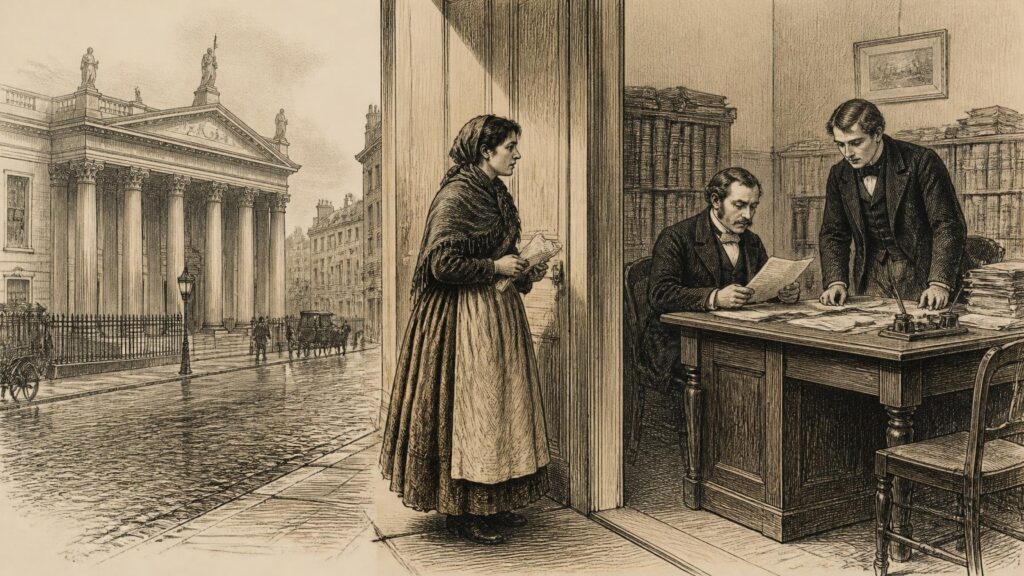
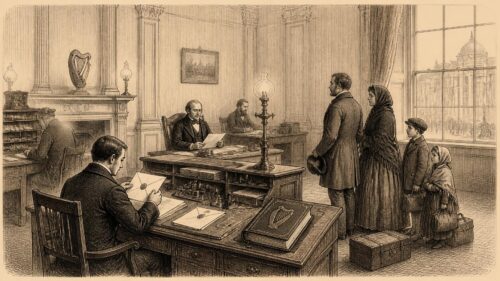
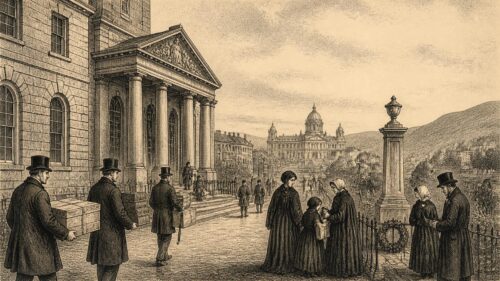
AI generated historical illustration, not a contemporary photograph.
At a Glance
For much of modern Irish history, the right to bring a civil case and the practical ability to do so were very different things. A court might be formally open to every citizen, yet its procedures, professional costs and distance from ordinary experience could place it beyond the reach of people of modest means. Civil legal aid reform emerged from that contradiction. Its history is not simply an account of statutes and offices. It is a record of voluntary action, public inquiry, international litigation, constrained administration and repeated arguments over what access to justice ought to mean in an unequal society.
Opening Door
Civil legal aid concerns disputes outside the criminal process: family breakdown, housing, employment, welfare, debt, discrimination, immigration and many other matters in which people seek advice, representation or help navigating tribunals and courts. The distinction matters. By the later twentieth century, the principle that an accused person of insufficient means might need legal representation in criminal proceedings had gained statutory recognition in Ireland. Civil disputes were treated differently. The individual was often assumed to be able to seek private legal services, make an agreement, abandon the matter, or represent himself or herself.
That assumption rested uneasily beside the realities of law. A dispute can be civil in classification but grave in consequence. It may determine whether a person can leave a damaging marriage, resist eviction, secure maintenance, challenge a discriminatory decision or protect a child’s welfare. Legal rules may be publicly available in a narrow technical sense, yet inaccessible to someone without money, time, confidence, literacy, transport or familiarity with institutions. In this setting, reformers argued that access to justice was not exhausted by the absence of a locked courtroom door.
The Irish debate acquired particular force during the social changes of the 1960s and 1970s. Post-war expectations of public provision were expanding, while voluntary organisations increasingly demonstrated that legal problems were not confined to property owners and commercial clients. People living on low incomes brought questions about family security, social welfare, debt, employment and tenancy. Their needs exposed a gulf between professional legal services, traditionally concentrated in private practice, and the lived circumstances of people who could not meet ordinary fees.
Documented evidence shows that the principal arguments for reform were practical as well as philosophical. Cost was a barrier, but not the only one. The later account of the Pringle Committee identified lack of knowledge, the perception that solicitors served the better-off, a psychological distance between disadvantaged clients and lawyers, and the difficulty of reaching offices, especially in central Dublin. These observations are important because they describe access as a chain: legal aid could not be only a payment mechanism if potential clients did not know a remedy existed or felt unable to approach a lawyer.
It is tempting to describe the history as a simple movement from exclusion to entitlement. The evidence supports a more qualified reading. Ireland did build a permanent State scheme and later gave it statutory status. Yet each achievement carried limits: eligibility rules, contributions, excluded areas of law, finite staff and waiting periods. The history of civil legal aid reform is consequently best understood as an unfinished negotiation between aspiration, administrative capacity and the recurring insistence that rights must be effective in practice.
Voluntary Beginnings
The most conspicuous early challenge came from the Free Legal Advice Centres, generally known as FLAC. In April 1969, law students associated with Trinity College Dublin established the organisation to provide free advice and information to people who could not afford professional fees. Its foundation belongs to a wider international era in which students, community groups and voluntary advisers questioned whether law served poorer citizens fairly. In Ireland, however, the initiative developed its own distinctive character, combining direct assistance with a sustained campaign for State responsibility.
FLAC’s early work mattered not merely because it helped individual clients, but because it produced evidence of demand. Its own historical account records thousands of files within a few years and a widening network of centres. Volunteers included students, solicitors and barristers. Matters brought to the centres included family, criminal, landlord and tenant questions. Those categories should not be mistaken for a complete survey of need; a voluntary organisation’s files reflect who knew of its existence and could reach it. Nevertheless, they made visible a constituency that conventional legal provision had not adequately reached.
The organisation also helped alter the language of the debate. Poverty had commonly been discussed through income, housing, employment and welfare. FLAC encouraged recognition that legal disadvantage had an institutional form of its own. A person might possess a legitimate claim yet lack the means to discover it, frame it or pursue it against a landlord, employer, spouse or public body. Advice could prevent a dispute from worsening; representation could make a remedy usable. This was a claim about citizenship as much as charity.
In 1975 FLAC opened Coolock Community Law Centre, described as Ireland’s first community law centre. The experiment pointed towards a different model from a remote professional service. A centre embedded in a community could combine legal work with local knowledge, make lawyers more approachable and recognise patterns affecting many residents. Its significance was therefore greater than the size of one office. It raised the question of whether a future public scheme should be community-based, educational and attentive to structural legal problems, rather than confined to separate individual cases.
There is no need to romanticise this period. Voluntary effort could not supply a national, reliable legal service. It depended upon goodwill, uneven resources and the availability of practitioners prepared to work without normal remuneration. By 1980, a shortage of funding forced FLAC to close many centres, although work continued in Cork and its focus evolved. That experience itself reinforced the campaign’s central proposition: access to civil justice could not safely rest on voluntary labour alone.
Folklore often compresses campaigns into tales of a few determined individuals forcing an indifferent State to act. There is a kernel of truth in the importance of personal initiative, but the documentary record is more complex. Volunteers, clients, lawyers, civil servants, parliamentarians, judges and international institutions all shaped the outcome. FLAC did not create civil legal aid single-handedly. Its lasting contribution was to organise experience, publicise barriers and make it harder for government to treat the problem as marginal.
Pringle Inquiry
Government response took institutional form in July 1974, when the Committee on Civil Legal Aid and Advice was appointed under the chairmanship of Mr Justice Denis Pringle. The committee was asked to advise on introducing a comprehensive scheme, its form, nature and administration, the legislation required, interim advice centres and assistance in specified cases, and the likely cost. The breadth of those terms is revealing. The question was not whether some limited help might be offered, but how an enduring national system could be designed.
The committee reported in December 1977. Its findings captured barriers that were economic, geographical, cultural and informational. Low-income people could believe legal assistance was unaffordable even before seeking advice. They might not know which problems had a legal dimension. They might doubt that a solicitor’s services were relevant to difficulties involving welfare or family life. They might experience professional offices and central-city locations as alien or inaccessible. The report therefore treated legal need as broader than courtroom advocacy.
Its broad recommendation was for a comprehensive civil legal aid and advice scheme, administered by a Legal Aid Board independent of the profession while including professional representation. The model envisaged legal advice, assistance and advocacy across courts and tribunals. It also contemplated public education, research and review of legal services, alongside evaluation of the scheme itself. Means testing, contributions from those able to make them and an assessment of the merits or reasonableness of a case were envisaged. The committee did not propose an unconditional State-funded lawyer for every civil dispute.
That distinction remains central. In public debate, legal aid is sometimes treated as a binary question: either a person receives entirely free representation or receives nothing. The Pringle approach was more administrative. It tried to reconcile access with public expenditure by targeting assistance and filtering cases. Such filters were not necessarily hostile to reform; every public scheme has to make choices. Yet each filter creates risks. A rigid income limit can exclude someone too poor to pay privately. A narrow merits assessment can deny support where the law is unsettled. A contribution can become another barrier for a household already under pressure.
The report’s ambitions were wider than what was eventually established. In particular, later critics observed that the State scheme did not acquire the proposed research, legal education and community-centre functions. This difference matters historically. It marks a divergence between two theories of civil legal aid. One treats it primarily as a service for eligible individuals with particular cases. The other views it as part of a wider infrastructure of legal capability, public information and reform. Ireland’s eventual scheme principally adopted the former theory.
The interval between report and implementation also demonstrates that commissions do not automatically produce change. The Pringle Report gave reform an authoritative blueprint, but it did not itself create a right, staff a law centre or fund representation. Another event, arising from one woman’s pursuit of judicial separation, would bring the inadequacy of civil access to justice before the European Court of Human Rights.
Strasbourg Turning
Johanna Airey’s case became a landmark in Irish and European legal history. In the 1970s, she wished to pursue judicial separation in the High Court. The procedure was complex and costly, and she could not afford representation. Although a person could in theory appear without a lawyer, that formal possibility did not answer the practical problem. The European Court of Human Rights considered whether the absence of accessible legal assistance prevented effective access to a court under Article 6 of the European Convention on Human Rights.
In its judgment of 9 October 1979, the Court held that Mrs Airey had not enjoyed an effective right of access to the High Court for the purpose of seeking judicial separation. Its reasoning was carefully qualified. The Court did not say that the Convention required free legal aid in every civil case. Nor did it prescribe one universal institutional solution. Simplified procedures could sometimes assist, and self-representation might be practical in particular matters. But the Court found that the complexity and importance of Mrs Airey’s situation made the theoretical possibility of acting alone insufficient.
The evidence considered by the Court showed the practical character of the barrier. Every judicial separation petition initiated in Ireland between January 1972 and December 1978 had involved legal representation. That did not prove that self-representation was legally impossible, but it was strong evidence that it was not a realistic route in such proceedings. The case supplied a durable principle: rights guaranteed on paper must be practical and effective rather than merely theoretical or illusory.
Airey is sometimes portrayed as though Strasbourg ordered Ireland to establish the later Legal Aid Board exactly as it did. That is not accurate. The Court stated that it was for the State to choose the means of meeting its Convention obligations. Legal aid was one possible means, procedural simplification another. The Government had already informed the Court that it intended to introduce legal aid in family-law matters. The judgment strengthened the urgency and authority of reform; it did not draw the detailed administrative map.
The case nevertheless had effects far beyond Mrs Airey’s personal circumstances. It situated civil legal aid within the law of human rights rather than treating it solely as discretionary welfare policy. Access to justice became linked to the State’s positive responsibility to ensure that a legal remedy could genuinely be used when circumstances demanded it. The ruling also connected family law, poverty and legal procedure at a moment when Irish society was beginning a long transformation in attitudes to marriage, women’s equality and private life.
Interpretation should be kept separate from direct proof. It is reasonable to interpret Airey as a constitutional moment in the public understanding of Irish legal aid, because its language and consequences recur throughout later debates. It would be too simple, however, to claim that one judgment solved the structural problems revealed by voluntary centres and the Pringle Report. The scheme that followed was significant, but limited in reach and shaped by the resources government chose to devote to it.
Administrative Scheme
In response to the Pringle process and the Airey litigation, the State introduced a non-statutory Scheme of Civil Legal Aid and Advice in 1979. The Legal Aid Board began operating the scheme, and the first law centre opened in 1980. This was a major institutional departure. A person of limited means could now seek civil advice and, in appropriate cases, representation through a public service rather than relying entirely upon private charity, professional goodwill or personal savings.
Its administrative rather than legislative basis was consequential. The scheme existed through executive decision and Exchequer funding, not through a detailed statutory entitlement. It could develop services, establish offices and employ salaried lawyers, but applicants did not initially possess the same legislative assurance that later accompanied the 1995 Act. The arrangement demonstrated the State’s acceptance of a responsibility identified by Airey, while retaining considerable flexibility over scope, resources and delivery.
The model centred on law centres staffed by salaried personnel and supplemented by part-time clinics. It did not reproduce the community-law vision in full. Later accounts by FLAC describe a service with little community participation and no general research or public legal education function. Nor did it take on every area of legal need. Certain categories of case were excluded, and tribunals were among the areas outside the ordinary scheme. This meant that a citizen’s prospects could depend not only on need and means, but also on the forum in which a dispute happened to be decided.
Family law became dominant within the service. That reflected the immediate background of Airey and the seriousness of disputes about marriage, maintenance, custody and domestic safety. It also reflected wider legal and social change. Legal services were required by people seeking remedies within a family-law system undergoing gradual reform. Family cases often involved emotionally difficult facts, unequal bargaining power and procedural demands not readily handled without advice.
Yet the family focus had an unintended historical consequence. It encouraged a public association between civil legal aid and family law, even though poverty-related legal need extended into housing, employment, welfare, debt and equality. The distinction is not simply semantic. A service designed and resourced around one dominant stream of work may be less capable of responding to other forms of disadvantage, particularly disputes handled through specialist tribunals or administrative processes.
Underfunding and geography were recurring concerns. The creation of law centres did not mean that access was immediate or uniform across the State. Waiting lists and distance remained obstacles, particularly where demand outstripped the number of available solicitors. A historical assessment must acknowledge both sides: the scheme was a real advance over the preceding absence of general provision, and it remained substantially narrower than the comprehensive system imagined by the Pringle Committee.
Statutory Settlement
Pressure for firmer legal foundations continued. In 1992 FLAC joined other bodies in forming the Civil Legal Aid Alliance, seeking legislation for the scheme. That effort culminated in the Civil Legal Aid Act 1995, enacted on 16 December 1995. The Act made provision for State legal aid and advice in civil cases for persons of insufficient means and established the Legal Aid Board on a statutory basis. Its enactment is the clearest legislative milestone in the history of Irish civil legal aid.
The Act gave the Board a principal function of providing legal aid and advice in civil cases, within its resources and subject to the Act, for people meeting its requirements. It also provided for family mediation. This wording contained both promise and limitation. It recognised public legal assistance as a statutory function rather than a temporary administrative experiment. Yet the phrase “within the Board’s resources” made explicit that the service’s practical extent would remain dependent on funding and capacity.
The statute distinguished legal advice from legal aid. Advice could explain how Irish law applied to an individual’s circumstances and what steps might appropriately be taken. Legal aid involved representation and the formal work required to conduct a case. That distinction is administratively sensible: many disputes can be clarified or resolved without litigation, while representation is resource-intensive. But for clients, the boundary can be sharp. Advice may reveal that a person has a strong claim without giving that person the means to pursue it.
Eligibility was structured through financial and merits criteria. Applicants generally had to show that they lacked sufficient means, that the case satisfied the relevant legal tests and that legal assistance was appropriate. Contributions could be required. The scheme was therefore neither universal civil representation nor purely charitable relief. It was a means-tested public service designed to target limited resources. The basic architecture still reflects the compromises anticipated in the Pringle Report.
The 1995 settlement also preserved significant exclusions. The Act did not create an open-ended duty to fund all civil claims. Restrictions on areas of law, types of proceeding and forms of action shaped who could use the service. Later analysis particularly criticised the exclusion of many tribunal matters and the inability of the Board to support test cases or representative actions in the ordinary way. These constraints limited the system’s capacity to address problems affecting groups, or to establish precedent capable of helping many people beyond the original client.
Legislation should not be confused with completion. The 1995 Act was a decisive gain because it translated a service into a statutory framework. At the same time, it settled a particular model: individual service provision, tightly governed eligibility, finite resources and substantial discretion in implementation. Reformers who had hoped for a broader access-to-justice institution continued to argue that the statutory scheme was a floor rather than a finished architecture.
Family Focus
The history of civil legal aid cannot be separated from the history of Irish family law. Airey arose from judicial separation, and the public scheme grew first in an environment where family disputes vividly illustrated the cost of inaccessible procedure. Family law cases may involve children, housing, income, safety and continuing relationships. Even where parties want an agreement, they may need legal advice to understand rights and consequences. Where conflict is acute, representation can be indispensable.
The Legal Aid Board’s role in family mediation added another dimension. Mediation offers separating couples an opportunity to negotiate arrangements without contested litigation, and it can reduce cost, delay and hostility when participation is safe and meaningful. It should not, however, be mistaken for a substitute for legal rights or representation in every case. Mediation depends on informed participation and a sufficient balance of power. Domestic abuse, intimidation, unequal resources or complex legal issues may make other safeguards necessary.
The concentration of work in family law is historically understandable but administratively consequential. It can create pressure on law centres and influence the public perception of whom the service is for. A person facing a housing, employment or social-welfare problem may find that the legal system categorises the issue differently from a family dispute, perhaps placing it in a tribunal or a forum outside ordinary legal-aid coverage. Thus, the question of “scope” has never been an abstract technicality. It determines which hardships are treated as deserving of publicly supported legal help.
Family law also illustrates why timeliness matters. A delayed appointment can be more than inconvenience when maintenance, access, custody, safety or accommodation is at issue. Legal aid reform has therefore repeatedly involved arguments about staffing, waiting lists and the availability of private practitioners, not merely formal statutory entitlement. A scheme that is open in principle but unavailable at the point of crisis may fail the practical standard associated with Airey.
There is a further historical irony. The original Strasbourg case was about the inadequacy of access to family-law remedies. Later decades saw important changes in Irish family law, including constitutional and legislative developments that widened the range of remedies available. But an expanded body of rights can generate a greater need for advice and representation. Law reform and legal aid reform must therefore be considered together. New legal rights do not automatically become social realities if those entitled to rely on them cannot afford the route to enforcement.
The family-law emphasis should consequently be read as both an achievement and a warning. It demonstrates where civil legal aid has made a visible difference to ordinary lives. It also reveals the danger of treating one category of need as the whole field of access to justice. The historical argument for civil legal aid was never confined to family breakdown, and its future has continued to turn on legal problems that occur beyond the family home.
Persistent Limits
Criticism of civil legal aid has endured not because the earlier reforms were meaningless, but because their limits remained visible. Means testing has been a central point of contention. A threshold can direct help to those in greatest financial difficulty, but living costs do not align neatly with disposable-income calculations. Someone above a limit may still be unable to finance a solicitor, counsel, expert reports and the risk of litigation. The familiar phrase “the squeezed middle” describes a real access problem, though it should not obscure the deeper hardship of those far below the threshold.
Contributions can create similar tension. They embody the proposition that recipients who can contribute something should do so, preserving public funds. Yet the person seeking aid may already be confronting a sudden separation, loss of work, rent arrears, illness or a dispute with a better-resourced opponent. An amount that appears modest to an administrator may be prohibitive to a household managing immediate insecurity. Whether a contribution is fair cannot be judged in isolation from the urgency and consequences of the case.
Scope is the second enduring problem. Legal disputes concerning social welfare, employment, discrimination and housing frequently involve specialised decision-makers, administrative rules or tribunals. If a scheme excludes cases because of their subject matter or forum, it can leave people to face institutions alone precisely where public decisions exert great force over everyday life. Critics have argued that blanket exclusions fail to assess whether representation is genuinely needed in an individual matter.
Test cases and representative actions raise another issue. An individual legal-aid service may assist one client but lack the mandate to pursue litigation intended to clarify a point of law for many people. From the standpoint of public expenditure, that limitation can seem cautious. From the standpoint of legal equality, it may be short-sighted. A well-chosen test case can remove uncertainty, alter an unlawful practice or prevent many identical disputes. The historical debate here is about whether civil legal aid should merely respond to harm after it occurs or also contribute to systemic correction.
The absence of a broad statutory research and legal education function has likewise mattered. People often seek lawyers late, after a deadline has passed or a dispute has hardened. Clear public information and community legal education can prevent escalation and help citizens identify problems early. Independent organisations have continued to provide information, advice, strategic litigation and policy advocacy in part because the State scheme’s remit is concentrated on direct client service.
These criticisms should be described fairly. They do not establish that every demand for legal aid must be met by the Legal Aid Board, nor that litigation is always the best answer. Courts, mediation, advice services, regulatory bodies, citizens’ information and voluntary organisations all occupy parts of the wider landscape. The historical disagreement concerns coordination and adequacy: whether the combined system allows people of insufficient means to enforce rights with practical effectiveness, rather than simply directing them from one limited service to another.
Review Reckoning
The publication of the Independent Review Group’s reports on 24 July 2025 placed the long history of reform under fresh examination. The Department of Justice described the exercise as the first review of the civil legal aid scheme since its introduction in 1979. The group, chaired by former Chief Justice Frank Clarke, considered the current scheme, consultation evidence, comparative research and financial questions. Both majority and minority reports were published, an important indication that informed participants did not reach identical conclusions about the required pace and scale of change.
The review’s very existence is historical evidence. A service created in response to the circumstances of the late 1970s was being assessed nearly half a century later in a changed Ireland. Family structures, migration, equality law, housing pressures, employment regulation, digital administration and tribunal systems had all transformed the context in which people encounter legal problems. The review recognised that access to justice had to be considered alongside wider civil-justice reform rather than as an isolated legal-aid question.
Its publication should not be treated as proof that every criticism of the existing scheme has been accepted by government, or that all proposed reforms will occur. Reports are arguments supported by evidence and consultation; implementation requires political decisions, legislation where necessary, funding and administrative planning. The distinction is especially important in legal history, where an announced reform can be confused with a completed one. As of the reports’ publication, they represented a substantial official assessment, not the final chapter of Irish civil legal aid.
Campaigning organisations have stressed income limits, delays, restricted scope and the difficulty of securing sufficient legal practitioners. Their perspective is not neutral, but it is historically valuable. Advocacy groups preserve evidence about the experience of clients who may otherwise appear only as anonymous statistics. The State’s perspective, meanwhile, must consider finite resources and the practical effects of expanding entitlements. A responsible history should recognise the legitimacy of both questions while noting that cost arguments do not erase Convention and rule-of-law concerns about effective access.
The 2025 review also revives the old contrast between an individual service model and a wider access-to-justice model. Should civil legal aid focus chiefly on personal representation in defined categories, or should it be connected more explicitly with legal information, education, early advice, strategic litigation and community support? That is, in substance, a return to questions raised by the Pringle Committee and community-law advocates decades earlier. The language has changed, but the underlying dilemma is recognisably continuous.
For historians, continuity should not be mistaken for failure alone. It shows that civil legal aid has become a settled subject of public responsibility rather than an obscure voluntary cause. The unresolved questions are now about the breadth, timeliness and resilience of that responsibility. That is a more advanced debate than Ireland possessed before the 1970s, though it remains one with serious consequences for people who require help now rather than after another cycle of review.
Historical Meaning
The Irish history of civil legal aid reform demonstrates that legal systems can exclude without expressly denying a right. A court may accept a claim in law while costs, procedure and professional dependence make it inaccessible in fact. Johanna Airey’s case supplied the most enduring judicial expression of that insight. FLAC and community-law advocates supplied the practical evidence from people’s lives. The Pringle Committee translated the problem into institutional design. The Legal Aid Board and the 1995 Act gave it a permanent State framework.
Each stage had a different historical function. Voluntary advice centres revealed demand and challenged professional distance. The public inquiry legitimised comprehensive planning. Strasbourg established that effective access could require positive measures. The administrative scheme made State provision real, if restricted. Statute converted that provision into an organised legal framework. Later criticism tested whether the framework had kept pace with changing forms of legal need.
The central lesson is not that civil legal aid is a benevolent addition to an otherwise accessible justice system. It is that access to law is itself a condition of equality before law. Rights concerning family life, housing, income, work or discrimination become precarious if their holders cannot obtain understandable advice and, when necessary, representation. This does not dictate that every dispute must be publicly financed. It does require public institutions to confront the difference between nominal availability and practical use.
There is also a distinctly Irish lesson in the relationship between civil society and the State. Reform did not descend fully formed from government. It was pressed by students, voluntary lawyers, community organisations, clients and campaigners who made legal need visible. Nor did campaigning end when legislation passed. The persistence of advocacy reflects the fact that a legal-aid scheme is not preserved by enactment alone. It must be staffed, funded, reviewed and adapted.
The title of this history, then, does not mean that justice has always been denied. Thousands of people have received advice, representation and mediation through the public system, and that achievement deserves recognition. “Deferred” better captures the longer record: reform has repeatedly acknowledged a principle, then struggled over the means needed to fulfil it. The future of civil legal aid in Ireland will depend on whether the country treats that interval between right and remedy as an unavoidable feature of public life, or as a problem that democratic institutions are obliged to reduce.


The article highlights a persistent tension between civil legal aid as individual casework and as a broader system of legal capability. Ireland’s eventual model provided an important route to advice and representation, particularly in family law, yet it did not fully embrace the Pringle Committee’s envisaged roles in community engagement, legal education and research. The 2025 review suggests that practical access still depends on more than formal eligibility for people facing institutions amid acute personal vulnerability and uncertainty. How should Ireland fairly balance targeted representation with preventative, community-based information and support when designing the next stage of civil justice provision?