

Hound Heritage
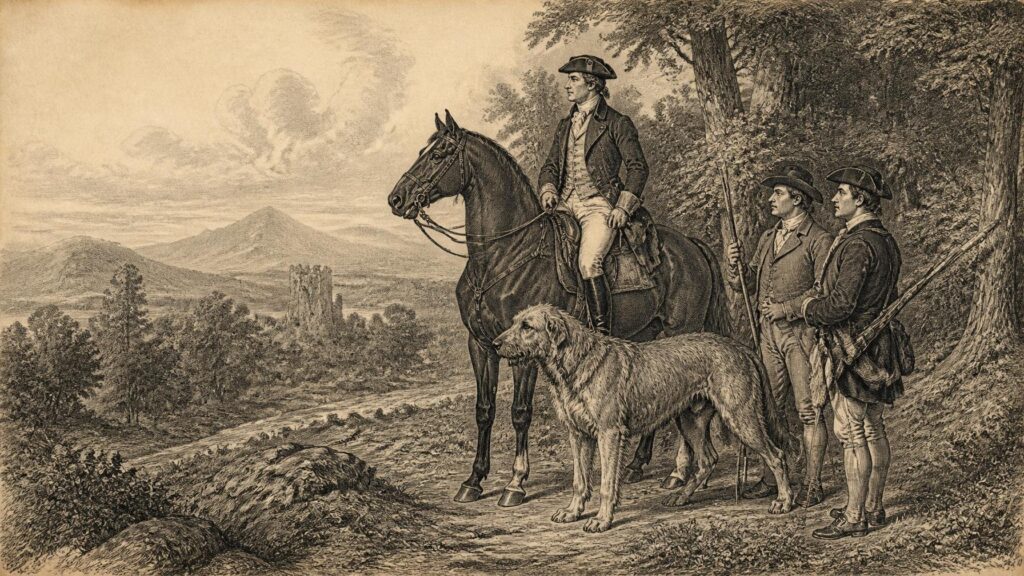
AI generated historical illustration, not a contemporary photograph.
At a Glance
The Irish wolfhound occupies an unusual place in Ireland’s past: it is at once a dog, an emblem, a subject of law and literature, and an object of historical argument. Great hounds certainly belonged to the social and imaginative world of Ireland over many centuries. Yet the familiar modern image of an immense, rough coated, wolf slaying breed reaching unbroken into remote antiquity cannot simply be read back into the evidence. The history of the wolfhound is strongest when it is treated not as one seamless tale, but as a succession of related histories: of Irish dogs, aristocratic hunting, literary prestige, changing landscapes, extinction, Victorian reconstruction, and national memory.
Evidence Threshold
The name Irish wolfhound invites a tempting simplicity. It appears to promise a single ancient breed, preserved in Ireland from heroic times until the present. Historical evidence does not permit so easy a conclusion. The word “breed”, in its modern sense of a population defined by pedigree, standardised appearance and organised registration, belongs chiefly to the nineteenth century. Earlier sources describe dogs by function, value, colour, coat, size, ownership or reputation. They speak of hounds, greyhounds, wolf dogs and great dogs, but do not provide the continuous pedigrees or measurements needed to identify a modern breed across a millennium.
This distinction is not pedantry. It changes the questions that can responsibly be asked. Documentary sources establish beyond serious doubt that Ireland was renowned for valuable hounds, that dogs figured prominently in law and saga, that Irish hounds travelled abroad as prestigious gifts, and that large hunting dogs survived into the early modern period. They do not establish that every famous hound was identical in form to the modern Irish wolfhound, nor that the enormous animal of modern breed standards existed unchanged in the age of Cú Chulainn.
A careful account must also distinguish three kinds of testimony. Documentary evidence includes letters, laws, estate descriptions and later sporting writing. Archaeological evidence consists of animal remains recovered and measured from excavated sites. Literary and folkloric evidence reveals what dogs meant to storytellers and audiences, but is not a literal inventory of canine bodies. All three are valuable, although each answers different questions. A hero’s hound in a saga may show the cultural rank of dogs with striking clarity while telling us little certain about the animal’s shoulder height.
The Irish wolfhound’s history is therefore not diminished by uncertainty. Rather, uncertainty is part of its history. The dog became compelling because successive generations used inherited fragments of evidence to picture courage, hospitality, kingship, hunting, loyalty and Irish distinctiveness. The modern wolfhound is not merely the passive survivor of that process. It is one of its most important creations.
Roman Witness
The earliest frequently cited written testimony comes not from Ireland but from late Roman aristocratic correspondence. In a letter of the early 390s, Quintus Aurelius Symmachus thanked his brother Flavianus for seven Scottici canes, hounds of the Scoti. In the language of the period, Scoti referred to the Gaelic people of Ireland, not to modern Scotland. The dogs had been displayed at Rome and caused astonishment; the famous phrase about their seeming to have been brought in iron cages belongs to the tradition of interpreting this letter.
The evidence is important, but its limits are equally important. Symmachus confirms that seven striking Irish dogs reached Rome as gifts for public spectacles. He shows that Ireland participated, however indirectly, in far reaching networks of elite exchange. He does not name a breed, describe their coat, give their height, or call them wolfhounds. Nor should the context be romanticised. The animals were intended for Roman games, a setting in which rare creatures were prized precisely because they could be made into spectacle.
Nevertheless, the letter has enduring significance. It establishes that exceptional hounds were associated with Ireland in the late fourth century, and that their perceived size or power impressed a metropolitan audience. Later writers readily turned these dogs into direct ancestors of the modern Irish wolfhound. That is an interpretation, not a statement contained in the letter itself. The safer conclusion is substantial enough: the reputation of Irish hounds is very old, and it was already international.
The Roman notice also demonstrates why words must be handled with care. A modern reader may hear “Irish hounds” and imagine a kennel of dogs conforming to a present day standard. A Roman observer was more likely responding to unusual animals, their apparent ferocity, their foreign origin and their usefulness in a public display. The historical force of the passage lies in that encounter between Ireland’s exported prestige and Rome’s appetite for rarity.
Legal Hounds
Early Irish legal material offers a richer view of dogs as social property. The law tracts transmitted in medieval manuscripts preserve rules concerning the valuation, injury, maintenance and responsibilities of dogs. They make clear that dogs were neither marginal animals nor mere household scavengers. Different kinds of dogs had different economic and legal worth, and the standing of an animal could reflect the rank and means of its owner.
The terminology is varied. The Irish word cú, conventionally rendered hound, has a broad cultural life. It appears in personal names, honorifics, stories and legal language. Cú faoil, literally a wolf hound, is especially important to the later history of the Irish wolfhound; yet a term meaning “hound for wolves” identifies an intended quarry or function, not necessarily a uniformly defined biological breed. The same caution applies to English terms such as greyhound and wolf dog in later centuries.
Legal evidence suggests a society attentive to canine training and control. A valuable dog could cause injury, enter another person’s land, attack stock, steal food or damage property. Such possibilities generated obligations for owners and compensations for victims. The rules reveal a practical world in which dogs guarded compounds, accompanied men, hunted, and were expected to be managed. A hound’s value could be considerable because it represented labour, skill, status and utility rather than sentimental attachment alone.
The prominence of dogs in law should not be converted into proof that every powerful dog was gigantic. What it proves is more revealing: hounds occupied a recognised place in the ordering of early Irish society. They were worthy of precise valuation because they served elite and domestic purposes and because their conduct had consequences. In that legal landscape, a famous hound was entirely plausible. The later wolfhound inherited this older prestige, even where its modern form had yet to be made.
Literary Hounds
Irish literature gives dogs a grandeur difficult to match elsewhere in medieval Europe. The best known example is Cú Chulainn, whose name is commonly translated as the Hound of Culann. In the story attached to that name, the young Sétanta kills the guard dog of the smith Culann and offers himself as replacement until another hound can be raised. The tale declares the hero’s strength and binds him to a canine image of guardianship, loyalty and dangerous power.
Such narratives cannot be treated as eyewitness reporting. The surviving versions of Irish sagas were written down long after the periods they purport to describe, and their settings are shaped by literary convention. The dog of Culann belongs to heroic narrative, where creatures and warriors alike may be magnified to express extraordinary qualities. The story is evidence for the symbolic language of hounds, not a secure anatomical description of a prehistoric wolfhound.
That symbolic language was, however, extraordinarily durable. Hounds accompany the Fianna in later literary tradition; they hunt deer and boar, guard their masters, recognise friends and enemies, and share the heightened emotions of heroic action. The dog could stand for an ideal warrior: swift, courageous, loyal to a lord, fierce against danger and alert at the boundary between the household and the wild. To call a man a hound was not merely to compare him with an animal. It could confer honour.
Medieval Irish writing also preserves a world in which hunting was a marker of aristocratic life. Packs, hunts, forests and quarry provided a vocabulary through which rank was displayed. The hound’s prestige came partly from proximity to power. A valuable dog was a gift fit for a king, a possession fit for a champion and an image fit for poets. When nineteenth century breeders and antiquarians sought an ancestry for the Irish wolfhound, this literature offered them a deep reservoir of memory. It also offered temptations to mistake poetic magnificence for zoological fact.
Medieval Gifts
Hounds moved through political and commercial worlds as gifts. Medieval and early modern references repeatedly associate Ireland with notable dogs sent overseas. The gift of a hound could signal alliance, favour, wealth or diplomatic regard. It carried practical value, but also the prestige of its place of origin. A rare Irish dog, like a fine horse, weapon or falcon, made the giver’s resources visible.
The evidence is uneven, and individual reports require scrutiny, especially when later writers repeat earlier claims without returning to original records. Yet the broad pattern is secure. Ireland had a reputation for hounds, and that reputation was sufficiently well established for Irish dogs to feature in accounts of royal and aristocratic exchange. The dogs were often described in terms that English readers could understand, including greyhounds. Such labels may tell us as much about the observer’s vocabulary as about the dog itself.
It is easy to assume that a gifted hound must have been used to hunt wolves. In fact, large sight hounds and hunting dogs could pursue a range of quarry, while their value could also lie in guarding, display, companionship and breeding. Wolf hunting was undeniably part of the later Irish story, but it should not become a universal explanation for every large dog. A culture able to prize hounds highly would have bred and maintained animals for several purposes.
The gift tradition matters because it helps explain the international afterlife of the Irish hound. Foreign observers encountered the animal as an object of esteem before they encountered it as an emblem of a nation. By the time antiquarians began compiling histories of the wolfhound, scattered accounts from Rome, Britain and continental Europe could be arranged into a narrative of ancient celebrity. That narrative rested upon real exchange, but its later coherence was partly the work of collectors and patriotic readers.
Tudor Descriptions
Descriptions from the sixteenth century bring the subject closer to recognisable historical ground. Edmund Campion, writing his history of Ireland in the Tudor period, described Irish greyhounds as unusually large in bone and limb, comparing them in size with a colt. The sentence has been quoted endlessly in wolfhound histories because it offers a vivid contemporary image of a large Irish dog.
It deserves attention but not credulity beyond its scope. Campion was an English observer writing about Ireland, and “colt” is a rhetorical comparison rather than a measurement. He did not provide weights, heights, breeding records or a morphological diagram. His description does, however, strongly support the existence of conspicuously large Irish hounds in the sixteenth century. It also illustrates the instability of names: an animal later claimed as a wolfhound could be called a greyhound by a contemporary writer.
Other early modern descriptions similarly point to large, prized dogs associated with hunting and with high status. Collectively, they make it unreasonable to deny any historical relationship between Ireland and powerful hounds. Yet they do not solve the problem of continuity. A large hound need not be a closed breed, and dogs could be crossed, imported, lost, exchanged or reclassified over generations. Ireland, Scotland, England and continental Europe shared canine traffic as well as sporting practices.
The Tudor accounts should therefore be read as evidence of reputation and type rather than as a studbook. They show that the old Irish hound was not solely a creation of Victorian imagination. At the same time, the physical particularities of the present Irish wolfhound cannot be extracted whole from a few evocative sentences. The most defensible picture is of a family of imposing hunting dogs whose appearance may have varied with district, owner, purpose and period.
Wolf Campaigns
The association of Irish hounds with wolves gained urgency in the seventeenth century, when wolves remained a feared presence in Ireland. Their decline and eventual disappearance were bound to profound environmental and political change. Deforestation, settlement, changing land use, bounties, legislation and organised hunting all altered the conditions in which wolves could survive. The wolf’s fate was not simply a sporting story; it belonged to the remaking of the Irish landscape.
Kieran Hickey’s research on wolves in Ireland has emphasised the documentary record of sightings, attacks, hunting and killing, alongside the impact of environmental change. The Cromwellian period has a prominent place in later accounts because government policy and financial rewards encouraged wolf destruction. The details of particular proclamations and alleged export restrictions on wolf dogs have sometimes been repeated more confidently than their surviving evidence warrants. What is beyond dispute is that wolves were treated as a problem to be eliminated and that their disappearance followed sustained human pressure.
The last Irish wolf is commonly dated to 1786, though exact last animal stories deserve the usual caution attached to extinction narratives. Such stories tend to concentrate a gradual process into one memorable death. By the late eighteenth century, however, the wolf had vanished from Ireland. This changed the practical place of any dog valued chiefly for killing wolves. A hunting tradition might survive in memory, but the quarry no longer existed.
It would be too simple to say that the disappearance of wolves automatically caused the extinction of the wolfhound. Dogs can find new work and owners can preserve them for fashion or prestige. Yet the removal of wolves did weaken a powerful justification for maintaining a costly specialist hound. Rural economies, hunting fashions and estate priorities were also changing. The great Irish dog increasingly became something remembered, described and mourned rather than routinely bred for a living task.
Material Silence
Archaeology supplies the most important corrective to the popular image of an ancient, calf sized wolfhound. Animal bones from excavated Irish sites can be compared with those of modern dogs and other mammals. Finbar McCormick, a leading Irish zooarchaeologist, drew attention to the absence of dog remains of modern Irish wolfhound size from Iron Age and early Christian contexts. This does not mean that Ireland had no large dogs, nor that literary hounds were imaginary. It means that the material evidence has not produced the gigantic animals often projected into early periods.
This absence matters because bones are less susceptible than heroic prose to the pressures of national romance. They do not provide a complete census of ancient dogs: preservation is selective, excavation is incomplete, and unusually valued animals may not have entered deposits likely to survive. Nonetheless, a lack of very large specimens across the available evidence is a serious reason for restraint. Historical reconstruction must allow archaeology to qualify literary expectation.
Small or medium sized dogs could still be formidable. The usefulness of a dog in hunting, guarding or warfare does not depend only on enormous stature. Speed, courage, scent, training, cooperation and the use of packs are equally relevant. An early Irish hound need not resemble a modern wolfhound in order to have inspired respect or to have played a real part in elite hunting culture.
The archaeological caution also helps separate cultural continuity from bodily continuity. Ireland has a long lived tradition of valuing hounds, represented in law, language and literature. That tradition can be continuous even if the exact shape and size of dogs changed. The modern wolfhound’s claim to heritage is therefore strongest as a claim to represent and revive a historic Irish hound tradition, not as an assertion that every feature of the contemporary dog has been physically unchanged since antiquity.
Vanishing Breed
By the nineteenth century, writers were debating whether the old Irish wolfhound survived at all. The debate itself is revealing. Some believed remnants lingered in remote Irish kennels or in dogs descended from earlier stock. Others thought the true animal had disappeared and that dogs called wolfhounds were deerhounds, mastiffs, Great Danes or mixed survivors given a grand name. The uncertainty was real, not merely an argument invented by later historians.
Sporting writers responded to disappearance in ways familiar from Victorian natural history. Loss invited classification, collection and restoration. A vanished dog could become more attractive precisely because it seemed to embody a lost landscape of wolves, forests, chiefs and great hunts. In this climate, the Irish wolfhound acquired a double appeal. It was both an animal to be recovered and an emblem of an Ireland imagined as ancient, noble and distinct.
Claims of survival must be read critically. Family tradition, remembered appearance and local naming could preserve genuine information, but they could also be reshaped by the desire to possess a rare remnant. A dog described as an Irish wolfhound in the 1840s may indeed have retained lines from old Irish hunting stock; equally, the label may have been applied retrospectively to a large rough hound. The historical record rarely supplies enough pedigree evidence to settle every case.
There is no need to dismiss all such claims in order to recognise their fragility. Fragments of older dog populations may well have contributed to later breeding. The problem comes when fragmentary descent is transformed into an unbroken pure line. Victorian breeders themselves were often more candid than their successors about the difficulty. They spoke of recovery, restoration and approximation because they knew that an ancient animal could not simply be summoned back by declaration.
Victorian Recovery
Captain George Augustus Graham stands at the centre of the modern breed’s formation. An army officer, writer and dog breeder, Graham investigated the history of the Irish wolfhound and gathered dogs he believed retained relevant Irish wolfhound blood or type. His surviving writings show an ambitious but qualified project. He did not straightforwardly claim possession of an immaculate ancient breed. He argued instead that enough authentic material remained to rebuild or recover the old hound.
That language is crucial. Graham’s programme was an act of reconstruction. Deerhound blood played a major part, and other breeds have been identified in discussions of the developing strain, including Great Dane and mastiff type dogs. Accounts differ in emphasis because nineteenth century breeding records are incomplete and because enthusiasts have long disputed how much each contribution mattered. What cannot responsibly be denied is that the modern Irish wolfhound emerged through deliberate selection and crossing, not through the simple registration of a wholly intact medieval population.
Graham’s efforts were institutionalised in 1885 with the Irish Wolfhound Club and a standard of points. This was a decisive moment. The standard did not merely describe dogs; it created an ideal against which future dogs would be judged. Breeders could now select for stature, rough coat, strength, sighthound form and a particular dignified expression. The Irish wolfhound became recognisable as a modern pedigree breed through the very processes that made many Victorian breeds: clubs, shows, standards, pedigrees and the disciplined pursuit of type.
Reconstruction should not be mistaken for fraud. Every pedigree breed is, in part, a humanly organised population shaped by selection. Graham’s achievement was to give form to a powerful historical aspiration. His dog was intended to recall the great hounds of Ireland while functioning in a modern world that no longer needed wolves hunted. The project was transparent enough in its contemporary language to be called a recovery rather than an untouched survival.
National Emblem
The recovered wolfhound flourished as a national emblem because it joined several desirable ideas. It was visibly impressive, associated with heroic literature, linked to the vanished wolf, and named for Ireland. In the late nineteenth and early twentieth centuries, when cultural nationalism gave renewed importance to language, legend, sport, art and heritage, the dog could appear as a living relic of a distinctive Gaelic past.
Its symbolism was not confined to one political tradition. Images of Irish wolfhounds circulated across imperial, unionist, nationalist and commercial settings. This flexibility was part of their strength. The animal could signify ancient Ireland, aristocratic sporting culture, military valour, domestic loyalty or picturesque Celtic tradition according to the user. A national symbol need not have one fixed meaning to become powerful; it often succeeds because it can carry several at once.
The wolfhound’s adoption as an emblem also reveals the selective nature of national memory. It foregrounded a noble hound and a heroic hunting past, while obscuring the complexity of the breed’s reconstruction in Britain and Ireland, the uncertain size of ancient dogs, and the violence of wolf extermination. Such selectivity is not unique to Ireland. Nations commonly transform mixed and disputed inheritances into clean visual symbols.
Yet the emblem is not empty. The hound genuinely draws on Irish texts, traditions and historical reputations. Its authority lies not in a false claim that nothing changed, but in the persistence of the idea that Ireland’s past included exceptional dogs. The modern wolfhound made that idea visible. Through paintings, public display, club life and popular imagery, it became a large bodied argument for continuity between memory and modernity.
Living Legacy
Today’s Irish wolfhound should be understood as both a living dog and a historical inheritance. It has a real relationship to Ireland: not a superficial marketing association, but a relationship grounded in centuries of Irish references to hounds, in the country’s literary traditions, in early modern descriptions and in the conscious nineteenth century attempt to create a breed representing that inheritance. The connection is substantial even though it is not genetically or morphologically simple.
Its history offers a useful lesson in how heritage works. Continuity need not mean immobility. A tradition can persist through adaptation, loss, selection and reinterpretation. Ireland’s hound tradition survived the disappearance of wolves, the uncertainty surrounding older dog lines and the transformation of breeding practices. It survived because people valued the story enough to recreate an animal capable of carrying it forward.
That story should not be stripped of folklore. Cú Chulainn, the Fianna, royal gifts and legendary hunts are central to the wolfhound’s cultural life. But folklore should be named as folklore, literature as literature, and documented records as records. When these categories are allowed to retain their differences, the wolfhound becomes more interesting, not less. The dog is no longer required to bear the impossible burden of proving every old tale literally true.
The Irish wolfhound’s enduring distinction lies in this layered inheritance. Roman spectators marvelled at Irish dogs; early Irish law measured their value; poets gave hounds heroic force; hunters faced a changing countryside; antiquarians mourned a loss; Victorian breeders built a type; and modern Ireland recognised a national creature in the result. Hound heritage, in this sense, is not an uncomplicated survival from the past. It is the past repeatedly remembered, tested, revised and given four legs.
The article’s distinction between cultural continuity and bodily continuity is especially intriguing. Legal texts, literature and gift records show that prestigious Irish hounds mattered deeply for centuries, while archaeology offers no clear evidence for animals matching the modern wolfhound’s size in early periods. Captain Graham’s nineteenth-century reconstruction therefore appears not simply as preservation, but as a creative act linking scattered historical traditions to a new pedigree breed and national emblem. This raises a question about heritage: how should we assess a breed’s authenticity when its identity rests on memory, changing canine types, and deliberate modern reconstruction rather than uninterrupted continuity?