

Island Accord
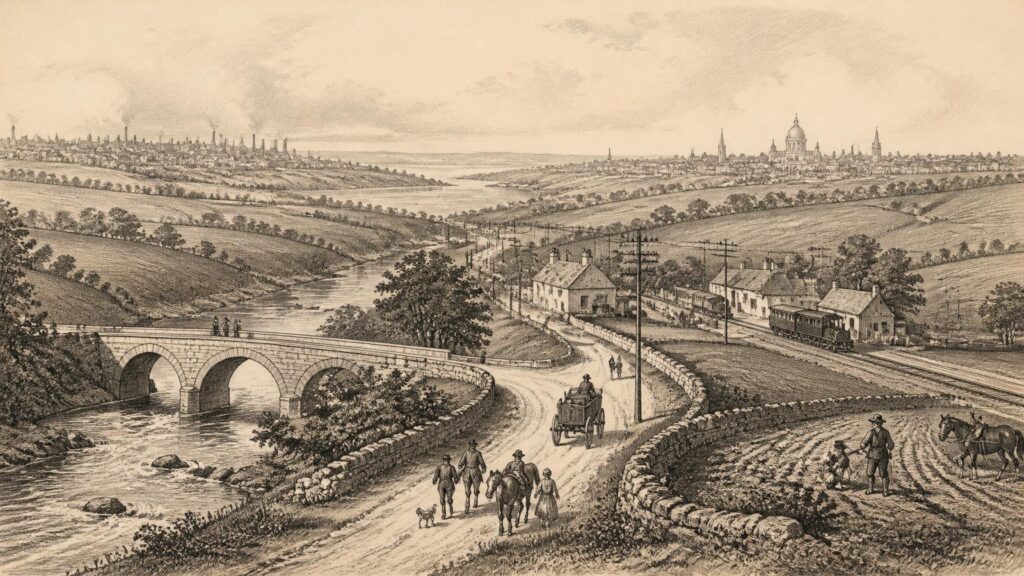
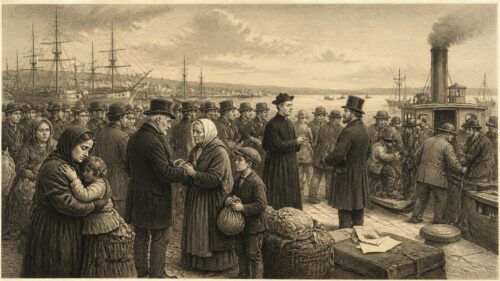
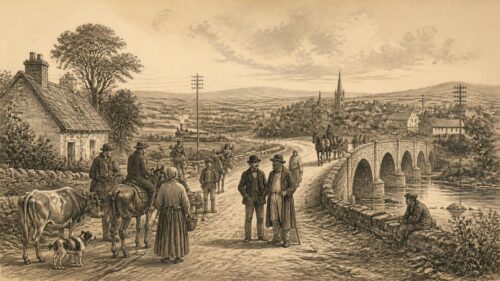
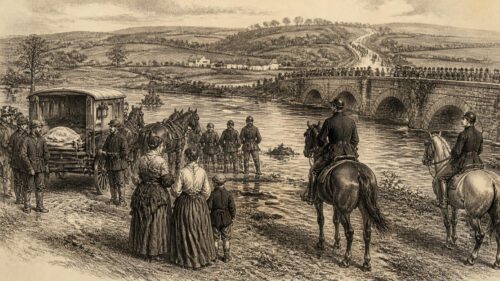
AI generated historical illustration, not a contemporary photograph.
At a Glance
Shared Island and North South co-operation belong to the most consequential—and most easily misunderstood—threads in modern Irish history. They concern neither an automatic route to constitutional unity nor a merely technical programme of public administration. Rather, they describe recurring attempts to organise practical relationships across a border created by partition, while accommodating profoundly different political allegiances, identities and constitutional aspirations.
Divided Island
The Irish border emerged from the constitutional upheavals of the early twentieth century. The Government of Ireland Act 1920 proposed separate institutions for Northern and Southern Ireland within the United Kingdom, while also providing for a Council of Ireland. That council was intended to permit co-operation between the two jurisdictions and, in the language of the time, potentially encourage unity by agreement. Yet the southern parliament envisaged by the Act never developed into an effective institution amid the revolutionary crisis and the electoral success of Sinn Féin. The machinery for all-Ireland co-operation therefore began life not as a settled arrangement but as an unrealised provision of a partition settlement that was itself rapidly overtaken by events.
The Anglo-Irish Treaty of December 1921 created the Irish Free State while allowing Northern Ireland to remain outside it, an option Northern Ireland exercised almost immediately. The Treaty retained an altered conception of a Council of Ireland, but the political conditions required to make it meaningful did not exist. The new border was not simply a line on a map. It marked separate systems of government, law, taxation, public services and political authority. It also cut through local economies, transport routes, family networks and social landscapes. People continued to cross it, trade across it and live with its consequences, but official co-operation was limited and frequently overshadowed by wider constitutional conflict.
It is tempting, in retrospect, to treat cross-border arrangements as an obvious practical necessity. History suggests otherwise. What looks administratively sensible can carry symbolic weight in a divided society. For many nationalists, closer North South links offered recognition that the island possessed shared interests and a larger national context. For many unionists, formal all-island bodies could suggest a weakening of Northern Ireland’s place in the United Kingdom. Those positions were neither fixed in every detail nor held identically by all individuals, but they shaped the political reception of almost every institutional proposal made during the twentieth century.
This is why North South co-operation must be understood alongside, rather than apart from, questions of sovereignty and consent. The recurring problem was how to allow joint work where common interests existed without requiring either tradition to surrender its constitutional position. The most enduring agreements did not solve that disagreement. Instead, they supplied procedures through which disagreement could be contained and practical business could continue.
Early Possibilities
Even in the decades after partition, the two parts of Ireland were never wholly separate in social or economic life. Agriculture, waterways, energy, tourism, fisheries, public health and transport all presented obvious cross-border questions. Informal contact, professional networks and particular statutory arrangements persisted. Nevertheless, high politics generally constrained what could be achieved. Relations between Dublin and Belfast were affected by the Irish state’s constitutional claim to the whole island, by the security concerns of Northern Ireland’s unionist government and by the often strained relationship between London and Dublin.
There were moments of cautious engagement. The meeting of Taoiseach Seán Lemass and Northern Ireland Prime Minister Terence O’Neill in 1965 has acquired a prominent place in public memory as a gesture of thaw after decades of official distance. Its importance should not be exaggerated into a lost settlement: it did not dissolve the constitutional dispute or create robust joint institutions. Yet it did demonstrate that contact between the heads of government on the island was possible, and it was associated with an interest in trade, economic development and practical relations. In historical terms, its significance lies partly in its limits. Personal diplomacy could open doors, but it could not by itself overcome entrenched political structures.
The worsening Northern Ireland crisis after the late 1960s altered the setting completely. Civil-rights protests, communal violence, the arrival of British troops in 1969, paramilitary campaigns and the collapse of the Stormont parliament in 1972 made security and constitutional reform urgent. In this setting, cross-border co-operation was no longer only a matter of economic rationality. It became bound up with the search for a political settlement, with policing and security, and with the need to recognise both British and Irish dimensions of Northern Ireland.
That transformation mattered. Earlier schemes for co-operation could be framed as optional improvements to administration. From the 1970s onward, institutional links across the border increasingly appeared as one component of a wider attempt to make Northern Ireland governable on terms acceptable to both communities and to both governments. This did not make them easier to establish. It made them more politically charged.
Sunningdale Experiment
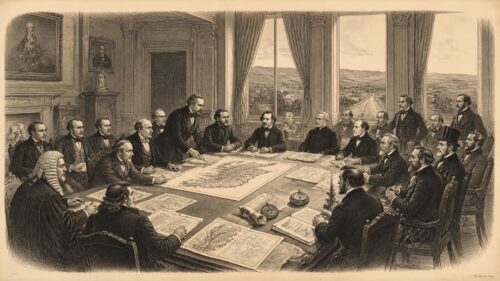
The Sunningdale Agreement of December 1973 was the first major effort during the Troubles to combine power-sharing within Northern Ireland with a formal Irish dimension. Negotiated by the British and Irish governments and the parties involved in the proposed Northern Ireland Executive, it envisaged a Council of Ireland composed of a Council of Ministers and a Consultative Assembly. The ministerial body was to include equal numbers from the Northern Ireland Executive and the Irish Government, act by unanimity and develop executive, harmonising and consultative functions.
The programme outlined at Sunningdale was strikingly practical. It contemplated work on natural resources, agriculture, fisheries, trade, industry, electricity, tourism, roads, transport, public-health advice, sport, culture and the arts. The language of efficiency was prominent: scarce expertise might be better used, duplication avoided and complementary activity encouraged. Such aims closely resemble later descriptions of cross-border policy. Yet the constitutional setting ensured that they could not be received as neutral administrative measures.
For supporters, the Council of Ireland offered a way to recognise relationships within the island without predetermining its constitutional future. For opponents, especially within unionism, it raised anxieties that authority would drift from Belfast towards Dublin and that a supposedly practical body would become a staging post towards Irish unity. The fear was political rather than merely bureaucratic. It reflected the belief that institutions create habits, loyalties and precedents, and that even a limited executive role could alter the constitutional balance.
The Sunningdale arrangements did not survive. The Northern Ireland power-sharing Executive collapsed in May 1974 amid intense loyalist opposition, including the Ulster Workers’ Council strike. It is inaccurate to reduce that outcome to one issue alone: industrial action, paramilitary intimidation, divisions within unionism, the fragility of the Executive and the wider violence of the period all mattered. Still, the Council of Ireland was a central focus of opposition. Sunningdale left a durable lesson for later negotiators. North South structures could not be detached from consent, legitimacy and the internal arrangements of Northern Ireland.
There is a common shorthand that the Belfast Agreement was “Sunningdale for slow learners”. It has been widely repeated, but it is a political aphorism, not an adequate historical explanation. It captures the continuity between the two settlements—power-sharing and an Irish dimension—but obscures crucial differences. The 1998 settlement rested on more extensive multi-party negotiations, explicit constitutional changes, referendums in both jurisdictions, a clearer consent principle, new rights provisions and a more elaborate set of interlocking institutions. Sunningdale was a formative precedent, but not a simple draft of what came later.
Governmental Dialogue
After Sunningdale, the British and Irish governments continued searching for ways to address Northern Ireland. The Anglo-Irish Agreement, signed at Hillsborough on 15 November 1985, was a major development in that search. It established the Anglo-Irish Intergovernmental Conference, giving the Irish Government a formal consultative role in relation to Northern Ireland affairs while affirming that Northern Ireland would remain part of the United Kingdom for so long as a majority there wished it to do so.
The Agreement was not itself a North South institution in the later Belfast Agreement sense. Its central mechanism was intergovernmental: Dublin and London, rather than an Executive in Belfast and the Irish Government, were the principal actors. Yet it was highly important to the history of co-operation. It formally connected the two governments in regular discussion of political, legal, security and cross-border matters. It also affirmed that the conflict could not be responsibly managed through unilateral British policy alone.
Unionist opposition to the Agreement was forceful and sustained. Many unionists regarded it as granting the Irish state an unacceptable voice in Northern Ireland’s internal affairs, particularly because it was concluded without unionist consent. Nationalists often saw it differently, as an overdue acknowledgement that Dublin had a legitimate interest in Northern Ireland and as a potential safeguard for minority rights. These contrasting readings illustrate a central feature of Irish political history: the same institutional arrangement may be understood as protection by one community and intrusion by another.
Despite these controversies, the Anglo-Irish Agreement helped establish practices of official contact and demonstrated that British-Irish relations could be institutionalised even in a period of continuing violence. It did not produce a comprehensive settlement, and it did not command cross-community acceptance in Northern Ireland. But its emphasis on regular dialogue, its attention to cross-border matters and its recognition of interdependent relationships contributed to the political groundwork from which the 1990s peace process grew.
The distinction between intergovernmental co-operation and North South co-operation remains important. The first concerns relations between the British and Irish states. The second concerns direct working relationships between the devolved administration in Northern Ireland and the Irish Government. These levels often overlap, but they are not identical. The architecture created in 1998 deliberately included both: one strand for North South relations and another for British-Irish relations across these islands.
Negotiated Settlement
The Belfast Good Friday Agreement of 10 April 1998 transformed the constitutional and institutional context. It was endorsed in referendums held on 22 May 1998 and entered into force on 2 December 1999. Its importance lies not simply in establishing new bodies but in setting those bodies within a linked settlement covering internal government in Northern Ireland, North South relations and East West relationships.
Strand Two of the Agreement established the North South Ministerial Council. The Council brings together ministers from the Northern Ireland Executive and the Irish Government to develop consultation, co-operation and action on matters of mutual interest. Its wording is careful. It is not a parliament for the island, nor a superior authority over either administration. Decisions are made by agreement, and each side remains accountable within its own democratic and legal system: the Northern Ireland Assembly on one side and the Oireachtas on the other.
This design represented an attempt to answer objections that had haunted earlier proposals. The North South Ministerial Council was rooted in the authority of the devolved institutions in Northern Ireland, rather than operating as a structure imposed solely by the two governments. Its work was tied to cross-community participation, a requirement reflected in the Northern Ireland Act 1998. Conversely, the Council gave formal and continuing expression to the Irish dimension sought by nationalists. Neither objective could stand securely without the other.
The Agreement itself described the North South Ministerial Council and the Northern Ireland Assembly as mutually interdependent. This was more than a constitutional formula. It meant that stable cross-border co-operation was expected to depend on functioning devolved government, while the broader settlement required that North South commitments be taken seriously. That interdependence has had practical consequences whenever devolved institutions have been suspended or absent. It reveals that co-operation is not an optional annex to the Agreement but part of its internal balance.
The constitutional provisions accompanying the Agreement were equally significant. The British Government recognised that a change in Northern Ireland’s constitutional status would occur only with the consent of a majority there. The Irish state amended Articles 2 and 3 of its Constitution after the referendum. These changes did not end aspirations to a united Ireland, nor did they require anyone to abandon a British identity. They redefined the framework: constitutional change would rest on consent, while relationships across the island could be developed in the meantime.
Institutional Practice
The North South Ministerial Council began work on 2 December 1999. It oversees twelve areas of co-operation, while six North South Implementation Bodies were established to carry out specified functions on a cross-border or all-island basis. The distinction is useful. In some fields, ministers co-ordinate policy while each jurisdiction retains its own delivery system. In other fields, a dedicated body operates under policies agreed by the Council.
The six implementation bodies are Waterways Ireland, the Food Safety Promotion Board, the Trade and Business Development Body, the Special EU Programmes Body, the North South Language Body and the Foyle, Carlingford and Irish Lights Commission. Their titles indicate the deliberately varied character of the system. Waterways, food safety, trade promotion, European funding programmes, languages and shared marine loughs are not interchangeable subjects. Together, however, they show how the Agreement translated general commitments into working organisations with defined remits.
The Language Body includes agencies concerned with the Irish language and Ulster-Scots. That structure is historically revealing. It reflects an effort to recognise cultural plurality rather than treating one tradition as the sole expression of the island’s cultural inheritance. The arrangement does not remove disagreement about language policy or identity. It does, however, make room for institutional recognition of more than one cultural tradition within North South co-operation.
The Council’s wider areas of work have included agriculture, education, environment, health, tourism, transport, sustainable development, inland fisheries and aquaculture, and other agreed fields. Their significance is often most visible at a local rather than ceremonial level: food safety information, navigable waterways, tourism routes, disease control, research partnerships, environmental management and shared services. This practical scale is not evidence that the work is politically insignificant. On the contrary, it is precisely because daily services touch questions of jurisdiction, finance and accountability that agreed procedures matter.
The Joint Secretariat at Armagh supports the Council and is staffed by officials from Northern Ireland and the Irish Civil Service. Its location has symbolic as well as administrative resonance. Armagh is associated with ecclesiastical and political histories extending across the island; placing a joint secretariat there avoided making either Belfast or Dublin the exclusive centre of the new relationship. Such symbolism should not be romanticised, but it illustrates the care given to institutional balance.
Evidence of the system’s endurance should not be mistaken for evidence of uninterrupted ease. The Council’s operation has been affected by interruptions to devolved government. Where an Executive is not functioning, ministerial participation from Northern Ireland cannot proceed in the ordinary way. This confirms the Agreement’s premise that internal power-sharing and North South co-operation are connected. It also demonstrates a historical reality: institutions can preserve a framework and a professional network, but political authority cannot be indefinitely replaced by administrative continuity.
European Context
European integration supplied an important setting for North South co-operation long before the Belfast Agreement. Ireland and the United Kingdom entered the European Economic Community together in 1973. Common membership did not remove political conflict, but it placed the two states within shared legal, economic and policy structures. Over time, European programmes encouraged cross-border projects and created habits of collaboration among public bodies, businesses, universities and community organisations.
The Special EU Programmes Body, created under the 1998 arrangements, is a particularly clear example of this connection. It has managed European Union programmes designed to support peace, reconciliation and cross-border co-operation. Such funding did not create peace by itself, and it would be historically careless to claim that grants settled constitutional questions. Yet material investment in shared projects helped give institutional expression to the idea that relationships could be built through practical work as well as high-level negotiation.
Brexit reintroduced uncertainty into this landscape. The United Kingdom left the European Union on 31 January 2020, and the principal provisions of the Protocol on Ireland and Northern Ireland took effect on 1 January 2021. The Protocol, subsequently adjusted through UK-EU arrangements, sought to address the distinctive problems created by the land border on the island. Its provisions have been politically contested, particularly in unionism, but its stated purpose included maintaining the conditions necessary for continued North South co-operation under Strand Two.
The historical point is not that the European Union replaced the Belfast Agreement, or that North South co-operation depends on a single external institution. It is that common European membership made some forms of co-operation easier and less exceptional. Brexit exposed how many arrangements had relied upon shared rules, funding streams and regulatory assumptions. It also showed that the border remains a practical as well as constitutional question, even when physical infrastructure is absent from much of its length.
Shared Island
The Shared Island initiative is a more recent Irish Government policy framework. It was launched in 2020 and is co-ordinated through a unit in the Department of the Taoiseach. Its declared purpose is to use the potential of the Belfast Good Friday Agreement to promote co-operation, connection and mutual understanding across the island, engaging with all communities and traditions while supporting research and dialogue about a shared future.
The phrase “Shared Island” can invite misunderstanding because it is used in a political environment where the constitutional future of Ireland is actively debated. As a matter of documented policy, however, the initiative is not identical to a constitutional blueprint for Irish unity. Its published emphasis includes practical investment, North South and all-island collaboration, the North West and border regions, civic dialogue, research and reconciliation. Supporters may see such work as valuable preparation for closer future relationships; critics may question its assumptions, priorities or language. A historian should distinguish these interpretations from the programme’s formal description.
The initiative’s funding has supported projects and programmes in fields such as research, infrastructure, tourism, environmental action, community links, culture and emergency co-operation. The Government’s 2025 programme committed further funding through 2035. Such announcements demonstrate sustained political backing from Dublin, but they should not be treated as proof of an all-island consensus. Co-operation that is durable in a plural society requires consent, transparency and the capacity of institutions on both sides of the border to participate.
The historical novelty of Shared Island lies less in the idea that cross-border problems deserve joint attention—earlier generations repeatedly made that argument—than in its combination of investment, research and public conversation. The initiative attempts to connect large policy questions with everyday experience: roads and rail, health and emergency services, higher education, culture, climate adaptation and the economic life of border communities. Whether it succeeds will be judged not only by expenditure or conferences but by whether it broadens trust across political traditions.
Contested Meanings
North South co-operation has never possessed one settled meaning. Nationalist and republican opinion has often regarded it as recognition of the island’s interdependence and as compatible with an aspiration to unity by consent. Unionist opinion has often approached it cautiously, especially where arrangements appear capable of diluting Northern Ireland’s constitutional link with Great Britain or bypassing its institutions. Others, including many people whose primary concern is neither nationalism nor unionism, may assess co-operation largely in terms of services, costs, opportunity and local benefit.
These perspectives cannot responsibly be collapsed into caricature. Unionism is not simply opposition to every form of co-operation; there have been unionist participants in North South institutions and support for practical collaboration where it is beneficial and properly accountable. Nationalism is not simply indifferent to safeguards; the 1998 settlement itself incorporated consent and power-sharing as essential elements. Nor are all public attitudes reducible to constitutional identity. The purpose of historical analysis is not to declare one reading correct, but to show why institutional details carry different meanings for different communities.
Folklore and political memory also require care. Stories of a naturally seamless island, broken only by politicians, overlook the long-standing diversity of regional economies, identities and governmental systems. Conversely, claims that the border made co-operation inherently impossible ignore the many relationships that survived and the repeated official efforts to develop common work. The documented record supports neither myth. It shows an island linked by geography and social life, divided by constitutional authority, and repeatedly obliged to negotiate the consequences.
The most persuasive interpretation is that North South co-operation functions best when it does not demand an immediate answer to every constitutional question. The Belfast Agreement made that possible by pairing co-operation with consent, acknowledging British and Irish identities, and placing institutions within democratic accountability. That is not a guarantee against conflict. It is a framework for managing conflict without making ordinary practical contact impossible.
Historical Balance
From the dormant Council of Ireland provisions of 1920, through Sunningdale and the Anglo-Irish Agreement, to the North South Ministerial Council and Shared Island initiative, a consistent historical pattern is visible. Proposals for co-operation have tended to emerge where common practical needs meet unresolved constitutional division. Their success has depended less on rhetorical claims about inevitable unity or permanent separation than on whether participants can accept rules, safeguards and reciprocal authority.
The Belfast Good Friday Agreement remains the decisive framework because it treats relationships within Northern Ireland, across the island and between Britain and Ireland as connected. Its creators did not pretend that historic allegiances would disappear. They built institutions on the assumption that they would continue. North South arrangements were therefore designed neither as a substitute for Northern Ireland’s devolved institutions nor as an instrument of unilateral constitutional change. They were designed as agreed channels for action in areas where co-operation could yield mutual benefit.
Shared Island belongs within that longer story. It draws on the language and possibilities of the 1998 settlement while operating in a changed context of Brexit, renewed constitutional debate, climate pressures and uneven regional development. Its future significance will depend on evidence rather than aspiration: on projects delivered, relationships sustained, scrutiny accepted and the willingness of people from different traditions to regard co-operation as legitimate.
Irish history offers no simple law that shared interests overcome political difference. It offers something more modest and more useful. It shows that relationships across the border have endured when institutions recognise difference honestly, protect democratic consent and make room for practical work. The island may be geographically shared; the terms on which it is politically and socially shared remain matters of continuing negotiation.

The article presents North South co-operation as most durable when practical gains are matched by consent, parity and accountability within separate democratic systems. Its comparison of Sunningdale with the Belfast Good Friday Agreement suggests that institutional design alone cannot secure acceptance; participation, constitutional safeguards and political circumstances shape how identical-looking arrangements are understood. Shared Island initiatives may therefore carry symbolic meaning even when focused on transport, health or environmental problems. This raises a question: should success be measured through cross-border benefits or through its capacity to sustain confidence between communities with constitutional aspirations, and how might those aims be balanced?