

Learning Ireland
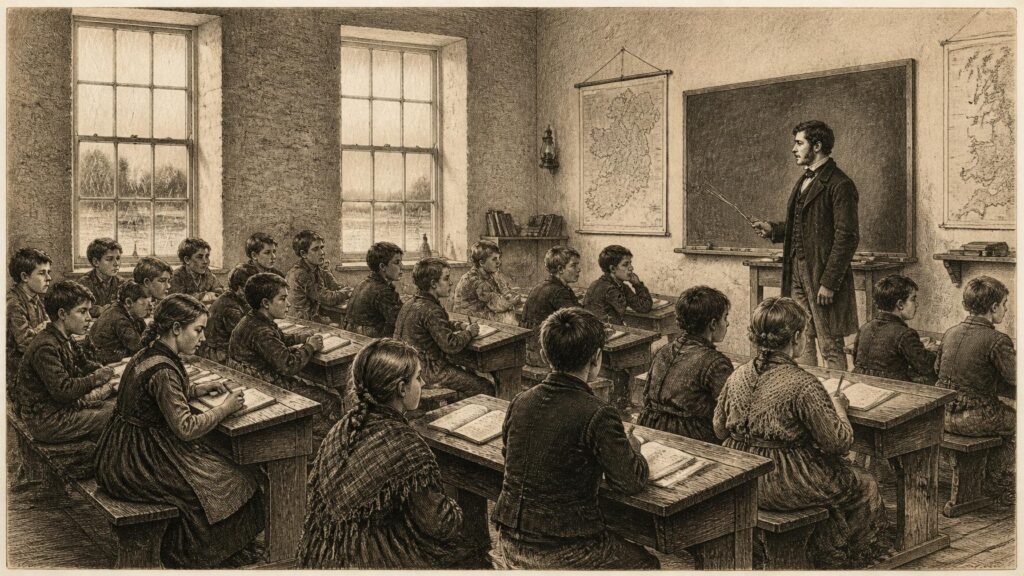
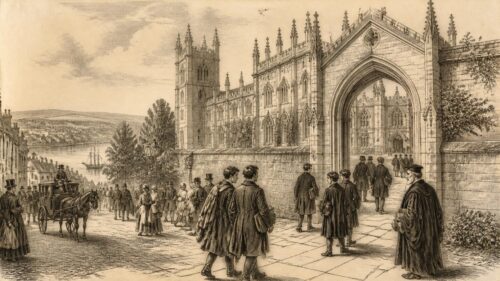
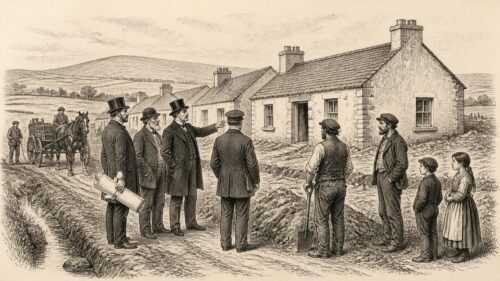
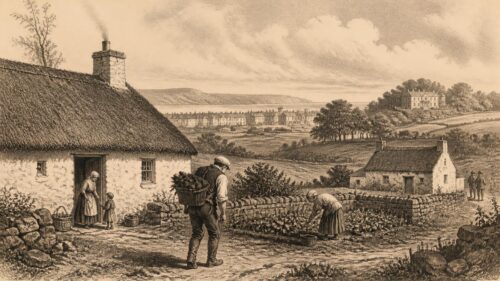
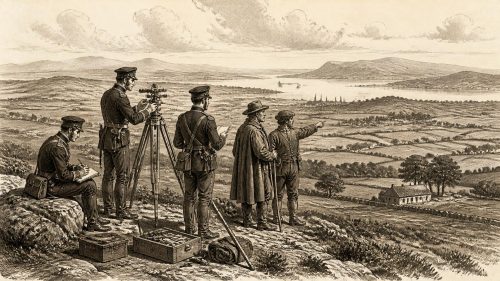
AI generated historical illustration, not a contemporary photograph.
At a Glance
The history of education in Ireland is not a simple ascent from ignorance to enlightenment. It is a record of determined parental demand, local initiative and intellectual ambition, but also of poverty, unequal access, religious authority, linguistic change and State power. Schools became places where children learned letters and arithmetic; they also became arenas in which communities disputed faith, nationality, social rank and the proper limits of government.
Early Traditions
Long before a State-supported national school system appeared, people in Ireland sought and supplied education through a varied patchwork of arrangements. Learning belonged to households, churches, charitable bodies, private teachers, classical academies and small local schools. Its availability was uneven, and the evidence is necessarily uneven too: surviving descriptions tend to favour inspectors, clergy, travellers and better-resourced institutions over the daily experience of poor families. Yet the surviving record makes one conclusion secure. The creation of the National Board in 1831 did not introduce learning into an otherwise uneducated country; it attempted to reorganise, finance and regulate a field that was already active.
The best-known component of that earlier landscape is the hedge school. The phrase has acquired great symbolic force. In popular memory it evokes a Catholic teacher conducting forbidden lessons beneath a hedge, at continual risk from hostile law and authority. That image contains a historical truth about restrictions on Catholic education in the penal era, but it should not be treated as a photograph of ordinary practice. Scholars have shown that so-called hedge schools occupied many settings: cabins, barns, rented rooms, chapels and purpose-built spaces as well as outdoor sites. They were usually fee-paying, often precarious, and differed greatly in quality and curriculum. Some supplied elementary reading, writing and reckoning; others offered Latin, mathematics, surveying, bookkeeping, literature or elements of Greek.
The label therefore describes a loose social phenomenon rather than a single institution. It is misleading to imagine a wholly clandestine educational underground continuing unchanged until 1831. Penal legislation and the wider confessional order constrained Catholic schooling, especially its formal and institutional forms, but enforcement and local conditions varied over time. By the late eighteenth and early nineteenth centuries, small schools could be found widely across the countryside. A University College Dublin economic-history study of pre-Famine attendance argues from contemporary testimony and quantitative evidence that demand for basic literacy and numeracy was considerable. Education was often paid for in small sums by households whose material circumstances remained insecure.
This matters because it corrects a condescending narrative in which rural Irish families are cast merely as passive recipients of improvement from above. Parents made difficult calculations about fees, labour and distance. A child might attend seasonally, leave during harvest or be withdrawn when illness, emigration, bereavement or a household crisis intervened. Schooling was an aspiration, but it competed with the immediate value of children’s work. Girls as well as boys appeared in local schools, although their opportunities, subjects and routes into paid employment were shaped by gendered expectations. The historical question is not whether families valued education; abundant evidence suggests that many did. The harder question is what kind of education they could afford, reach and sustain.
Religious organisations were central long before the national system. Protestant charitable schools, parish provision, diocesan initiatives and later Catholic teaching congregations all formed part of the educational landscape. Edmund Rice’s schools for poor Catholic boys, begun at the opening of the nineteenth century, were an important example of organised Catholic educational philanthropy. Such initiatives cannot be reduced to a single purpose. They offered instruction and opportunity, but they also cultivated religious identity and moral discipline. That combination would remain fundamental to Irish schooling well into the twentieth century.
National System
The National Board of Education, established in 1831 under British administration, marked a major institutional turn. Its declared aspiration was to provide elementary education in which children of different denominations might receive secular instruction together, with religious teaching separately arranged. In principle, this was a non-denominational design intended to reduce sectarian conflict while extending schooling. In practice, it entered a society in which churches, clergy, parents and local patrons had strong and differing views about religious formation. The system’s architecture was therefore a compromise from the outset.
Rather than building a comprehensive network of State-owned schools, the commissioners recognised and funded local schools whose managers accepted the rules. The arrangement connected public finance and inspection to local ownership and patronage. It enabled rapid expansion, especially in places where communities or religious interests could provide a site and management. It also embedded a pattern that has proved remarkably durable: schools publicly supported and centrally regulated, yet commonly under private or denominational patronage rather than direct State ownership.
The scale of growth was striking. UCD’s centenary study of schooling in 1916 records that 4,547 national schools were open twenty years after the scheme began, enrolling 511,239 pupils. The same study shows both the initial breadth of the project and its limits. Schools regarded as multi-denominational formed a declining proportion of the system over the nineteenth century. By 1900, denominational realities had largely prevailed. It is more accurate to say that the national system created a publicly financed framework within which denominational education became predominant than to describe it as either wholly secular or wholly clerical.
The curriculum centred on the tools of basic literacy and numeracy: reading, writing and arithmetic. This was not politically neutral. English was the operative language of administration, commerce and much formal advancement. Schooling through English could furnish pupils with useful skills, including skills that emigrants carried to Britain, North America and elsewhere. At the same time, it contributed to the long-term displacement of Irish in many communities. The relationship was not mechanically causal: famine, mass migration, changing labour markets, social prestige and family strategy all affected language shift. Nevertheless, a school system in which English predominated became one important institution in that transformation.
The Famine years exposed the fragility of education as well as life. Death, eviction, destitution, emigration and family disruption affected attendance, local finance and children’s capacity to learn. It would be insensitive to portray schools as standing outside that catastrophe. In some places they provided a measure of routine and relief; in others they were weakened by the same social collapse that engulfed their pupils. The expansion of national schooling continued afterwards, but the population it served had been altered profoundly.
Inspection, training and payment systems shaped classroom practice. Teachers worked under close administrative direction and, at various points, under systems that attached funding or professional consequences to measurable results. These arrangements encouraged attention to examined subjects and attendance, but they could also narrow teaching. Large classes, inadequate buildings, scarce materials and poorly paid staff constrained ideals. The nineteenth-century schoolroom was not a uniform experience. One-room rural schools, urban schools, convent schools and schools managed by different denominations could differ sharply in resources and atmosphere.
Faith Governance
Religion was not simply an added subject in Irish education; it influenced ownership, staffing, ethos, daily routine and public controversy. Catholic emancipation in 1829 and the enormous expansion of Catholic institutions after the Famine altered the balance of educational provision. Religious sisters, brothers and clergy founded and staffed schools across the country. Protestant churches and organisations maintained their own educational interests. For many parents, a school’s religious character was inseparable from trust: it concerned the moral formation of children and the survival of a community’s identity.
That reality helps explain why the original aspiration to mixed schooling encountered difficulty. It is tempting to judge nineteenth-century actors solely by modern expectations of pluralism, but historical explanation requires attention to their circumstances. In a society marked by long histories of religious discrimination and political conflict, communities often feared that schooling controlled by another denomination would endanger their children’s faith. Denominational structures answered those fears for many families. They also hardened boundaries and made the system less capable of offering common schooling across them.
The religious orders’ contribution included real educational labour: teaching large numbers of children, establishing secondary schools, training teachers and sustaining institutions where public resources were limited. Any credible history must acknowledge that contribution. It must also recognise the authority that such provision conferred. Public funding and private religious management formed a partnership in which accountability could be diffuse. The State set rules and paid grants; patrons owned property or exercised influence; managers ran institutions; families often had limited practical alternatives.
The same pattern appeared in more troubling settings. Industrial and reformatory schools were not ordinary national schools, yet they belong in the history of education because they joined instruction to residential confinement, welfare policy and discipline. The Ryan Report, made publicly available through UCD’s Industrial Memories project, documents how the system developed under nineteenth-century legislation and how religious bodies became major managers. Its findings require careful language. Not every school, staff member or pupil had the same experience, and the record is not a warrant for collective caricature. But the report established that many children in institutions suffered neglect and abuse, and that educational provision inside industrial schools could be markedly inferior to that available outside them.
These facts change the moral balance of any celebratory account of educational expansion. School attendance cannot by itself be equated with educational benefit. A child removed from family, required to labour, or taught in an institution designed primarily around control had a fundamentally different experience from a child attending a local school. The historical record therefore asks readers to distinguish the expansion of schooling from the fulfilment of children’s rights.
Language Politics
Language is among the clearest examples of education serving more than academic ends. The early national system did not make Irish its normal medium of instruction. For officials and many teachers, English was the language of books, administration, employment and social advancement. For Irish-speaking families, however, this could produce a difficult bargain. English-language schooling might offer economic opportunity, especially in an emigrant world, while simultaneously making the home language seem less useful or less prestigious.
It would be too simple to accuse every nineteenth-century teacher of consciously seeking cultural destruction. Many worked within prescribed systems and responded to what parents believed would help children survive. Equally, it would be wrong to deny that policy and curriculum could carry cultural consequences. The exclusion or marginality of Irish in formal education gave institutional weight to English at a moment when other pressures on Irish-speaking communities were intense.
By the later nineteenth century, cultural revivalists increasingly regarded schools as essential to national renewal. The Gaelic League pressed for greater recognition of Irish, and bilingual initiatives emerged in the early twentieth century. UCD research on Kerry schoolgirls notes that, from 1904, a bilingual programme permitted a syllabus through Irish in Irish-speaking and bilingual districts where teachers could deliver it. This was a significant change, though its reach depended on local capacity, teacher competence and official support. It should not be mistaken for an immediate reversal of language shift.
After independence, Irish acquired a new symbolic and official place in education. The Free State sought to use schools in the restoration of the language and the formation of a distinct national culture. Irish became a required subject and, in some settings, a medium of instruction. These policies expressed a powerful belief that political independence required cultural recovery. They also generated practical problems. Many teachers had themselves been educated chiefly through English; resources and training were limited; and pupils’ everyday linguistic worlds often differed from the ideal imagined in policy.
The history is thus neither one of total failure nor of uncomplicated revival. Schools preserved, taught and normalised Irish for generations of pupils; Irish-medium education later developed through Gaeltacht schools and gaelscoileanna. Yet compulsory study did not automatically make Irish the habitual community language of most learners. The distinction between learning a language as a subject and living through it socially is crucial. It remains an important historical lesson in the limits of schooling as an instrument of cultural policy.
Unequal Pathways
Primary education expanded much faster than access to secondary or higher education. The Intermediate Education Act of 1878 created a system of public examinations and results-based grants for secondary schools. It opened a formal route beyond elementary schooling for girls as well as boys, an important development in principle. Yet fees, geography and social position continued to determine who could remain in education. Secondary schools were concentrated where families could support them, and examination success often reflected access to time, books, coaching and stable domestic circumstances.
The examination system had lasting consequences. It supplied recognised credentials and helped create a national framework for advancement. It also encouraged curricula that rewarded particular academic subjects, notably languages and mathematics. Technical, practical and vocational learning could be treated as secondary in status, even when it responded more directly to local employment. The tension between a prestigious academic route and vocational preparation did not begin in the twentieth century; it was built into the changing educational landscape of the later nineteenth century.
Attendance law addressed another barrier. Compulsory attendance for children aged six to fourteen was introduced in 1892, but compulsion on paper did not end poverty or child labour. Families could still need children’s earnings or help at home, and enforcement varied. UCD’s account of education in 1916 records that attendance dropped sharply among older pupils and that most had left school by fourteen. Compulsory schooling raised expectations and enrolment, but it did not abolish the economic conditions that made early departure rational for many households.
Literacy figures nevertheless demonstrate profound change. Census evidence cited in historical research shows a substantial fall in recorded illiteracy between the mid nineteenth century and the early twentieth century. Such statistics should be read carefully: the ability to read and write was self-reported or reported within census categories, and literacy is not identical to broad education. Even so, the direction of change is unmistakable. The national system, together with family demand, teachers’ work and wider social transformation, brought basic literacy to far more people than before.
Gender complicates the story. Girls’ participation in national schools was substantial, and falling illiteracy among girls was a major achievement. Yet equal enrolment did not guarantee equal opportunity. Curriculum, family duties, occupational expectations and access to post-primary education remained gendered. Women religious were among the most important providers of girls’ education, creating opportunities unavailable in earlier periods, while also transmitting particular ideals of femininity, domesticity and religious vocation. Historical assessment must hold both truths together.
Independent State
The revolutionary and early Free State years brought education into debates about sovereignty, citizenship and national reconstruction. The Democratic Programme of the First Dáil envisaged a duty to secure children’s welfare and education, while the new State confronted damaged finances, entrenched patronage structures and widespread rural poverty. Independence did not produce a wholly new school system. It inherited buildings, staff, examinations, administrative habits and the central role of churches. Change was often layered onto existing institutions rather than imposed upon a blank slate.
The 1937 Constitution gave education a distinctive place. Article 42 acknowledges the family as the primary and natural educator, protects parental freedom to provide education at home or in private schools, requires a minimum education, and provides for free primary education while allowing aid to private and corporate initiative. This language constitutionalised a settlement in which parental rights, religious and moral formation, public responsibility and non-State provision coexist. It helps explain why debates over school patronage and ethos have carried such constitutional as well as political weight.
The constitutional text should not be read as a complete description of lived reality. Families did not enter the system with equal means, and children did not all receive equal educational support. Rural isolation, disability, institutionalisation and household poverty continued to matter. The State’s commitment to free primary education was important, but post-primary schooling remained beyond the reach of many families for cost and distance reasons. For much of the twentieth century, completing primary school was still the expected endpoint for a considerable portion of the population.
At the same time, the independent State expanded teacher training, curriculum development, vocational provision and administrative capacity. Education was increasingly seen not only as religious and civic formation but as a foundation for economic development. That shift became especially visible after the 1950s, when policy makers confronted emigration, industrial change and the need for a more educated workforce. It did not replace older ideals; it joined them.
Expanding Access
The introduction of free post-primary education in 1967 was one of the most consequential changes in modern Irish social history. Government approval came in November 1966, and the scheme brought together free tuition, transport and supports for pupils in need. It is rightly associated with Minister for Education Donogh O’Malley, though it also depended upon civil servants, teachers, school managers, transport providers, families and a broader climate of reform. Great reforms are seldom the achievement of one person alone, but individual political decisions can matter decisively.
The importance of transport should not be understated. In a rural country, a nominally free secondary education would have been of limited value if children could not reach a school. National transport schemes made access more practicable beyond towns and cities. They did not eliminate every barrier: uniforms, books, family income, travel time and local school capacity still mattered. Yet the combined effect of fee abolition and transport altered what many families could imagine for their children.
This was a change in expectation as much as in administration. Secondary schooling became increasingly normal rather than exceptional. The long-term effects reached into employment, higher education, family aspirations and Ireland’s changing economy. It would be historically careless, however, to claim that free post-primary education alone caused later economic transformation. Economic policy, international investment, demographic change, expanded higher education and many other factors were involved. The supportable conclusion is narrower and still significant: widening access to second-level education enlarged the pool of people able to pursue further study and skilled work.
The late twentieth century also brought formal legislation intended to clarify rights and responsibilities. The Education Act 1998 set out a statutory framework for the education system, recognising the roles of students, parents, teachers, patrons and the Minister. It reflected a language of partnership and learner welfare more explicit than that of earlier eras. Yet the old historical questions did not disappear. Who controls a school? What place should religion hold? How should minority beliefs be accommodated? How can disability, disadvantage and language difference be addressed? These remained live issues because they were rooted in the system’s long development.
Institutional Shadows
A mature history of Irish education must not isolate institutional abuse as an unfortunate footnote. The industrial and reformatory school systems made education part of a wider apparatus of child welfare, poverty policy and social control. Children entered for varied reasons, including bereavement, poverty, neglect allegations, offending and family crisis. The categories used by officials could conceal the structural causes of hardship. A child’s presence in an institution was not proof of moral failure by that child or family.
The Ryan Report documented systemic failures in institutions run over many decades. Its evidence included poor educational standards in internal schools, the withdrawal of some children from class for work, and the lasting harm suffered by former residents. This is not folklore, nor is it an allegation resting only on retrospective generalisation. It is the conclusion of an official inquiry based on extensive testimony and documentary investigation. The appropriate historical response is neither sensationalism nor evasion: it is to state clearly that educational institutions entrusted with vulnerable children often failed them gravely.
That history has influenced later understandings of children’s rights, inspection, safeguarding and accountability. It also warns against treating institutional respectability as evidence of humane practice. Buildings, uniforms, examination results and religious language may convey order; none guarantees care. Education has always involved power between adults and children. The central historical question is how that power was checked, and whose voices were heard when it failed.
Living Legacy
Ireland’s educational inheritance is therefore mixed but substantial. The country developed widespread primary schooling, sharply improved literacy, widened women’s educational participation, extended secondary access and built institutions of further and higher learning. These achievements were real, produced through the efforts of generations of pupils, parents and teachers. They should not be diminished by acknowledging the constraints and injustices that accompanied them.
Equally, the past remains visible in present structures. The continuing importance of patrons, the place of religious ethos, debates about Irish-medium schooling, examination pressure, rural access and unequal outcomes all have historical roots. History does not dictate policy, but it explains why simple solutions can prove elusive. A school system is not merely a collection of classrooms; it is an accumulation of legal settlements, local loyalties, cultural aspirations and remembered experiences.
The enduring lesson is that education in Ireland has never been solely about transmitting knowledge. It has been a means by which families sought security, churches sought continuity, governments sought capable citizens, reformers sought equality and communities sought cultural survival. Those purposes have sometimes reinforced one another and sometimes collided. To understand Irish education historically is to understand that tension—and to recognise that its future, like its past, will be shaped by choices about whose learning is valued, who is included and who has the power to decide.
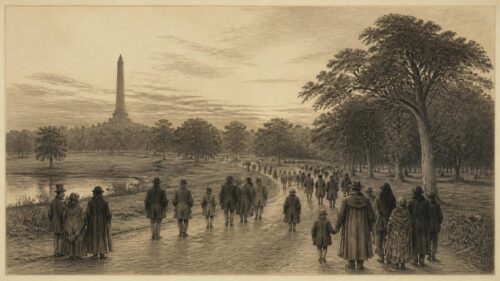
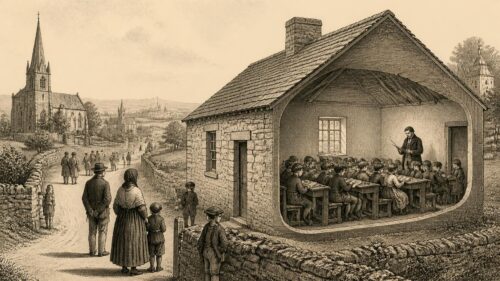
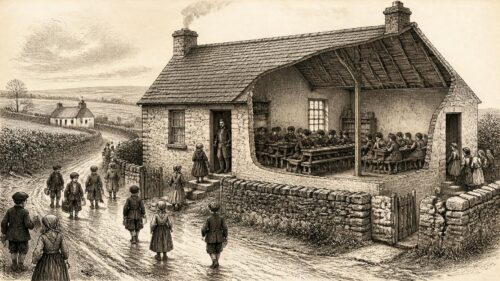
The article presents Irish education as a double inheritance: schools expanded literacy and opportunity, yet their governance, language policies and unequal access could reinforce social divisions. Particularly striking is the tension between English-language schooling as a route to employment and migration, and its role in diminishing Irish within community life. This suggests that educational success cannot be measured solely by enrolment, examinations or literacy rates, because cultural continuity and children’s lived experiences matter. How should we assess the legacy of Irish schooling when policies that offered advancement simultaneously reshaped linguistic identity, and what evidence reveals families’ understanding of that trade-off?