

Trust Tested
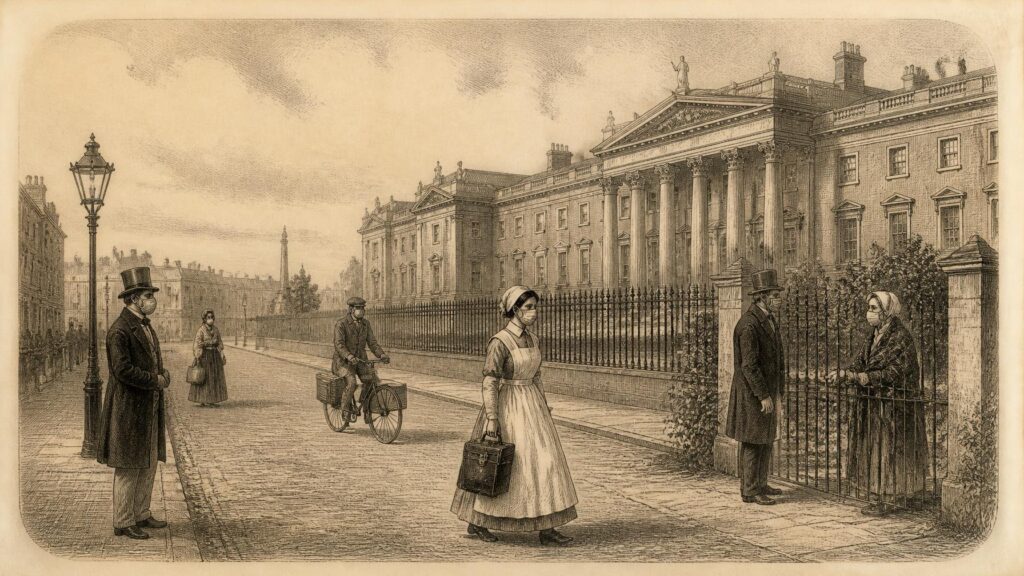
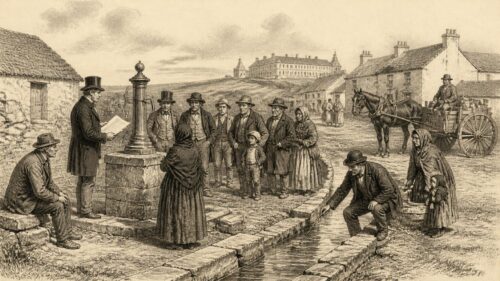
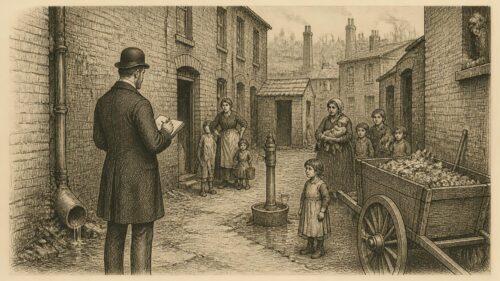
AI generated historical illustration, not a contemporary photograph.
At a Glance
COVID-19 made public trust a matter of national consequence in Ireland. The pandemic required people not merely to obey laws, but to accept repeated, disruptive and often frightening changes to ordinary life: remaining apart from relatives, closing businesses, cancelling funerals, wearing masks, testing, isolating, accepting vaccination and yielding private information for public-health purposes. The Irish record shows neither a story of simple national unity nor one of universal coercion. It is instead a history of emergency government dependent on consent, communication, institutional credibility and the practical fairness of the burdens imposed.
Historical Frame
In historical terms, the COVID-19 pandemic belongs to a long Irish experience in which disease has exposed the capacities and limits of public authority. Cholera, tuberculosis, influenza and other epidemics had previously made health inseparable from poverty, housing, migration, local administration and the relationship between state and citizen. The crisis beginning in 2020 differed in its scientific resources, global speed and digital infrastructure, but it retained an older political truth: public-health measures work most effectively when people regard institutions as competent, candid and concerned for the common good.
Trust is sometimes treated as a vague emotion. During COVID-19 it had practical consequences. A person who trusted the information available was more likely to alter daily behaviour, seek testing, isolate after exposure, accept a vaccine or comply with a restriction even where detection and enforcement were improbable. Conversely, distrust could turn ambiguity into suspicion. A change in advice that scientists understood as a response to better evidence might appear to others as proof of deception. A policy intended to reduce risk could be experienced as arbitrary if its rationale was not intelligible or its effects were unevenly distributed.
Ireland entered the emergency with institutions shaped by its constitutional democracy, a centralised Department of Health, the Health Service Executive, public-health expertise, local community networks and a political culture in which national broadcasting and official briefings still held substantial authority. Yet none of these facts guaranteed confidence. The health system had well-known pressures before the pandemic. The State also had to govern a rapidly changing threat with incomplete knowledge, while much of the population encountered information through social media as well as through official channels.
The historical task is therefore not to ask whether Ireland “trusted science” in the abstract. It is to examine how confidence was made, tested, lost, restored or withheld in particular settings. Those settings included official briefings, hospitals, nursing homes, workplaces, schools, vaccination centres, family homes and smartphones. They also included the Oireachtas, where emergency restrictions and their implications for civil liberties received scrutiny. The pandemic was national in scale, but trust was always experienced personally and locally.
Emergency Governance
The first phase of the crisis brought a sharp concentration of public attention upon official expertise. The National Public Health Emergency Team, generally known as NPHET, became a central feature of Irish public life. Chaired by the Chief Medical Officer, it assessed evidence and advised government as the situation developed. Government retained the power to make decisions, but the public presentation of medical advice gave NPHET an unusually visible role in democratic life.
This arrangement had strengths. In a fast-moving emergency, it created a recognisable source of expert advice and allowed public messages to be repeated with consistency. The prominence of public-health officials could reassure people that decisions were being informed by epidemiology and clinical knowledge rather than only by immediate political convenience. The Department of Health’s early published material also recorded that pandemic preparation, contact tracing and coordination with international health bodies had begun before widespread transmission took hold in Ireland.
Yet emergency governance carries a built-in difficulty. Ministers must balance advice about infection with education, employment, welfare, business viability, mental health, constitutional rights and social cohesion. Experts may identify risk; elected government must make choices between risks. During COVID-19, the distinction could become blurred in public understanding. Some citizens wanted political leaders to follow medical advice closely; others feared that complex social choices were being presented as if they were merely technical necessities.
This did not mean that scientific advisers lacked legitimacy. Rather, it showed why the language of decision-making mattered. Public trust is strengthened when institutions explain what is known, what remains uncertain, who has made a decision and why a particular trade-off has been chosen. It is weakened when responsibility appears to drift between officials and ministers, or when the public cannot see how competing harms have been weighed. The issue was not whether pandemic policy should have been expert-informed; plainly it had to be. The issue was how expert advice could be connected openly to democratic accountability.
The emergency also altered normal rhythms of government. Regulations and guidance changed repeatedly. Restrictions were introduced, eased, adjusted and reintroduced as infection patterns, variants, hospital capacity and vaccination altered the balance of risk. Such movement was not in itself evidence of failure. A rigid policy in an evolving pandemic would have been dangerous. But frequent revision increased the burden of explanation. People needed to understand not only the current rule but why it had replaced the rule they had followed previously.
Public Consent
Documented survey evidence suggests that broad sections of the Irish public accepted substantial restrictions, particularly in the earlier phases of the pandemic. The Oireachtas Joint Committee on Justice, in its 2021 report on civil liberties, considered evidence that relatively small proportions of respondents described restrictions as too strong in much of 2020. The committee also noted evidence that many people wanted a cautious approach to reopening. This is important historical evidence, although it should not be exaggerated into a claim that every measure was popular or every community was equally able to comply.
Consent during a public emergency is not identical to unanimous approval. People may follow a rule because they fear illness, because they wish to protect a vulnerable relative, because they feel solidarity with healthcare workers, because they think a rule is legally binding, or because they see no realistic alternative. These motives can coexist. The word “compliance” captures observable behaviour but does not fully reveal its moral meaning. A person staying home could be acting from trust, anxiety, care, exhaustion, resignation or all of these at once.
Irish public messaging frequently appealed to collective responsibility. The language of protecting one another, safeguarding older people and reducing pressure on hospitals encouraged a social interpretation of individual restraint. Such appeals could be effective because they linked sacrifice to a recognisable public purpose. They also made the quality of official conduct especially important. If people were asked to make painful sacrifices for others, they expected institutions and public figures to demonstrate seriousness, consistency and reciprocity in return.
That expectation helps explain why perceived double standards mattered so much. Reports that influential people, businesses or officials appeared to enjoy exceptions could do disproportionate damage even where they involved a small number of cases. Trust is relational. It rests not only on whether the public believes a rule has a sound objective, but on whether citizens believe that the rule is applied fairly and that those with power are bound by the spirit as well as the letter of the restrictions.
There was also an important constitutional point. Strong support for public-health measures did not remove the need to examine them critically. Majority agreement cannot by itself settle whether an interference with liberty is proportionate, necessary or properly scrutinised. The Justice Committee’s report made this distinction clearly in substance: popular restrictions still required attention to rights, oversight and the quality of emergency law. This remains one of the most useful lessons from the period. Public confidence and civil liberty should not be treated as opposing forces; durable confidence requires people to know that rights remain meaningful when fear is greatest.
Measured Behaviour
Ireland’s pandemic response was notable for its use of behavioural research. The Economic and Social Research Institute worked with government on projects concerning attitudes, risk perception, communications, testing, isolation, vaccination and activity. This work recognised a basic fact often missed in accounts focused solely on regulations: the main defence against a respiratory virus, before widespread vaccination and alongside it, was large-scale coordinated behaviour.
The Social Activity Measure, developed by the ESRI’s Behavioural Research Unit in collaboration with the Department of the Taoiseach, was especially significant. Conducted fortnightly from January 2021 to June 2022, it collected detailed accounts of recent activity and associated attitudes from a large national sample over repeated waves. Rather than relying only on broad questions about whether people had complied, it sought to identify where contacts occurred, how people perceived risk, whether masks were worn and how restrictions affected everyday routines.
Its historical importance lies partly in method. Governments have always sought information about populations during crises, but the pandemic made rapid feedback a routine part of policy. The State did not simply issue rules and await case numbers. It also attempted to understand how people interpreted guidance and where behaviour created transmission opportunities. This was an effort to make policy responsive to lived practice rather than to regulation on paper alone.
Behavioural evidence could improve communications, but it could not abolish the underlying inequalities of the emergency. A person working remotely in a spacious home had different choices from a person in crowded accommodation, a frontline workplace or precarious employment. Nor did survey data settle every moral question. They could show patterns and associations; they could not decide how society ought to distribute hardship. The value of the research was not that it replaced political judgment, but that it made some consequences of policy more visible.
The ESRI’s later analysis described the Social Activity Measure as a resource for future collective emergencies. That conclusion is persuasive, provided the limits are remembered. Online panels can have selection effects; self-reported behaviour can differ from actual behaviour; and population averages can hide the experience of small or marginalised groups. Good evaluation must treat behavioural data as one source among many, alongside official records, health outcomes, local knowledge, testimony and rights-based analysis.
Digital Confidence
The COVID Tracker application became one of the clearest examples of how trust and technology became entwined. Contact-tracing apps promised a means of notifying people who might have been exposed to infection. Their effectiveness, however, depended on voluntary public acceptance. An app could be technically sound and still fail if people feared surveillance, misunderstood how it operated or doubted that its benefits justified sharing information.
Irish researchers carried out behavioural pre-testing of COVID Tracker before its launch. Their work examined privacy assurances, the framing of the app’s purpose and the presentation of exposure notifications. This was more than a technical exercise. It showed an official awareness that privacy was not an afterthought to be explained once the system was built. Public acceptance had to be considered in the design and communication of the intervention.
The episode illustrates a wider distinction between data collection and public legitimacy. In an emergency, officials may have compelling reasons to gather information quickly. But citizens need clear answers to questions that are both practical and ethical: What information is held? Who can access it? For what purpose? How long will it remain available? Can it be used for matters unrelated to health? Is participation voluntary in reality as well as in formal terms? Vague reassurances are rarely enough when trust is already under pressure.
Digital systems also widened differences in capacity. Online booking, digital certificates, smartphone notifications and web-based information could make services faster for many people, while creating obstacles for those without reliable devices, broadband, confidence in digital systems or accessible information. The historical record of COVID-19 should resist presenting digitisation as an uncomplicated advance. Its benefits were real, but a public service becomes less trustworthy when access depends upon resources that are unevenly held.
Unequal Burdens
Trust cannot be understood without asking who bore the costs of protection. Restrictions did not fall evenly across Irish society. Some households faced isolation in cramped conditions. Some workers lost income or experienced uncertainty about their future. Parents and children had to manage disrupted schooling and care. Older people in long-term residential care, their families and staff endured particular fear and separation. Bereavement was intensified where normal rituals of visitation, wake, funeral and communal consolation were curtailed.
Later ESRI research on infection and social disadvantage reinforces the importance of this perspective. It found higher infection rates in more deprived areas and identified connections between risk and factors such as overcrowding, work unsuitable for home working, reliance on public transport and congregated settings. This evidence does not mean that deprivation alone explains the Irish experience. It does mean that instructions to “stay safe” could not have the same practical meaning for everybody.
That distinction is central to public trust. A rule may be formally universal yet substantively unequal. A person who cannot work from home may regard an official appeal to limit contacts differently from a person whose work and home life can be transferred online. A family separated from a relative in residential care may understand necessity while still feeling that their grief received insufficient recognition. Trust does not require every citizen to welcome a policy. It does require institutions to see foreseeable hardship, communicate honestly about it and provide credible support.
The pandemic also demonstrated that social solidarity is more durable when it is matched by material reciprocity. Income supports, workplace protections, accessible health care and practical help with isolation were not merely economic measures. They were part of the moral architecture of compliance. They signalled whether the State expected sacrifice from citizens while sharing the consequences of that sacrifice. When support was prompt and comprehensible, it could sustain cooperation. When it was inaccessible, delayed or ill-fitted to a person’s circumstances, official assurances naturally carried less weight.
For historians, this is a warning against making public trust a purely cultural explanation. Trust grew from communication and leadership, but it was also shaped by housing, employment, disability, family circumstance and access to services. The same press conference could be heard very differently in different homes. A useful future evaluation must therefore connect national decisions to uneven social realities rather than treating the public as a single audience.
Contested Authority
Public trust was substantial in some respects, but it was never total. The independent COVID-19 Evaluation’s consultation material records both trust and deep distrust among respondents. Some participants described confidence in a government they believed was acting on scientific advice and in the public interest. Others challenged the data, objected to the role of unelected advisers, opposed restrictions or viewed vaccination policy with suspicion. These accounts are historically important, but they must be interpreted carefully.
Consultation testimony is evidence of experience and belief; it is not automatically a representative measure of national opinion. Nor does the presence of a strongly held allegation establish its factual truth. Some pandemic claims, especially those alleging that COVID-19 deaths were systematically fabricated or that vaccines were a covert scheme of control, circulated widely online without reliable evidential foundation. Such claims should be identified as misinformation or unsupported folklore, not repeated as alternative facts. Respecting citizens’ experience does not require treating every claim as equally evidenced.
At the same time, dismissing all scepticism as irrational would be historically careless. People could reasonably ask whether particular restrictions were proportionate, whether communications were sufficiently clear, whether schools and care homes received proper attention, how decisions were scrutinised and whether emergency powers might become normalised. Democratic dissent includes questions that governments may find inconvenient. Trust is damaged not by the existence of questioning, but when institutions appear unable or unwilling to answer legitimate questions with evidence and candour.
The difference between criticism and conspiracy is therefore crucial. Criticism tests policy against evidence, rights and consequences. Conspiracy treats the absence of perfect certainty as proof of secret intention, and it commonly interprets contrary evidence as further confirmation. The former is essential to democratic health; the latter can corrode the shared factual ground required for public action. The Irish experience shows why public institutions must make space for sceptical inquiry while responding firmly to falsehoods that endanger others.
Folklore also developed in a less dramatic sense. Stories circulated about miraculous immunity, harmlessness for certain groups, secret exemptions, supposedly simple cures and impending rule changes. Some were humorous attempts to cope with uncertainty; others were damaging. Their persistence reminds us that emergencies generate informal knowledge as well as official information. Policy cannot assume that publishing facts once will settle public understanding. It must explain, repeat, listen and correct without humiliation.
Vaccination Confidence
The vaccination programme offered perhaps the strongest practical test of confidence in science, public administration and collective obligation. Ireland’s rollout was initially constrained by international supply and was organised around prioritisation, beginning with people at greatest risk and frontline healthcare workers. By the autumn of 2021, official figures recorded very high uptake among adults. That achievement should not be reduced to a simple measure of trust, but trust was plainly one important part of it.
Vaccination required people to make a decision about a new medical intervention amid intense international discussion, changing recommendations and highly visible reports of rare adverse events. The State’s task was not simply to invite uptake. It had to explain eligibility, safety monitoring, supply limits, dose intervals and the continuing relevance of precautions. GPs, pharmacists, vaccinators, local services and family networks all helped make a national programme credible in everyday life.
Yet high uptake did not mean perfect public understanding. ESRI experimental research published after the main vaccination phase found substantial misperceptions of vaccine effectiveness and of waning protection among a nationally representative Irish sample. Many participants underestimated protection against mortality, while others overestimated it; participants also did not reliably take account of waning over time. The finding is historically valuable because it complicates the easy equation of uptake with knowledge. People can accept a vaccine while holding inaccurate beliefs about what it does.
This has consequences for future public communication. Overconfident messaging may create avoidable disappointment when advice changes or booster doses become necessary. Excessive technical detail, on the other hand, can obscure a straightforward public-health message. The better course is transparent explanation: vaccines reduce particular risks; protection is not absolute; evidence develops; recommendations may change; and uncertainty is not the same as ignorance. In a democracy, people are more likely to accept revised guidance when they have been prepared for the possibility of revision from the beginning.
Evaluation Record
Ireland’s current independent COVID-19 Evaluation turns the history of trust into a formal public question. Its terms of reference require a factual account of the strategy and approach adopted between 1 January 2020 and 28 February 2022, identification of lessons across health, social care and wider government, and recommendations for future decision-making. Its remit includes hospitals, community care, long-term residential care, economic and social effects, decision-making structures and the protection of democratic processes and civil rights.
The form of the evaluation matters. It is non-statutory and expert-led, but it has sought documents, research, stakeholder perspectives and public consultation rather than relying solely on official files. By September 2025, the general public consultation had received more than 7,000 responses as well as individual and stakeholder submissions. Consultations with younger people and on long-term residential care followed. These exercises cannot substitute for a representative national survey, yet they bring experiences into the record that administrative documents alone cannot capture.
The evaluation’s published material makes its intention to build trust through transparency, cooperation and a non-adversarial approach explicit. That ambition deserves cautious support. A lessons-learned process may secure more participation and produce recommendations more quickly than an adversarial inquiry. But a cooperative approach must not become a soft account of hard questions. Trust will depend upon whether the eventual report is clear about evidence, uncertainty, institutional responsibility, failure as well as success, and the differing experiences of citizens.
As of 1 November 2026, the evaluation’s published progress material indicated that its final report was intended by the end of 2026. It had gathered extensive departmental documentation, undertaken consultations and held engagements with officials, stakeholders and experts. The final assessment should therefore not be anticipated or invented. A historical article can identify the questions before the evaluation; it cannot honestly announce conclusions that the panel has not yet published.
Future Lessons
The central lesson of Ireland’s COVID-19 experience is that trust is a public capability. It allows a society to act together before every fact is settled and before every policy can be individually enforced. But it cannot be commanded at a press conference, supplied by a slogan or stored indefinitely in an institution’s reputation. It is built through accurate information, visible competence, proportionate action, fairness in the sharing of burdens and genuine accountability.
Future emergency planning should preserve the strengths of the Irish response: a recognisable public-health voice, rapid use of evidence, practical behavioural research, a willingness to communicate directly and an ability to mobilise vaccination and social supports. It should also address weaknesses exposed by the crisis. Communications must distinguish advice from political decision. Digital tools must be designed for privacy and inclusion. Restrictions must be accompanied by explanations of their purpose, duration, evidence base and unequal effects. Bereavement, disability, precarious work and residential care cannot be treated as secondary concerns.
Most importantly, evaluation must resist the temptation to write a comforting national story. There was solidarity, but there was also exhaustion. There was broad compliance, but there were also rights concerns and serious mistrust. There was impressive vaccination uptake, but imperfect understanding of risk. There was innovation, but also inequality. These propositions are not contradictory. They are the texture of a democratic society confronted by a prolonged emergency.
Trust tested in crisis may either be depleted or renewed. The difference depends on whether institutions learn publicly. Ireland’s eventual evaluation will be judged not only by the recommendations it makes, but by whether people who suffered, served, complied, dissented or felt overlooked can recognise that their experience was considered fairly. That is the historical significance of the process. A future pandemic will bring new facts, but it will once again require citizens to act together. The most durable preparation is therefore not merely stockpiles, plans or technology. It is a state that has earned the right to be believed.

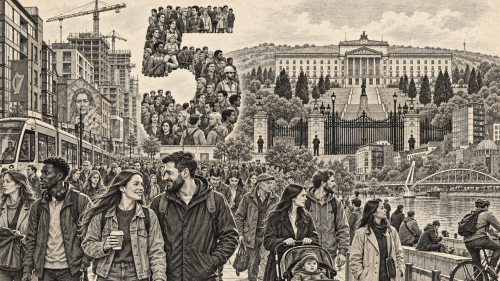

The article highlights a revealing tension: Ireland’s early willingness to accept restrictions coexisted with sharply unequal abilities to endure them. Behavioural surveys and official briefings could track attitudes and explain changing rules, yet they might not fully capture overcrowded homes, insecure employment, disrupted mourning or digital exclusion. The article therefore suggests that trust rested not simply on confidence in expertise, but on whether citizens saw sacrifices, protections and rights applied fairly. This raises an implication for emergencies: evidence must include lived experience alongside national averages. How might advice, data, rights scrutiny and community testimony build trust among diverse Irish groups?