
Nitrate Regulation
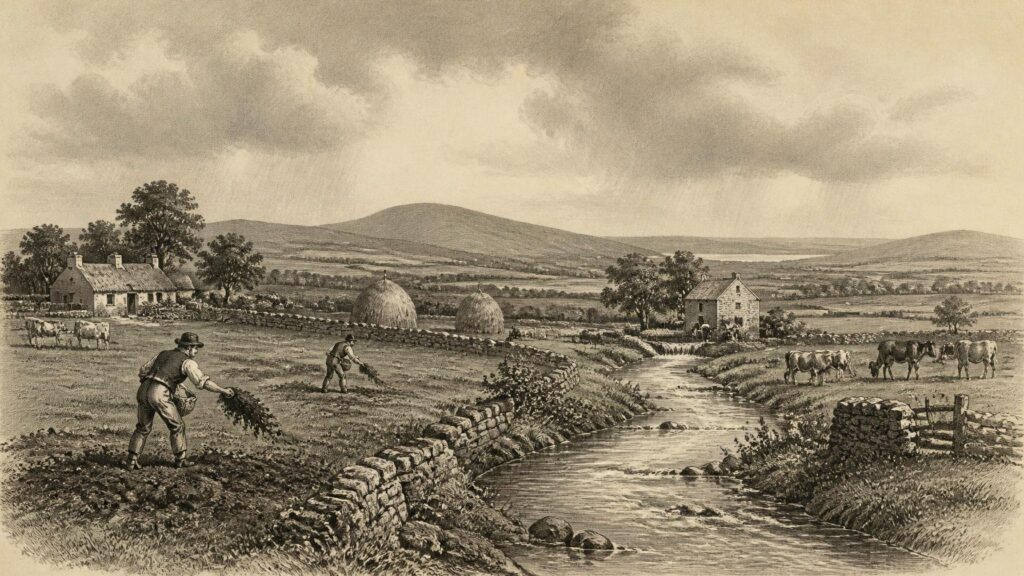
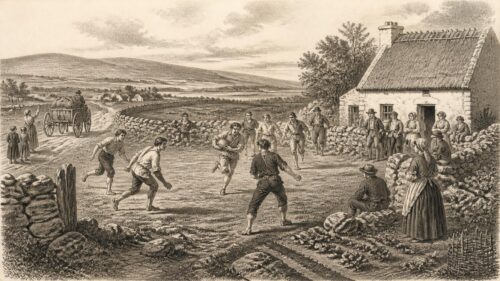
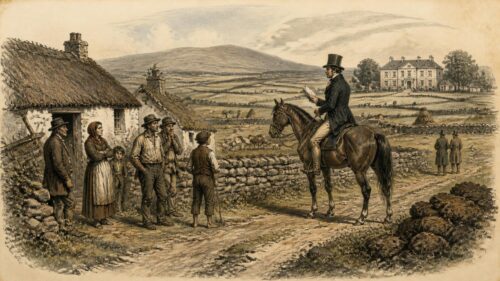
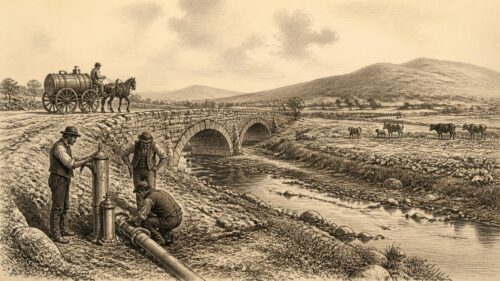
AI generated historical illustration, not a contemporary photograph.
At a Glance
The history of nitrates and water quality in Ireland is not merely a technical tale of chemistry and regulation. It is a record of how a country whose farming depended long upon grass, livestock, soils and rainfall came to reckon with the environmental cost of greater productivity. Nitrate in water became a public concern because the same nutrients that helped make pasture grow could, when used or managed beyond the capacity of land and vegetation to retain them, travel through soil, groundwater, drains, rivers and estuaries. The resulting story joins rural labour, agricultural science, state policy, European membership, drinking-water protection and the changing condition of Ireland’s waters.
Historical Setting
Nitrate is a form of nitrogen that dissolves readily in water. Nitrogen is indispensable to plant growth, and farming has always involved attempts to replenish fertility removed in crops, milk, meat and livestock sales. Traditional systems did so with animal manure, crop rotations, legumes, seaweed in coastal districts and locally available organic materials. Such practices were not automatically harmless, but their scale and distribution differed greatly from the fertiliser-intensive systems that developed later. It is therefore misleading to imagine a simple past of wholly pure water suddenly disrupted by modern agriculture. Human settlement, animal husbandry, drainage and waste have long affected local waters. What changed decisively was the volume, concentration, mobility and commercial organisation of plant nutrients.
Ireland’s climate and geology made this issue particularly important. Rainfall is plentiful across much of the island, while many soils are wet, shallow, permeable or drained. In freely draining ground, nitrate can move downward towards groundwater; in other landscapes, nutrient-bearing water can move rapidly through drains and streams. What happens on a field is therefore linked to a wider catchment: the area from which water travels to a river, lake, spring, bay or coastal water. This connection between farm and downstream water was understood imperfectly at first, but it became central to twentieth-century agricultural research and late twentieth-century environmental governance.
Modern discussion often treats nitrate as if it were identical with all agricultural pollution. It is not. Nitrogen and phosphorus both matter, but they travel differently and affect waters in different ways. In broad terms, phosphorus is often a major concern in freshwater, particularly where soil and surface runoff carry it into lakes and rivers. Nitrogen, much of it in nitrate form, is especially important in estuaries and coastal waters, where it can support excessive growth of algae and aquatic plants. Human-health standards for drinking water are also distinct from ecological thresholds. A supply may remain beneath a drinking-water limit yet still form part of a catchment where nutrient levels are ecologically damaging.
Fertility Traditions
The historical starting point is not nitrate pollution but the perennial difficulty of making Irish land productive. A 1957 paper by T. Walsh, P. F. Ryan and J. Kilroy, published by the Statistical and Social Inquiry Society of Ireland, described many Irish soils as lacking abundant natural reserves of plant nutrients. That assessment belongs to the agricultural science of its day, but it captures a durable practical reality: fertility had to be maintained or added if crops and grass were to yield well. Manure was precious because it returned nutrients to land, while lime was used to improve soil conditions and make other nutrients more available to plants.
The nineteenth century brought a new commercial vocabulary of fertility. Guano, bone-derived materials, superphosphate and later potassic fertilisers entered agricultural discussion and trade. The Walsh, Ryan and Kilroy study is especially useful because it cautions against exaggerating the early scale of change. It records that superphosphate was not used in substantial quantity in Ireland until the later nineteenth century and that potassic fertilisers were of little consequence nationally before its close. It also found no evidence of important use of nitrogen fertiliser in Ireland before the early twentieth century. Agricultural improvement was under way, but the quantities involved did not yet resemble those of the post-war era.
This matters for water history. The appearance of chemical fertiliser did not immediately create a national nitrate crisis. Small, costly and unevenly distributed inputs had a different environmental significance from later systems of regular purchased fertiliser, improved pasture, concentrated livestock and mechanised slurry handling. Nor can present-day measurements simply be projected backwards. Systematic national water-quality monitoring came much later, and historical researchers must resist assigning precise chemical conditions to periods for which the evidence does not exist.
There is also a cultural temptation to contrast traditional manure with artificial fertiliser as though one were natural and the other inherently polluting. The historical evidence does not support such a neat moral division. Both contain nutrients; both can be beneficial when matched to crop need and harmful if poorly timed, poorly stored or applied where soils and weather favour loss. The consequential change was the capacity to apply larger nutrient quantities, often more quickly, and to sustain livestock and grass output at levels not possible within older nutrient cycles alone.
Scientific Farming
By the early twentieth century, agricultural science, advisory work and commercial manufacture were increasingly shaping farming decisions. Experimental institutions promoted the measurement of soil fertility, grass response and animal production. Nitrogen fertiliser became attractive because it could stimulate grass growth and crop yield, while phosphorus and potassium addressed other limits in soil supply. Farmers were not passive recipients of expert instruction: they judged advice against weather, markets, credit, labour and the experience of neighbouring farms. Nevertheless, the direction of travel was clear. Fertility became increasingly something that could be bought, formulated, delivered and spread.
The technological background was international. Industrial chemistry made nitrogen fertilisers progressively more available during the twentieth century, while manufacturing and distribution connected Irish farming to wider British and European markets. The important historical point is not that every farm followed one model at once. Ireland retained great regional variety in farm size, enterprise and land quality. Yet scientific and commercial approaches encouraged the idea that grassland and tillage could be made predictably more productive through planned nutrient application.
That promise was powerful in a country where agriculture occupied a central place in employment, rural life and exports. Higher output could mean more saleable livestock, more milk and greater security for families working marginal land. It is too simple, therefore, to treat intensification as a mistake visible only in retrospect. It answered real pressures: low incomes, difficult soils, emigration, uneven markets and the demand to make farming viable. Environmental history is most useful when it retains this social context while also acknowledging consequences that were less visible at the time.
From a water perspective, the crucial scientific realisation was that nutrients do not stay where they are spread. A crop may take up part of the nitrogen supplied; soil organisms transform part; some may be retained temporarily in organic matter. But nitrate is highly mobile. When application exceeds plant demand, when grass growth is limited, when soil is wet or drainage routes are rapid, nitrate can be carried away. The route may be slow, through groundwater over years, or quick, through drains and watercourses after rainfall. This lag means that a water-quality measurement can reflect past as well as recent management.
Postwar Expansion
The most important transformation occurred after the Second World War. New state ambitions for economic development, agricultural research and farm modernisation aligned with the expanding availability of mineral fertilisers, machinery and technical advice. Recent historical research from Trinity College Dublin characterises the period from 1945 to 2007 as one of rapid intensification in Ireland’s pasture-dominated farm sector. That description fits a larger European pattern, though Irish development followed its own timetable and was shaped by the predominance of grassland livestock systems.
In this era, nitrogen became a means of increasing what grassland could carry. Better grass growth supported more animals and greater output; silage-making and winter housing changed the annual handling of livestock manure; slurry stores, tankers and spreading equipment altered the scale at which animal wastes could be collected and returned to land. These were major practical achievements. They also concentrated nutrient management into critical decisions about storage capacity, spreading dates, rainfall, soil conditions and field location.
Water concerns developed alongside this agricultural change. Public and group water supplies, especially those dependent on wells and springs, made groundwater quality a lived rural issue rather than an abstract environmental category. Geological Survey of Ireland material from later investigations preserves evidence from individual schemes: at Killeigh in County Offaly, for example, records reviewed in the early twenty-first century showed nitrate concentrations had been elevated at times before 2001, and historical averages at the springs had risen between 1979 and 1999. Such local evidence cannot stand for the entire country, but it illustrates why monitoring wells and springs became indispensable. A national average can conceal severe vulnerability in a particular source.
The evidence also demonstrates the danger of assigning every nitrate result to a single cause. Septic systems, farmyards, poorly protected wells, domestic discharges and local hydrogeology can all matter. In rural water supplies, nitrate may occur alongside microbiological contamination or other chemical indicators. Sound historical interpretation must therefore separate evidence of nitrate presence from a conclusory statement about its precise source. Catchment science has progressively made such distinctions more reliable, but it has not abolished uncertainty.
European Change
Ireland’s entry into the European Economic Community in 1973 was a turning point in agricultural history. Access to the Common Agricultural Policy, wider markets and price supports helped accelerate production-oriented change. The Environmental Protection Agency’s research on rural water services notes that agricultural pressures on water quality grew in many areas as farming intensified after entry to the EEC. The Common Agricultural Policy was not the sole cause: domestic policy, technology, farm succession, food processing and international demand all played parts. Yet European membership created a powerful framework in which Irish farming became more commercially integrated and more productive.
That same European connection eventually brought environmental obligations. The European Community adopted the Nitrates Directive in 1991 to protect waters from pollution caused by nitrates from agricultural sources. It required Member States to identify affected or potentially affected waters, designate nitrate-vulnerable zones or apply equivalent protection across their territory, monitor conditions and establish action programmes. Its importance lies in the shift it represented. Nutrient loss was no longer merely a matter of farm efficiency or local nuisance; it became a transboundary environmental responsibility governed through law, evidence and recurring review.
Implementation in Ireland was not immediate or uncomplicated. The Court of Justice of the European Communities ruled against Ireland on 11 March 2004 in Commission v Ireland, finding failures in obligations under the Directive, including issues concerning identification, designation, monitoring and action programmes. This judgment is a firm piece of documentary evidence, not a retrospective impression. It shows that by the early 2000s water protection had become a matter of legal accountability as well as scientific assessment.
The political response was substantial. Dáil debates in December 2005 recorded that Ireland had submitted a national action programme in July of that year after consultations with farming organisations and other interests. Regulations followed in 2006, with later revisions strengthening and adjusting the regime. The State chose a whole-territory approach rather than confining controls to a limited map of vulnerable zones. This approach recognised that the risks associated with nutrient loss were widespread and that drawing a narrow boundary around pollution problems could overlook the connected character of Irish catchments.
Regulatory Turn
The Nitrates Action Programme translated broad environmental aims into farm rules. Its central tools have included limits on livestock manure nitrogen, minimum slurry-storage requirements, restrictions on spreading during high-risk periods, limits near water and requirements governing fertiliser planning and record keeping. These rules have evolved through successive programmes, but their logic has remained consistent: prevent nutrients from being applied when plants cannot use them or when weather, soil and hydrology make transfer to water likely.
This was a profound change in the relationship between farmer and state. Nutrient management, once largely a matter of experience and advisory recommendation, became increasingly subject to inspection, documentation and statutory limits. For many farmers, the regulations imposed expense and constraint: larger storage facilities, altered work calendars and investments in equipment could be difficult, particularly where holdings were small or fragmented. The Farm Waste Management Scheme, introduced in 2006, offered grant support for infrastructure intended to help farms meet new standards. The scheme demonstrates that regulation was accompanied by public investment, even if the distribution of costs and benefits remained politically contentious.
The historical record should not be written as a simple contest between environmental protection and agriculture. Farmers had long understood that wasting fertiliser and slurry was economically undesirable. Agricultural advisers and researchers had also promoted better nutrient use. But regulations made the public stakes explicit. Water belonged not only to the farm through which it passed, but to households, downstream communities, fisheries, coastal environments and future users of wells and rivers.
There is an interpretative point here. The Nitrates Action Programme did not create the problem; it made a diffuse problem governable. It created common definitions, standard calendars, records and thresholds by which a vast number of individual actions could be assessed. This administrative history matters because nitrate pollution is seldom a dramatic single discharge. It is often cumulative: small losses from many fields, farms and seasons, travelling through a catchment and becoming visible only in monitoring data downstream.
Water Evidence
Modern monitoring supplies the clearest evidence of the scale and geography of the issue, although its results must be read with care. The Environmental Protection Agency’s assessment of water quality for 2016–2021 found high nitrate concentrations at 43 per cent of river sites, concentrated especially in the south and south-east. Its later State of the Environment reporting described nitrate concentrations as too high at 42 per cent of river sites and 17 per cent of estuarine and coastal water bodies, with particular concern in the south-east and south. These are ecological findings, not claims that every affected supply is unsafe to drink.
The EPA distinguishes the standards involved. The drinking-water maximum for nitrate is 50 milligrams per litre expressed as nitrate, while lower ecological concentrations are required to support healthy river and marine systems. This distinction is historically and politically significant. A debate framed only around drinking-water compliance can miss damage to estuaries, coastal bays and freshwater habitats. Conversely, a river failing an ecological nutrient objective should not automatically be described as a breach of the drinking-water standard. Careful language is part of accurate environmental history.
Patterns also reveal the importance of time. EPA reporting notes that average river nitrate concentrations in several affected regions generally rose from around 2013 and peaked in 2018–2019, after a combination of surplus nitrogen use and drought conditions, before fluctuating without a clear overall improvement. The removal of European milk quotas in 2015 formed part of the setting for renewed dairy expansion. The EPA links the increase in agricultural pressures on water bodies between 2015 and 2021 with significant intensification associated with quota removal and production strategies. This does not mean that dairy farming alone explains every local result, but it does show why national production policy and water quality cannot be studied separately.
Nitrate’s delayed movement complicates both blame and remedy. A farm may improve its nutrient balance today yet water travelling through a groundwater body may still carry the legacy of earlier losses. Conversely, a single favourable year of sampling cannot prove a catchment has recovered. Weather alters flows and concentrations, while monitoring frequency and the selection of sites affect interpretation. The proper historical conclusion is neither fatalism nor premature celebration: water recovery is possible, but it requires persistence, targeted action and enough time for hydrological systems to respond.
Coastal Consequences
The story does not end at the river mouth. Ireland’s estuaries, sheltered bays and nearshore waters receive nutrients from their catchments. Nitrogen can encourage blooms of algae and other plant growth; when organic material decomposes, oxygen conditions may be altered and ecological balances disturbed. The EPA has warned that excess nitrate is damaging the ecological health of many estuarine and nearshore coastal waters, particularly in the south and south-east. This gives nitrate history a maritime dimension. The consequences of nutrient management on inland grassland can be registered in waters where fresh and salt water meet.
Such connections challenge familiar historical boundaries. Agricultural history is often written in terms of ownership, livestock prices, land improvement and exports. Maritime history may concentrate on fisheries, ports and shipping. Water quality joins them. A field application made far from the coast can become part of the nutrient load of an estuary; an estuary’s ecological condition can, in turn, shape public arguments about farming practice, seafood waters, amenity and regional identity.
The evidence does not support a romantic claim that every Irish bay was once pristine, nor does it warrant treating all coastal change as agricultural in origin. Urban wastewater, industry, septic systems, altered drainage and climate conditions may also affect waters. The EPA specifically identifies agriculture and urban wastewater among the main sources of excess nutrients. The historical task is to recognise agriculture’s major role where evidence supports it while preserving the complexity of particular places.
Public Debate
Nitrates have become one of the most contested subjects in contemporary rural Ireland because they sit where livelihood, law and environmental responsibility meet. The Nitrates Directive establishes a general limit of 170 kilograms of livestock manure nitrogen per hectare each year, but the European system permits time-limited derogations under stricter conditions. Ireland has used such a derogation for certain more intensively stocked farms. The fifth Irish Nitrates Action Programme covered 2022–2025, and its rules included additional measures for farms qualifying for higher stocking limits.
Debate around the derogation illustrates a larger historical tension. Supporters emphasise the efficiency of grass-based dairy production, the economic importance of dairy farming and measures adopted by farmers to improve nutrient management. Critics point to water data, ecological decline and the difficulty of reconciling rising livestock intensity with catchments already carrying high nitrogen loads. Both positions draw upon genuine concerns, but neither should be allowed to obscure the documented condition of waters. The question is not whether farming matters to Ireland; it plainly does. The question is how production can remain compatible with the capacity of particular catchments to absorb nutrient pressures.
Folklore and local memory have a place in this history, but not the same place as monitoring evidence. Farmers and rural residents may remember a spring changing colour, a river thickening with weed, fish disappearing from a reach, or an unusually wet season washing fields hard. These memories can guide historians towards events and places worthy of investigation. They are not, by themselves, measurements of nitrate or proof of source. Equally, official datasets are not disembodied truth: they depend upon sampling design, laboratories, classifications and interpretation. The strongest history places local testimony alongside documentary, scientific and regulatory evidence without confusing one kind of evidence with another.
Future Lessons
The long history of nitrates and water quality in Ireland offers several lessons. First, environmental problems can arise from successes. The increased output made possible by improved grassland, fertiliser, livestock breeding, advisory systems and access to markets helped sustain many rural enterprises. Yet the same changes increased the need for careful nutrient management. Second, environmental effects are uneven. One catchment may respond differently from another because of soil, slope, drainage, geology, rainfall and the mix of farms and settlements within it. National rules are necessary, but local knowledge and targeted measures are indispensable.
Third, the history warns against treating compliance as the only measure of success. Rules on closed periods, storage and stocking are important safeguards, but ecological recovery depends on what reaches water. The EPA’s evidence-based thresholds make clear that water can be below a drinking-water limit and still carry too much nitrate for healthy aquatic ecosystems. That is a demanding standard, but it reflects the fact that water is more than a supply pipe: it is habitat, landscape, public resource and historical inheritance.
Finally, this history is still unfinished. Ireland’s regulatory response has grown more detailed since the 1990s, and scientific understanding of nutrient pathways has improved. But the persistence of elevated nitrate in many rivers, groundwaters and coastal waters shows that knowledge alone is not enough. The enduring challenge is to align farm-level decisions, public support, markets and law with the physical limits of land and water. The nitrate story is therefore a reckoning in the fullest sense: an accounting for nutrients applied, animals kept, waters affected, responsibilities shared and choices still to be made.

One striking issue is tension between national rules and the local pathways through which nitrate travels. Ireland’s whole-territory approach recognises connected catchments, yet the article stresses that geology, rainfall, drainage, nutrient use and non-agricultural sources can make one well or estuary more vulnerable than another. It also distinguishes drinking-water compliance from ecological health, complicating ideas of what counts as success. The history suggests that regulation must address cumulative losses while sensitive to place and time, particularly groundwater lags. How should nitrate policy balance nationally consistent farm standards with catchment-specific evidence, support and interventions to protect rural livelihoods and aquatic ecosystems?