

Dry Island
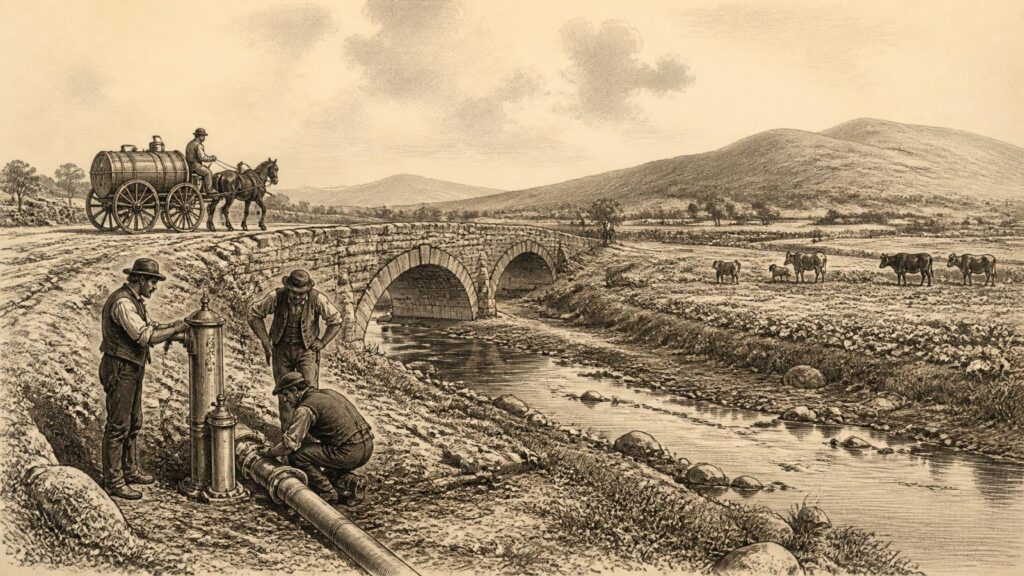
AI generated historical illustration, not a contemporary photograph.
At a Glance
Ireland’s drought of 2026 challenged an old national assumption: that a green Atlantic island, famous for rain, cannot seriously lack water. The evidence did not show that Ireland had ceased to be a wet country in annual terms. It showed something more historically important: that water can be abundant over a year yet unavailable in the place, season, quantity or quality required by households, farms, rivers and public services. The long dry summer exposed the accumulated consequences of dispersed local supplies, ageing networks, uneven storage, high leakage, rising demand and an infrastructure system still being remade.
Summer Shock
The summer of 2026 was not merely a spell of pleasant weather turned inconvenient. Met Éireann’s observations recorded a season of exceptional warmth and dryness, while July produced especially striking results. Rainfall was below the 1991–2020 average at all twenty-five reporting stations. At Cork Airport and Moore Park, both in County Cork, only 1.1 millimetres fell during July. At several southern and south-eastern stations, July was not simply an unusually dry July but the driest calendar month in their instrumental records. Such figures require care: a record at an individual station reflects the length and continuity of that particular record, not an assertion that nothing comparable happened anywhere before formal measurement. Yet they establish beyond doubt that the event was exceptional in the modern observational archive.
Met Éireann’s technical classifications help distinguish a meteorological drought from the broader social event called “drought” in ordinary speech. A dry spell is fifteen or more consecutive days on none of which at least one millimetre of rain is recorded. An absolute drought requires fifteen consecutive days with less than 0.2 millimetres on each day. A partial drought is a longer, twenty-nine-day period whose mean daily rainfall does not exceed 0.2 millimetres. These are precise rainfall definitions, not direct measures of empty reservoirs, damaged crops or household hardship. They are valuable because they prevent retrospectively turning every sunny spell into a drought, while also showing how rapidly an apparently minor rainfall deficit can become consequential.
During July 2026, every reporting station experienced a climatological dry period. Twenty stations, mainly in the Midlands, South and East, recorded absolute droughts, and fifteen recorded partial droughts. The records describe a countrywide pattern, but not a uniform experience. A person dependent on a shallow private well, a vegetable grower with an irrigation licence and storage pond, and a Dublin household supplied through a large treated network occupied very different water worlds. The same absence of rain moved through those worlds as falling groundwater levels, declining river flows, restrictions on use, rising pumping costs, crop stress or, in some places, no immediately visible difficulty at all.
Rain returned from the latter part of August, easing soil-moisture deficits in many districts. That recovery was important, but it should not be allowed to erase the summer from the historical record. Droughts are often narrated as dramatic beginnings followed by rain and relief. Infrastructure history suggests a different reading. A dry episode tests a network’s redundancy, its stored water, its ability to transfer supply between areas, the condition of pipes, the resilience of treatment works and the clarity of public communication. Rain can refill a field more swiftly than it restores a depleted aquifer, repairs a leaking main, builds an interconnection or supplies a farm that lacks lawful and affordable irrigation equipment.
Measured Drought
It is essential to separate what was measured in 2026 from what may reasonably be inferred. The measured case is strong. Met Éireann described summer 2026 as provisionally Ireland’s hottest summer in the long Island of Ireland temperature series beginning in 1900, with a national average of 16.28 degrees Celsius for June, July and August. July was exceptionally dry and warm. These figures establish the meteorological setting in which pressure on water supply, agriculture and ecosystems developed. They do not, by themselves, prove that every later impact was caused by climate change, poor infrastructure or a particular policy decision.
The phrase “drought” also contains several overlapping ideas. Meteorological drought concerns rainfall. Agricultural drought concerns the lack of water in soils available to plants. Hydrological drought concerns reduced flows, lake levels, groundwater or reservoir storage. Socioeconomic drought begins where scarcity interferes with supply, livelihoods, public health, industry or ecosystems. The categories can move together, but they do not always do so. A wet spring may leave reservoirs or groundwater comparatively secure at the opening of a dry summer. Conversely, repeated dry months can make a relatively modest heatwave dangerous because demand rises just as streams and springs diminish.
The Water Conservation Order applied nationally from 24 July to 26 August 2026 demonstrates the transition from weather observation to public-service management. It restricted non-essential use of water through a hosepipe ban. Such restrictions are often described as symbolic, but they are practical tools in systems where peak summer demand matters. Garden watering, vehicle washing and similar uses can impose large local surges, especially in the evening. Restricting them seeks to protect essential domestic supply, maintain pressure, reduce the likelihood of local outages and give treatment and distribution systems room to operate.
The order also had historical meaning. Ireland’s first national water conservation order was introduced during the drought of 2018. In a country whose public imagination has long treated rainfall as reliable, the hosepipe ban became a visible sign that plentiful annual precipitation does not automatically guarantee a dependable public supply. By 2026, restrictions could no longer be understood as an unprecedented curiosity. They formed part of an emerging repertoire of drought response: monitoring, demand reduction, leakage control, public messaging, emergency transfers and longer-term capital investment.
Interpretation begins with the question of recurrence. It would be unsound to say that one dry summer proves a permanent climatic transformation. Weather varies naturally, and Ireland has experienced severe drought before. It is, however, well supported by the Environmental Protection Agency’s climate assessments that projected change brings pressure on summer water availability, agriculture and water quality. The important historical conclusion is therefore neither that 2026 was wholly unprecedented nor that it was merely another familiar Irish summer. It was a recent severe event within a warming climate and an infrastructure system carrying greater demands than those of earlier droughts.
Older Dryness
Irish history is crowded with wet-weather stories: flooded fields, Atlantic storms, waterlogged harvests, saturated peat and winter rain. This can obscure the equally real history of dry periods. The instrumental record is strongest from the nineteenth and twentieth centuries onward, while earlier accounts depend on newspapers, diaries, estate records, agricultural reports and later reconstruction. Such sources can vividly describe dust, low rivers, failed wells or poor pasture, but they are not interchangeable with a continuous national rainfall series. Historical caution is particularly necessary when local memory turns a hard summer into a universal national calamity.
Met Éireann identifies the prolonged dry period from 1974 to 1976 among Ireland’s major weather events. The summer of 1976 remains a principal reference point: in the modern gridded rainfall series, it was the driest summer on record, with an average of 139.6 millimetres. The dry weather affected much of north-western Europe and became engraved in British and Irish recollection as a season of heat, parched lawns and water anxiety. Its significance lies not only in the weather itself but in the institutional contrast it offers. Ireland’s water services were then administered through local authorities, with highly varied resources and technical capacities. There was no single national utility responsible for coordinating public supply.
That older administrative landscape had deep roots. Nineteenth-century urban growth made water supply a central question of municipal government. Town commissioners, corporations and later county and urban councils sought reliable sources, constructed reservoirs, laid pipes and developed treatment arrangements. The work was uneven. Cities and larger towns could marshal greater rate bases, engineering expertise and political attention than small settlements. Rural communities frequently relied on wells, springs, pumps, private arrangements and group schemes. Water infrastructure was therefore never a single national inheritance. It was a patchwork made over generations by local government, state grants, voluntary organisation and household labour.
Drainage provides a revealing parallel history. From the nineteenth century onward, river drainage, arterial schemes and field drainage were promoted to make land more productive and reduce flooding or waterlogging. In a wet climate, removing surplus water seemed an obvious agricultural and public-health good. Yet drainage can alter how quickly rainfall leaves a catchment, how wetlands retain water and how landscapes buffer dry periods. This is not an argument that all historical drainage was mistaken; much of it responded to genuine hardship and economic need. It is an argument that infrastructure built for one environmental problem can shape vulnerability to another. The twentieth-century pursuit of drainage and the twenty-first-century desire to retain water belong to the same long story.
Folklore often supplies a further layer. Communities remember wells that “never ran dry”, holy wells believed to possess healing properties, and rivers associated with local saints or seasonal customs. Such traditions matter as cultural history and may preserve memories of places where water was valued. They are not, without corroboration, hydrological evidence. A holy well cannot be assumed to have maintained a steady yield through every drought, nor can a remembered dry riverbed be made to prove a nationwide event. The distinction is not dismissive. It allows folklore to be appreciated for what it is: a record of attachment, belief and local meaning rather than a substitute for measured climate data.
Modern Memory
The drought of 2018 furnished the most immediate comparison for 2026. That summer brought sustained warmth and rainfall deficits across much of Ireland, especially in the east, south and Midlands. Met Éireann recorded partial drought conditions at ten stations between late May and late July, and reported that the combined June and July rainfall totals were below the long-term average at every station. The event produced visible agricultural stress, wildfire risk, pressure on water supplies and widespread public attention. It also showed the importance of defining scale: even where the country as a whole was dry, the timing and severity of rain varied from place to place.
The 2018 experience altered how drought entered public policy. Water conservation became a national rather than a narrowly local concern. The language of resilience, leakage reduction and strategic water planning gained urgency. The drought did not create every weakness it revealed. Rather, it made longstanding weaknesses intelligible to a wider public. Networks with limited spare capacity, supplies dependent on single sources, small treatment works and dispersed rural abstractions all became easier to see when rain did not arrive on cue.
The years between 2018 and 2026 complicate any simple story of steady dryness. Ireland continued to experience wet seasons, damaging storms and damaging floods. Indeed, climate adaptation in Ireland must contend with a seeming paradox: greater risk from intense rainfall and flooding can coexist with more damaging dry spells and summer water stress. Infrastructure designed only to move surplus water away is inadequate; infrastructure designed only to store water may also fail if it neglects water quality, catchment ecology, flood safety and energy use. The task is not choosing between flood and drought, but dealing with a less predictable hydrological regime.
The drought of 2025, followed by the hotter and dry summer of 2026, sharpened this perception. Environmental assessments and official planning documents increasingly framed water security as a systemic matter, connected to housing growth, public health, food production, energy requirements, biodiversity and regional development. In historical terms, this marks a change from the older conception of water supply as a municipal engineering service. Water remains an engineering service, but it has become visibly linked to land use, climate science, environmental regulation and national economic planning.
Memory can nonetheless distort. Because 1976 and 2018 are famous, smaller dry events may disappear from public recollection. Because Ireland is associated with rain, short dry sequences can be spoken of as unprecedented when records show earlier examples. Conversely, invoking 1976 can wrongly imply that present risks need no new response. Historical comparison should do neither. Its purpose is to reveal continuity in exposure and change in context. In 2026 more people lived in towns and cities, demand was larger, water services were being centralised, environmental standards were more exacting and climate evidence was more developed than in the 1970s.
Water Systems
Uisce Éireann’s National Water Resources Plan provides the clearest official framework for understanding why a rainy country can be drought-vulnerable. The plan does not present Ireland as naturally water-poor. Instead, it identifies a need to operate and develop supplies so that water is safe, reliable and secure under population growth, environmental obligations and extreme weather. That distinction is crucial. Annual rainfall is a national statistic; safe drinking water at a kitchen tap depends on a chain of catchment, abstraction, treatment, storage, pumping, mains, monitoring and maintenance.
Much of Ireland’s public water comes from surface sources. Rivers and lakes can respond relatively quickly to dry weather, particularly where a supply depends upon a smaller catchment. Groundwater can offer valuable resilience, but its behaviour depends on local geology, recharge, abstraction and the condition of wells. The EPA’s climate assessment notes that many water-resource zones rely on a single source or take water from small local rivers, making them vulnerable to interruptions, drought and declining water quality. The point is not that every small supply is unsafe. It is that systems with few alternatives have little redundancy when their principal source is stressed.
The scale of the inherited system matters. Ireland has hundreds of water-resource zones and many treatment plants, ranging from large works serving major urban populations to very small facilities. This dispersed pattern reflects settlement history and local government development. It also produces a difficult balance. Small systems can be close to communities and sources, but they may have limited capacity for backup, specialist staffing, interconnection or major upgrades. Larger systems may gain technical resilience and economies of scale, but can create dependency on long transmission lines and major single sources.
Greater Dublin illustrates the problem of concentration. The region has historically drawn heavily on the River Liffey system. Uisce Éireann has stated that average demand in the Greater Dublin Area came close to the maximum sustainable capacity of existing sources even in normal conditions, and that the region’s dependence on one principal source increases exposure to drought or contamination. The proposed Water Supply Project for the Eastern and Midlands Region is intended to diversify this arrangement, linking supplies and creating capacity capable of serving a substantial portion of the population. Its historical significance lies in its scale: it represents a move from local supply logic towards regional resilience.
Yet new source development is not a complete answer. More water abstracted from a river or lake may damage ecological flows if it is not carefully managed. A new pipeline can improve security but cannot remove the need for conservation, leakage control, water-quality protection and demand management. Water history repeatedly demonstrates that a supply problem is rarely solved once and for all. Population growth, industrial change, pollution, new environmental standards and climatic shifts alter the meaning of adequacy. The system must be maintained, monitored and adapted rather than simply built.
Leaking Networks
Leakage has become one of the most recognisable symbols of Irish water infrastructure. It invites understandable frustration: in a drought, the sight or knowledge of water escaping from pipes appears to contradict calls for household restraint. The issue needs historical context. Networks assembled over decades contain pipes of varied age, material and condition, often buried beneath roads and private property. Repair programmes require survey work, skilled labour, traffic management, replacement materials, funding and time. There is no single repair that ends leakage across a national network.
Still, the principle is straightforward. Reducing leakage creates “headroom”: water that need not be abstracted, treated, pumped or transported. This can lessen stress on sources and defer some need for costly expansion. It can also reduce energy use, since moving and treating water consumes electricity. In drought conditions, leakage reduction becomes an immediate resilience measure as well as a long-term efficiency programme. It does not place all responsibility on infrastructure operators, however. Private-side leakage and waste can also be significant, and household conservation is most effective when accompanied by transparent public action on the network.
The politics of leakage reveal a wider issue of trust. Restrictive orders ask people to change familiar habits. They are more likely to be regarded as legitimate if the public sees evidence that authorities are controlling losses, publishing supply information and prioritising repairs. This is partly a communications problem, but not merely one. Trust depends on visible competence, equitable enforcement and honest acknowledgement of limits. A drought order cannot manufacture confidence where communities experience repeated outages or have long been promised upgrades.
Historically, such tensions are not new. Urban water authorities have always had to persuade ratepayers and consumers that expensive works were necessary. Victorian municipal schemes generated disputes over cost, ownership, source protection and the distribution of benefits. The modern debate differs in technology and regulation, but it carries familiar questions: who pays, who decides, whose supply is protected first, and how should the costs of resilience be shared between present users and future generations?
The 2026 drought therefore directed attention to pipes, but it also revealed the limits of treating pipes as the whole story. A leak-free network drawing from an over-stressed river would remain vulnerable. A large reservoir fed by polluted inflows would not be a complete solution. A new source unconnected to districts in need would not provide local security. Resilience depends on the combined performance of catchments, treatment works, storage, distribution, demand and governance.
Farm Water
Agriculture experienced drought differently from domestic supply. Grassland, tillage, horticulture and livestock enterprises vary greatly in their soils, water access, crop cycles and financial capacity. The 2026 dry period was particularly severe for outdoor vegetable production. Teagasc reported that unirrigated crops experienced yield and quality losses estimated at 25 to 40 per cent, while farms with irrigation retained more value but bore sharply increased costs. The report’s finding was not that irrigation eliminated drought damage. It showed that access to water, equipment, labour and energy created a significant difference in the ability to keep crops alive and marketable.
This contrast challenges a simplistic agricultural narrative. It is tempting to say that Ireland should merely build more irrigation because it receives abundant annual rainfall. But irrigation is not only a pump and a hose. It requires a lawful source, storage or reliable abstraction, pipes, machinery, fuel or electricity, staff, technical knowledge and sufficient water quality. It also raises questions about river flows, groundwater, neighbouring users and ecology. In dry conditions, the same streams desired for irrigation may be least able to sustain additional abstraction.
The older history of Irish farming helps explain the tension. For generations, agriculture was organised around excess water as much as shortage: wet soils, poor drainage, late springs and fodder difficulty. Land reclamation and drainage were often treated as routes to productivity. Horticulture and intensive field vegetable growing, by contrast, have always depended more obviously on controlled water where soil and crop demand require it. The 2026 experience brought irrigation into wider public discussion because long dry intervals tested systems designed for shorter periods of summer stress.
Teagasc’s assessment emphasised that only a minority of the relevant vegetable area had sufficient irrigation capacity and that capacity depended on more than raw access to water. This is a useful corrective to the image of drought as a simple shortage. Agricultural vulnerability is infrastructural and economic. One farm may lie beside a water source but lack storage or a viable connection. Another may possess equipment but face escalating energy and labour costs. A third may have water available but unsuitable soil, crop timing or permissions. Historical writing should preserve these differences rather than speak of “farmers” as a single affected group.
There is also an ethical question. Expanding irrigation may protect domestic food production and farm incomes, yet uncontrolled expansion could worsen ecological stress in dry catchments. The durable lesson is not that agriculture must choose between production and environment. It is that drought planning must bring them together: catchment-based allocation, efficient application, soil moisture retention, appropriate storage, crop choice and protection of rivers and wetlands. The dry summer made that integration more urgent; it did not make it simple.
Living Rivers
Rivers are often discussed in drought only as supply lines. They are also habitats, cultural landscapes, fisheries, receiving waters for treated wastewater and indicators of the health of a catchment. Low flows can concentrate pollutants, warm water, reduce oxygen and restrict habitat for aquatic life. These effects are particularly serious where water quality is already under pressure. The EPA’s assessment of Irish waters for 2019–2024 found that 52 per cent of surface waters were in good or high ecological status, leaving 48 per cent in unsatisfactory condition. That wider environmental context matters whenever drought leads to calls for increased abstraction or new storage.
Water quality and quantity cannot be separated neatly. During high flows, polluted runoff may be diluted but transported rapidly. During low flows, discharges and nutrient concentrations can have a greater local effect. A drought-resilient water system must therefore include treatment and distribution infrastructure, but also catchment protection. Safeguarding source waters can reduce the difficulty and cost of treatment, preserve environmental flows and improve the security of supplies over time.
Wetlands, peatlands, floodplains and healthy soils have a place in this account. They cannot be romanticised as natural machines capable of solving every water crisis. Nor should restoration claims be exaggerated beyond evidence. But landscapes that store water, slow runoff and support groundwater recharge can contribute to resilience, while degraded landscapes may shed water rapidly in storms and retain less through dry periods. This is one reason contemporary adaptation thinking increasingly joins land management to conventional engineering.
The historical irony is clear. Much Irish public works policy was shaped by the need to remove water from land or defend settlement against it. Climate adaptation now asks how some water may be held back safely, without recreating the stagnant conditions, flood risks or agricultural losses that earlier drainage sought to remedy. The answer will differ by catchment. There is no universal prescription, and historical experience warns against one-size-fits-all schemes imposed without local knowledge.
River heritage also matters. Canals, millraces, weirs, embankments and drainage channels are physical records of changing relationships with water. In drought, their remains can become unusually visible. That visibility may invite romantic speculation about former river levels or lost landscapes. It is better to treat them as evidence requiring context: an old mill weir proves past engineering and use, not necessarily a stable historical flow regime. Proper interpretation combines maps, engineering records, ecology and hydrological data.
Public Authority
The formation of Irish Water in 2013, now operating as Uisce Éireann, marked a major institutional shift. Responsibility for public water services moved from a fragmented local-authority model towards a national utility. The change was controversial, not least because it became entangled with debates over charges, austerity, public ownership and democratic accountability. Yet the drought history of the 2010s and 2020s shows why national coordination was considered necessary. Water systems cross county boundaries; droughts affect multiple authorities; and large strategic projects require technical capacity, capital and planning horizons beyond many individual local areas.
Centralisation does not abolish local reality. Water still comes from particular rivers, lakes, reservoirs and aquifers. Pipes still burst on particular streets. Small schemes still serve particular villages. Local authorities, group water schemes, environmental regulators, farmers and community organisations retain essential roles. The strength of a national plan depends partly on whether it can recognise regional differences rather than treating Ireland as one homogeneous water zone.
The National Water Resources Plan is significant because it sets out a framework based on reducing leakage, using water more efficiently and developing sustainable new sources where required. In historical terms, this is a move away from the older habit of addressing shortages primarily through a new engineering work after a crisis. It places supply, demand and environmental limits within one planning system. Whether implementation will match ambition is a question for future historians; the plan itself should not be mistaken for completed infrastructure.
Planning is slow because it must be. Large water projects require environmental assessment, route selection, land acquisition, consultation, engineering design, procurement and legal scrutiny. These processes can frustrate communities facing immediate shortages. But rushing can create durable environmental harm, high costs or public opposition. The difficult task is to distinguish avoidable delay from necessary democratic and scientific examination. Drought should accelerate preparedness, not become an excuse to disregard evidence or local rights.
The events of 2026 also showed the value of clear institutional language. A meteorological warning, a public request for conservation, a local supply notice and a legally binding conservation order are not the same thing. Public understanding improves when authorities explain what is happening, why a measure is required, its geographical scope, its start and end dates, and the uncertainty surrounding recovery. In an age of rapid information sharing, vague reassurance can undermine compliance as quickly as alarmism.
Climate Meaning
Any historical account of the 2026 drought must address climate change without making claims the evidence cannot carry. A single season is weather. Attribution of a particular event requires specialised scientific analysis, and this article does not claim that the 2026 drought was caused solely by human-induced climate change. What can be said is that Irish and international climate science identifies a warming trend, changing rainfall patterns and increasing risks relevant to water supply, agriculture and ecosystems. The EPA’s assessments project hotter, drier summers alongside wetter winters and more intense rainfall events, although the timing and local expression of those changes remain uncertain.
This uncertainty is not an argument for inaction. Infrastructure is built to endure for decades, and decisions made now shape exposure to conditions not yet fully known. The historical lesson of water supply is that systems are often judged by conditions more demanding than those assumed when they were designed. A pipe network built for one population, a reservoir sized for one pattern of demand, or a drainage system designed for one understanding of rainfall may become inadequate without any single dramatic failure.
There is a danger, however, in allowing climate language to obscure governance. If drought is described only as an unavoidable global emergency, avoidable domestic weaknesses disappear from view: delayed maintenance, inadequate interconnection, poor source protection, insufficient monitoring or unequal access to adaptation. The reverse error is equally serious: blaming every difficulty on local mismanagement ignores the climatic conditions that make old assumptions unsafe. The most defensible interpretation holds both truths together. Climate risk changes the conditions under which water services operate; policy and investment determine how exposed people remain.
Climate adaptation is sometimes presented as a contest between hard and soft measures. Hard measures include reservoirs, treatment plants, transfer pipelines, storage tanks and upgraded mains. Softer measures include conservation, pricing policy, drought plans, public information, catchment management and changes in farming practice. The distinction is useful but incomplete. A drought plan without physical capacity can become a plea for restraint. A pipeline without demand management can become an expensive invitation to waste. Durable adaptation joins engineering to governance and landscape management.
For historians, the key point is that 2026 belongs to an unfolding chronology, not a final verdict. Later years may show it to have been a turning point in investment and public understanding, or a warning insufficiently acted upon. That judgment cannot yet be made. What can be documented is that the drought arrived after earlier warnings, under plans already acknowledging climate risk, and amid an active debate about water infrastructure, irrigation and national resilience.
Future Lessons
The clearest lesson from 2026 is that Ireland’s water problem is one of reliability rather than simple national volume. Water must be available at the correct time, protected from contamination, treated to the required standard and delivered through functioning infrastructure. It must also remain in rivers and wetlands in quantities consistent with environmental health. This is a more demanding proposition than the old reassurance that Ireland is wet.
Historical perspective adds humility. Previous generations built waterworks, drainage channels, reservoirs and local schemes to solve the pressures they knew. Their works made modern life possible, even where they now require renewal or adaptation. It would be unfair to dismiss them as failures because they did not anticipate every present challenge. Equally, it would be irresponsible to inherit those systems passively, assuming that past abundance guarantees future security.
The 2026 drought exposed unequal capacities to cope. Large interconnected systems, well-maintained supplies and farms with viable irrigation had options that small, isolated or under-resourced systems lacked. Resilience is therefore a question of fairness as well as engineering. Investment choices determine whether rural households, smaller towns, vulnerable catchments and less capitalised farms receive meaningful protection or are left to manage each dry season as an exceptional private burden.
Evidence should guide that investment. Instrumental records can identify the severity and geography of rainfall deficits. Supply data can show demand, leakage, storage and source pressures. Ecological monitoring can identify rivers and aquifers least able to bear further stress. Local testimony can reveal the lived consequences that national statistics miss. Folklore and memory can illuminate cultural relationships with water, but they should be clearly distinguished from scientific evidence. The most credible public history of drought uses each form of knowledge for its proper purpose.
Dry Island is therefore not a contradiction. It is a description of a country where rain remains common, but where dry summers can reveal old vulnerabilities with new force. The drought of 2026 did not demonstrate that Ireland had run out of water. It demonstrated that water security must be built, maintained, shared and protected. Its historical importance lies in that revelation: an island long shaped by rain learning to plan seriously for its absence.