
Columba Evidence
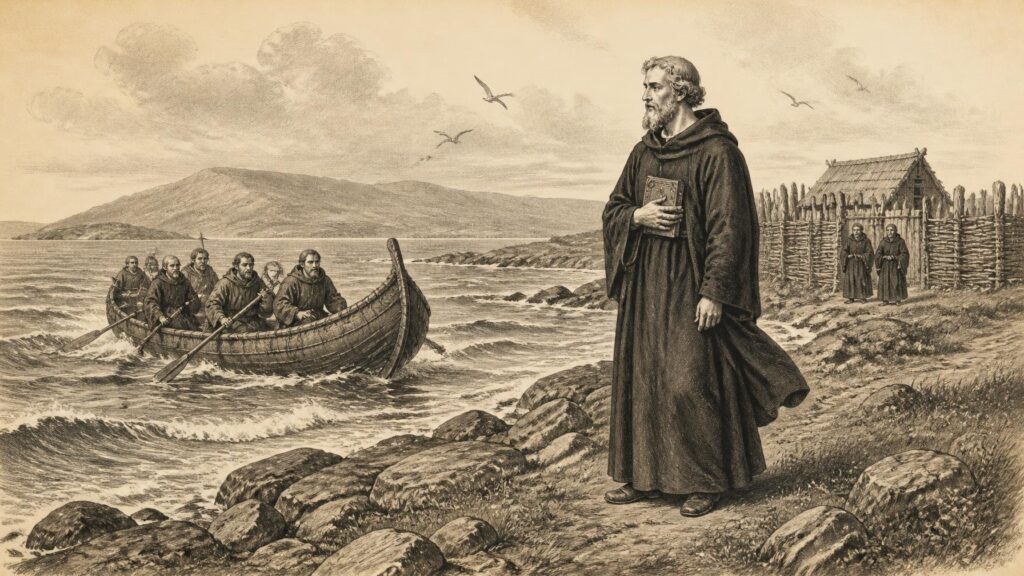
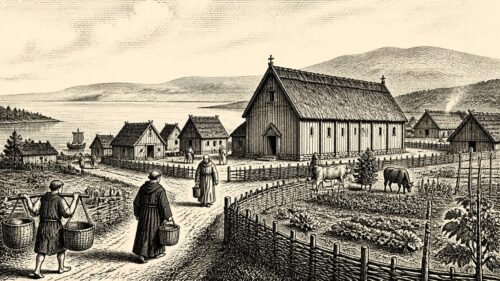
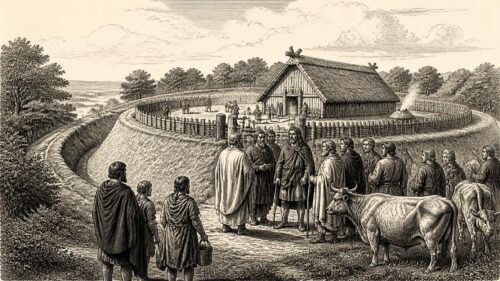
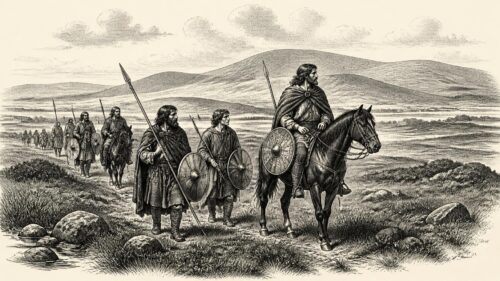
AI generated historical illustration, not a contemporary photograph.
At a Glance
Columba, or Colum Cille, belongs to the small company of early medieval Irish figures who are at once historical persons, monastic founders, literary presences and saints of enduring popular memory. His life cannot be recovered as a modern biography: the fullest surviving account was written roughly a century after his death, in a genre intended to proclaim sanctity rather than to supply a neutral chronicle. Yet the contours are clear enough. Born into a powerful northern Irish kin-group, Columba became associated with religious communities in Ireland and, above all, with Iona, the island monastery that gave his name influence across the Irish Sea world. The task is not to strip away every miracle and leave a diminished man behind, but to distinguish what the sources can securely show from later interpretation and cherished folklore.
Names Origins
The saint is generally called Columba in Latin and English historical writing, but Colum Cille is the familiar Irish form. It is often explained as “dove of the church”, though a name in a saint’s tradition can acquire layers of devotional meaning beyond whatever name was first used in childhood. He is usually dated to about 521 and to 597 in death. His family belonged to Cenél Conaill, a northern branch of the Uí Néill, one of the most formidable dynastic groupings in early Irish history. This ancestry is not a decorative detail. In sixth-century Ireland, ecclesiastical authority, landholding, kinship and royal politics were closely interwoven; a prominent churchman could not readily be understood apart from his kindred connections.
Later tradition places his birth at Gartan in what is now County Donegal. That association has been profoundly important to Donegal religious memory and is entirely plausible within the geography of Cenél Conaill. It should nevertheless be expressed carefully. There is no contemporary record of his birthplace, and the certainty with which modern readers may encounter Gartan in devotional accounts is not the same thing as documentary proof. His father is named in later sources as Fedelmid and his mother as Eithne. Accounts also describe fosterage, baptism and early religious formation. These details fit the social world of early Ireland, but most come through sources written after the events and cannot all be independently checked.
The Ireland into which Columba was born was neither an isolated outpost nor a country governed by a single modern-style state. It was a patchwork of kingdoms, lordships, client relationships and ecclesiastical settlements. Irish-speaking peoples also held territory and influence across the sea in western Britain, notably in Dál Riata. Sea routes connected rather than separated the northern Irish coast, the Hebrides, Argyll and parts of western Scotland. Columba’s subsequent movement between Ireland and Iona was therefore not a leap from one unrelated world to another. It was travel within a Gaelic-connected maritime region, though one politically diverse and religiously changing.
Some later narratives make Columba a naturally destined hero from the moment of birth. Such stories are valuable evidence for the growth of his cult, but are not evidence in the same sense for the circumstances of the sixth century. Early medieval saints’ lives commonly endowed holy people with signs, prophecies and special recognition in infancy. Readers should treat these episodes as hagiography: religious literature shaped to reveal holiness and to explain why a community revered its patron.
Early Formation
Columba’s education is difficult to reconstruct in detail. Tradition links him to several teachers and religious centres, and later Irish accounts furnish an extensive itinerary. The more securely grounded conclusion is modest: he was a learned ecclesiastic, capable of participating in the book culture, liturgical life and scriptural scholarship of the Irish church. Adomnán, his principal biographer, portrays him repeatedly as reading, copying and expounding sacred texts. A contemporary or near-contemporary Old Irish eulogy, the Amra Choluim Chille, also associates him with learning, biblical interpretation and the Psalms. The precise extent of his schooling remains uncertain, but the tradition that he was a man of books rests on more than mere romantic invention.
The most famous material object linked to Columba is the Cathach, a fragmentary Latin Psalter and among the oldest surviving Irish manuscripts. Its script and textual features make it a crucial witness to early Irish literacy. For generations it was believed to have been copied by Columba himself, and the association retains immense cultural force. Modern scholarship is more cautious. The manuscript’s connection with the saint cannot be proved by a contemporary inscription, even if there may be a historical basis for the tradition. What is demonstrable is that it was later enclosed in a richly significant shrine and treated by the O’Donnell family as a protective sacred object, even carried in connection with conflict. Thus the Cathach certainly tells a story about Columban devotion, medieval Irish lordship and reverence for Scripture; it does not provide certain handwriting evidence from Columba’s own desk.
Other works have been assigned to him, including Latin poems such as Altus Prosator. Attribution in early medieval literature is often complicated. A revered saint’s name could attach itself to texts admired within his ecclesiastical family, while an author’s work might be revised, transmitted or reinterpreted in later communities. It is therefore sounder to say that Columba stood at the heart of a learned Columban tradition than to claim with confidence that every work traditionally bearing his name came directly from his hand.
The familiar picture of Columba as an austere monk should not conceal his social position. A saint in this period could be a scholar, abbot, landholder, adviser and negotiator at once. Monasteries were places of prayer and discipline, but also communities with farms, dependants, travelling guests, libraries and political patrons. The spiritual and the practical were not easily separated. This helps explain why the life of a monk could become part of the history of kings and kingdoms.
Irish Foundations
Columba’s name is associated with a striking number of Irish churches and monasteries. Derry, Durrow and Kells are among the places most strongly tied to him in historical memory. The extent to which he personally founded every institution later described as Columban cannot always be demonstrated. “Foundation” itself has several possible meanings: a saint may have established a community, received land, supplied a rule or relic, been adopted as patron by an existing church, or acquired association through later reform and memory. The medieval desire to connect important churches with famous saints could make institutional pedigrees appear simpler and more direct than they originally were.
Derry, traditionally connected with an oak grove and known in Irish as Doire Cholm Cille, became one of the great centres of his cult. The name itself preserves the bond. Its later ecclesiastical prominence helped ensure that Columba was remembered not merely as an abbot who crossed to Iona, but as a northern Irish saint whose authority remained embedded in Irish landscapes. His cult also flourished in Tir Chonaill, the broad region associated with Donegal and his kindred. Places, wells, stones, churches and local customs accumulated stories that brought a sixth-century saint into the everyday religious geography of later generations.
Kells in County Meath acquired a particularly important place in the Columban story. Tradition says Columba established a settlement there in the sixth century. Whatever may be said of the earliest foundation, Kells became a major Columban centre, especially after the disruption caused by Viking raids on Iona and other monasteries. Relics associated with Columba were transferred there, and the town’s religious prestige was deeply intertwined with the broader Columban familia. The famous Book of Kells is conventionally linked to this world. Whether it was made on Iona, at Kells, or through work shared between communities affected by displacement remains debated; what is beyond doubt is its intimate relation to the artistic, liturgical and intellectual milieu of the Columban network.
Durrow, in what is now County Offaly, is likewise a major Columban house in tradition and history. The Book of Durrow, although its precise place of production remains contested, bears witness to the extraordinary manuscript culture associated with Insular monasteries. Such books should not be treated as the work of solitary genius detached from communities. They arose from systems of patronage, training, materials, copying, illumination and worship. Columba’s importance lies partly in the long afterlife of institutions that used his name to define their authority and identity.
It is tempting to draw a map of “Columba’s monasteries” as though it were a modern organisation with a single headquarters and fixed branches. The better historical image is a changing network of communities, kin ties, patrons, memories, books and relics. Iona possessed exceptional prestige, but the Columban world was never simply confined to one island. It reached through Ireland and Scotland, and its reputation later travelled much farther into Britain and continental Europe.
Ocean Crossing
According to Adomnán, Columba left Ireland in his forty-second year, conventionally placed around 563, in order to become a pilgrim for Christ. He settled on Iona, a small island off the west coast of present-day Scotland, within reach of the Irish Sea routes and the kingdom of Dál Riata. The date is traditional but widely accepted as a useful chronological anchor. The motive is less certain. Later popular accounts often present the departure as exile imposed after the battle of Cúl Dreimne, supposedly caused by a dispute over a copied psalter. This is one of the most famous stories in Irish cultural history, frequently compressed into the phrase “to every cow its calf, to every book its copy”.
That tale must be handled as later tradition, not as established fact. Adomnán does not explain the departure as punishment for copying a book or as penance for causing a battle. His stated image is religious pilgrimage. The association with Cúl Dreimne may preserve a memory of Columba’s involvement in the high politics of his kin, but the neat legal dispute and penitential exile narrative comes from later sources and cannot be projected back uncritically into the sixth century. The story has survived because it speaks powerfully to Irish ideas about learning, ownership and the consequences of conflict. Its cultural significance is real even where its historical particulars remain unproven.
Nor should Iona be imagined as a barren retreat cut off from the world. Its location was strategic. It lay in a seaborne corridor between Irish and Scottish Gaelic territories, and it could participate in the exchanges of Dál Riata while retaining the spiritual prestige of an island monastery. An island setting also suited monastic ideals of withdrawal, discipline and sacred enclosure. The combination of remoteness and connectivity was one source of Iona’s strength.
Columba did not sever his Irish ties. The sources indicate continued contact with Ireland and occasional returns. His kin connections, reputation and monastic interests crossed the water throughout his life. The conventional opposition between “Irish Columba” and “Scottish Columba” is therefore misleading. He was an Irish-born churchman whose career belonged to a Gaelic world spanning both shores. Modern national categories are useful for locating sites, but they do not describe the political and cultural arrangements of the sixth century.
Iona Community
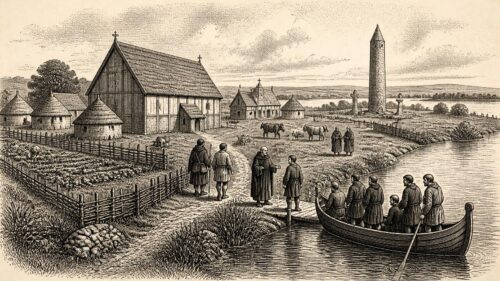
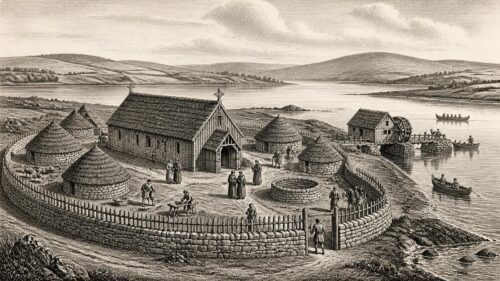
Iona became the centre most closely identified with Columba, though the surviving physical remains of Iona Abbey largely belong to later medieval rebuilding rather than to his lifetime. Archaeology and architecture can illuminate the long history of the island, but they cannot simply be read as a snapshot of the first monastery. Our richest account of early Iona comes from Adomnán, who was abbot from 679 to 704, several decades after Columba’s death. His Vita Columbae provides scenes of monks, guests, boats, barns, workshops, books, prayer and discipline. It is a work of devotion, but also a rare window onto the concerns of a major Insular monastery.
Adomnán does not arrange his work as a year-by-year biography. He groups stories under the saint’s prophetic revelations, miracles and angelic visions. This structure makes a vital point about its purpose. Columba is presented not primarily as an administrator with a career trajectory, but as a holy man through whom divine power was made visible. He foresees deaths and battles, heals the sick, calms dangerous seas, confronts threatening creatures and receives angelic visitors. These are not accidental ornaments. They form the central theological argument of the book.
For historians, this does not render the text useless. Hagiography is not straightforward reportage, but it can preserve names, relationships, places, practices and assumptions that would otherwise be lost. It tells us that Iona’s community regarded Columba as a commanding abbot, connected with rulers on both sides of the sea, protective of his monks and attentive to work and worship. It also tells us what Adomnán’s Iona wished to proclaim about itself: that its founder was holy, its traditions trustworthy and its authority recognised in a wider Christian world.
The daily rhythm suggested by the sources was demanding. Prayer structured the day; manual labour was expected; hospitality mattered; reading and writing had high value. Monks travelled by sea in small craft exposed to abrupt weather, while communications between communities depended on human memory, messengers and manuscript copies. The image of Columba blessing a storehouse before his death, whether read literally or devotionally, evokes an abbot concerned with the community’s material survival. Sanctity in such literature did not exclude management. On the contrary, good governance was part of the ideal holy life.
Royal Politics
Columba’s career unfolded amid competition among kings and dynasties. His status as a member of Cenél Conaill gave him standing in Irish affairs, while Iona’s position within the Dál Riatan sphere gave him influence in western Scotland. Adomnán depicts him meeting rulers, intervening on behalf of individuals and foretelling political outcomes. Some details are miraculous in presentation, but the broader conclusion that Columba was politically consequential is well supported.
The best-known episode concerns Áedán mac Gabráin, king of Dál Riata. Adomnán describes Columba’s role in inaugurating or ordaining him. Historians have long recognised the significance of the passage, even while debating its precise ritual and political implications. It indicates that the abbot’s blessing carried weight in royal legitimacy. Such a relationship did not mean that a saint controlled a king, nor that church and kingship were separate institutions bargaining from modern constitutional positions. It shows instead how sacred authority, dynastic interest and personal alliance could reinforce one another.
Columba is also connected with Brude, king of the Picts. Adomnán’s narrative of a visit to Brude’s stronghold has often been interpreted as an account of missionary conversion. It would be rash to claim that one encounter converted an entire people. The Christianisation of Pictland was a long and uneven process, and the sources do not permit so simple a conclusion. Nevertheless, the story supports the view that Columba and Iona had dealings beyond Dál Riata, in Pictish territory and among its rulers. The later prestige of Iona in northern Britain drew strength from such remembered contacts.
His political significance should not be exaggerated into a vision of Columba as architect of all northern British history. Much of the evidence is filtered through a seventh-century writer intent on demonstrating his saint’s foresight. Yet it would be equally mistaken to reduce the saint to a purely private ascetic. His family position and the reach of his monastic network made him a participant in public affairs. In the early medieval world, an abbot with royal kin and respected communities could be among the most influential figures in a region.
Miraculous Portrait
What, then, should modern readers do with the miracles? The answer depends on the question being asked. A historian cannot verify that Columba stilled a storm by prayer, drove away demons, or knew distant events through supernatural insight. These claims belong to the religious testimony of Adomnán’s text. They should be identified clearly as such, neither mocked as childish nor recast as plain fact. They explain how Iona understood sanctity and why the community regarded its founder as a heavenly protector.
Several miracle stories may also preserve ordinary realities beneath their sacred form. Dangerous voyages were routine in the Hebrides; an account of a calmed sea speaks to genuine maritime risk. Healing stories reflect the prevalence of illness and the value attached to prayer, blessing and holy persons. Prophecies about kings reflect the uncertainty of succession and warfare. A famous encounter with a water beast in the River Ness has become part of later Loch Ness folklore, but in Adomnán it functions chiefly as a sign of the saint’s authority over danger and pagan terror, not as a zoological report.
The literary portrait is remarkably vigorous. Columba can be tender to a distressed monk or animal, but he is also stern, quick to rebuke and formidable in presence. This is not the later sentimental image of a gentle Celtic saint communing harmlessly with nature. Adomnán’s Columba is a prophetic abbot whose anger can be righteous and whose holiness commands fear as well as affection. The same text that values humility represents him as socially commanding. That tension may offer a more useful historical impression than either romantic softness or modern sceptical caricature.
Adomnán wrote with an institutional purpose. By portraying Columba as a saint whose power extended across Ireland, Dál Riata and Pictland, he enhanced the standing of Iona in his own late seventh-century context. The Vita therefore reveals two periods at once: memories of a sixth-century founder, and the priorities of an abbey around a century later. This is not a defect peculiar to Adomnán; it is the normal condition of historical sources. Evidence must be read not only for what it says about its subject, but for why and when it was made.
Final Days
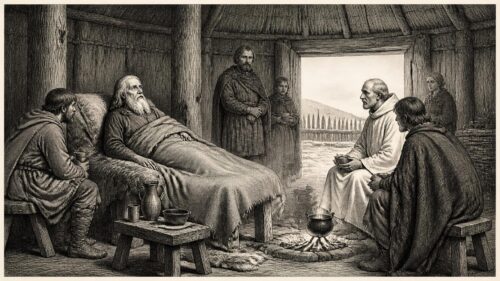
Adomnán’s account of Columba’s death is among the most moving passages in early medieval Insular writing. The saint is shown preparing his community, attending to practical stores, blessing those around him and continuing work on a Psalter. The narrative says that his copying stopped at a line whose sense is that those who seek the Lord will lack no good thing. He then goes to the church and dies in the course of night worship, surrounded by the spiritual radiance and angelic witness expected in a saint’s death.
Not every feature can be treated as documentary fact. The grieving horse that rests its head in Columba’s lap and the heavenly light seen over Iona belong to a crafted holy death scene. Yet the account plausibly preserves a community memory of a revered abbot dying at Iona in 597, and it shows what his successors thought his final example should be: prayerful, orderly, scriptural and concerned for the brethren who would remain after him.
Tradition commemorates Columba on 9 June, the feast day by which his memory entered Irish, Scottish and wider Christian calendars. His burial place on Iona became a focus of veneration. Later medieval claims connected the island with the graves of kings, saints and warriors; some are difficult to substantiate in their popular form. What can be said securely is that Iona’s sacred reputation was extraordinary and that Columba’s tomb, relics and memory were central to it.
The death of a founder does not end a foundation’s history. In Columban tradition, the authority of Columba continued through his successors, writings, relics and communities. His memory could be invoked in conflict, celebrated in poetry, embodied in manuscripts and attached to local landscapes. In this way the saint’s “life” became more than the span between birth and death. It became the continuing history of a religious familia.
Enduring Legacy
The Columban legacy remained powerful through the Middle Ages. Iona and its associated houses faced Viking raids, political change and institutional reorganisation, but the saint’s prestige was not extinguished. Kells and other Irish centres became crucial custodians of Columban tradition. Relics associated with Columba moved, were protected, displayed and invoked. The shrine of the Cathach illustrates how a manuscript could become both sacred heritage and political emblem.
Later Irish authors repeatedly remade his story. A twelfth-century vernacular life drew on older materials, while Manus O’Donnell’s sixteenth-century Betha Colaim Chille assembled and organised a vast body of tradition for a new audience in Tir Chonaill. These lives are not simply inferior substitutes for Adomnán. They are historical evidence in their own right, showing how Columba’s significance changed in medieval and early modern Ireland. They also require critical reading. The chronological distance from the saint means that their vivid anecdotes often reveal the interests of their own authors and communities rather than recoverable sixth-century events.
In the nineteenth century, Columba was claimed across denominational and cultural lines. Catholic writers, Church of Ireland historians and Presbyterian interpreters could all find a usable predecessor in the early Irish church. In Derry, devotion to Columba was expressed through rival and overlapping sacred geographies. In Donegal, local piety connected him to places of birth, protection and departure. Some supposed prophecies circulated under his name, including texts now known to have been forged in the nineteenth century. This warning matters: a famous saint’s authority has often attracted inventions as well as authentic tradition.
Modern interest in “Celtic Christianity” has often added another layer. Columba is sometimes portrayed as patron of an uncomplicated, ecological, anti-institutional spirituality. There are elements in the sources that invite reflection on sea, islands, animals and landscape, but the historical Columba was intensely ecclesiastical: a monk, abbot, reader of Scripture, leader of a disciplined community and figure involved with rulers. His world was not a modern alternative to organised religion. It was an organised Christian world in which monasteries were major centres of authority.
His importance to Ireland is therefore not limited to a birthplace or a handful of dedications. Columba illuminates the northern Uí Néill, the development of Irish monastic networks, the circulation of books and relics, Irish relations with western Scotland, and the long durability of saints’ cults. At the same time, his career cautions against narrow national ownership. He belongs deeply to Irish history and equally to the shared history of Ireland and Scotland. The sea that seems to divide these places on a modern map was, in his age, one of the roads along which people, ideas and devotions travelled.
Historical Judgement
To ask “What is the life of Columba?” is to ask two linked questions. The first concerns a sixth-century Irish abbot, born into northern aristocracy, associated with foundations in Ireland, settled at Iona and influential in the Gaelic world around the Irish Sea. The second concerns the saint constructed in texts, rituals, relics and local memory: a prophet, healer, scholar, protector and patron whose fame grew long after his death.
The historical Columba is recoverable in outline but not in every anecdote. Adomnán’s Life, the most important source, is indispensable precisely because it is not a modern biography. Its miracles cannot be treated as independently verified events, its chronology is selective, and its author wrote to honour both saint and monastery. Yet it preserves a compelling portrait of leadership, learning, kinship and travel in early medieval Ireland and Scotland. When read alongside Irish literary tradition, manuscript evidence and the histories of Columban sites, it gives Columba a clearer shape than many saints of his era.
His enduring achievement was not merely the founding of one island monastery. It was the creation, or at least the catalytic shaping, of a religious inheritance that communities on both sides of the sea made their own. Columba remains remembered because the evidence of his life was continually renewed: copied by scribes, preached by clergy, housed in shrines, written into place-names and reimagined by generations who found in him a figure equal to their hopes. That layered remembrance is not an obstacle to history. Properly understood, it is the greater part of his historical importance.

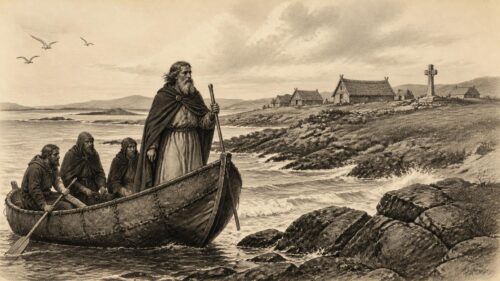
The article’s treatment of Columba’s departure to Iona is especially revealing because it distinguishes Adomnán’s image of pilgrimage from the later, compelling story of exile after Cúl Dreimne. This uncertainty highlights how traditions can express cultural concerns about books, conflict, kinship and repentance while remaining historically difficult to confirm. It also complicates modern Irish and Scottish claims that might isolate him within one national story, since his career operated across a connected Gaelic seaway. How should historians and communities balance the cultural value of the exile tradition with historical evidence for Columba as a leader within an Irish Sea world?