
Defence Reform
At a Glance
Initial Change
The archival record places the beginning of reform in the years after the Treaty, when the defence administration shifted from revolutionary command toward state structures. The Department of Defence file series notes three main numerical series created by the Ministry and Department, and states that the earliest files cover before, during, and after the formation of the Free State, including the Civil War and its immediate aftermath. This is an administrative framework rather than a full reform history. [5] [2]
A separate archival description states that the Department of Defence was established by the Ministers and Secretaries Act, 1924, and assigns it responsibility for the raising, training, organisation, maintenance, equipment, management, discipline, regulation and control of the military defence forces. The same file series notes that the A-series and 2-series span the transition into the official department. The evidence shows the assignment of powers, but not the detailed execution of each function. [2] [5]
Demobilisation Process
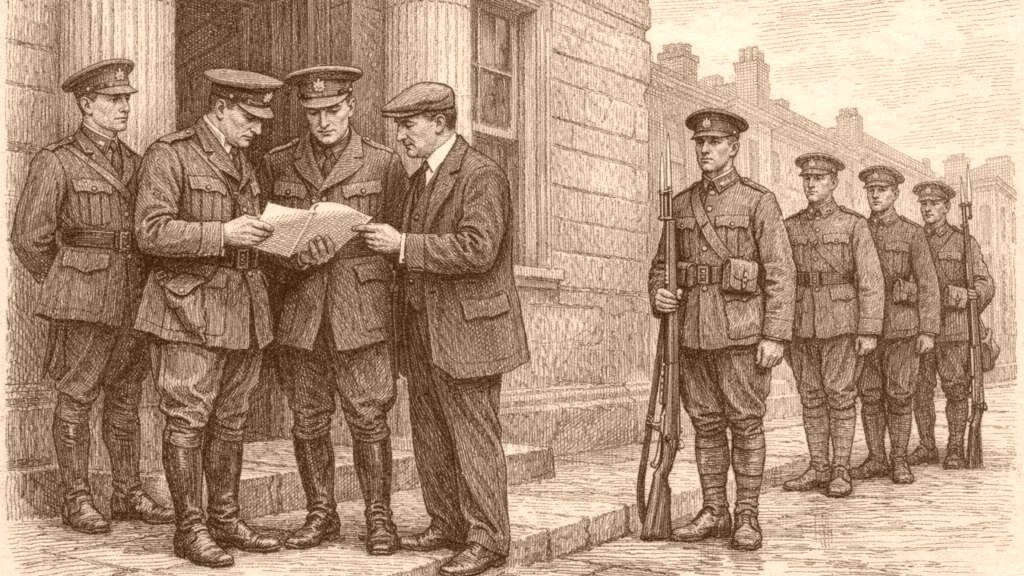
The pictorial history records that in autumn 1923 it was decided to reduce the strength of the army and reorganise it for peacetime, requiring a reduction of 30,000 personnel. It also notes that a small group of officers tried to resist demobilisation, leading to the Army Mutiny of March 1924. The passage does not describe the broader political context in detail, but it does show the scale of reduction and the existence of resistance within the force. [1]
The Military Archives summary adds that Richard Mulcahy resigned as Minister for Defence on 19 March 1924 after the mutiny, and that W.T. Cosgrave acted as Minister until 21 November 1924, when Peter Hughes was appointed. These dates mark a sequence of ministerial change visible in the archive description. The record identifies office-holding, but it does not by itself explain the policy content of each ministerial term. [2]
Administrative Foundation
The same archival description reports that, after the Civil War, the new state set about providing legal status for its armed forces, and that under the Defence Forces (Temporary Provisions) Act, 1923 the Executive Council formally established Óglaigh na hÉireann on 1 October 1924. It also notes a military mission sent to the United States in 1926 to study organisation and training methods. The passage shows institutional consolidation and later study, not a completed reform programme. [1]
The file series description likewise says that the Department of Defence records cover the Civil War period and its aftermath, while the A-series includes surviving files from the first series of departmental records. The same description notes that the later 2-series begins with the official formation of the department in 1924. Taken together, these statements show a shift from transitional files to a departmental sequence ordered by series. [5]
Organisation Board
The Army Organisation Board was set up in May 1925 by Lieutenant General Peadar McMahon to examine and report on the necessary modifications in the organisation of the Defence Forces so that they could fulfil the functions of a modern army in national defence. The description adds that the Board gathered evidence from commanders and senior officers, and studied armies in Europe and the United States. The evidence is specific about method and remit, but not about every recommendation. [3]
The same collection says the Board produced final drafts of reports and appendices on peace and war establishments, civilian personnel in barracks, and minutes of meetings. It also records correspondence between the secretary and senior officers. The documentation therefore covered structure, establishments, and administrative exchange. What remains unstated in the description is the precise content of the final proposals, which are not summarised in the brief finding aid. [3]
Financial Oversight
A 1925 committee report on the Army accounts describes severe accounting weaknesses in the earlier period. It says the absence of an adequate accounting system affected the Army accounts, that a satisfactory audit for the period ending 31 July 1922 was impossible, and that the Army Finance Department was established from 1 August 1922. The report presents improvement after that date, but only in general terms, not as a complete remedy. [6]
The same report states that no good purpose would be served by reporting in detail on every matter, but that there had not been sufficient attention to a proper accounting system when the Army was established. It also notes no satisfactory check on expenditure, prices, quality, quantity, purchases, or receipts, and says the Committee considered that some advantage was taken by trading concerns of the inexperience of Army officers. This is a financial critique, not a full policy analysis. [6]
Recorded Limits
The archive descriptions make clear that the surviving record is partial in form and scope. The Military Archives site says the material includes official records of the Defence Forces and Department of Defence and is valuable for evaluating military and departmental actions. The Department of Defence file series description distinguishes among series and notes that some files were later integrated into newer series. These descriptions help define the record, but they do not supply a full narrative of reform. [4] [5]
The same archival source also says the material covers the revolutionary period, the foundation of the National Army, and later effects of military and departmental actions. Within the excerpts used here, however, the reform story remains concentrated in demobilisation, departmental formation, and the Army Organisation Board. The evidence supports a sequence of institutional change, while leaving the detailed outcome of many proposals outside these excerpts. [4] [3] [5]
Source References
Hover over a number to see the source. Select it to open the source.

- [1] Page 14 - Defence Forces Pictorial History
- [2] Military Archives | Department of Defence A-Series
- [3] Military Archives | Army Organisation Board
- [4] Military Archives | Academic Research
- [5] Military Archives | Department of Defence File Series
- [6] Committee Reports::Final Report - Appropriation Accounts 1922 - 1923::02 April, 1925::Report

How did the early Free State record the reorganisation of its defence forces, from demobilisation and administrative formation to the later search for a modern army structure?