Year Witness605 CE
The annals preserve a small cluster of notices around 605 CE, but they do not present a full narrative for the year. In the Irish annals, the clearest 605 entries concern the death of Brandub son of Eochu, king of Laigin, and the repose or death of several ecclesiastics. Different compilations place some of these notices in 605, while others shift nearby events into adjacent years. This makes 605 best read as a year of scattered record rather than a complete sequence. The evidence allows careful comparison of dating and wording, but not reconstruction beyond what the texts explicitly state.
Dateline
Year Frame
The surviving notices do not give a continuous account of 605 CE. Instead, the year appears as a short annalistic cluster in which one compilation places several deaths and battles under 605, while another assigns nearby events to 604, 605, or 606. In Annals of Inisfallen, AI605 lists the repose of Comgall of Bennchor and then three battles: Cúil Caíl, Slemain, and Echros. The Annals of Ulster preserves a calendrical frame and distributes related notices across adjacent year labels, showing that the manuscripts do not align perfectly on the year line. [1] [3]
The most secure point is that 605 is an attested chronological slot, not that its events can be arranged into a single exact sequence. The Annals of Tigernach opens 605 with the kalends and then moves to notices about Phocas and the movement against Jerusalem. Across these texts, 605 is therefore present as a dated frame, but not as a year with a fully synchronized event list or a single agreed chronology. [2] [1] [3]
Royal Death
The clearest Irish royal notice associated with 605 is the death of Brandub son of Eochu, king of Laigin. The Annals of Ulster places his slaying under the sequence marked AD 604, identifying him as king of Laigin and saying that he was killed by his own kindred in treachery. Annals of Inisfallen likewise records the slaying of Brandub son of Eochu, king of Laigin, by his own kindred. The wording differs, but both texts agree that Brandub died by kin violence and that he was king of Laigin. [1] [3]
The dating is not uniform. Annals of Inisfallen sets the death in AI608 and explicitly notes that source-year correspondence differs from its own arrangement, while the Annals of Ulster places it in the sequence headed AD 604. That contrast means the event belongs to the immediate 604 to 608 cluster in these annals, but only one compilation places it in 605 itself. For 605, the value of the evidence is comparative: a major Leinster royal death lies close to the year, though the texts do not agree on the exact year label. [1] [3]
Battle Notices
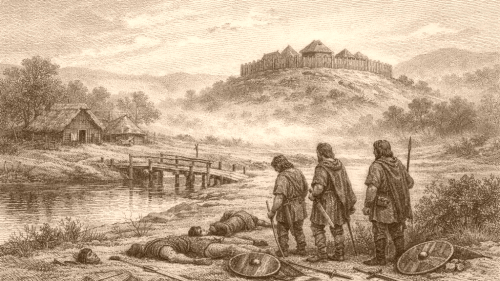
Several battle notices are attached to the same span, but their dating is unstable. In Annals of Inisfallen, AI605 lists the battle of Cúil Caíl, the battle of Slemain won by Colmán Rígmid with Conall escaping, and the battle of Echros. The Annals of Ulster, by contrast, places the battle of Slaebre and the vanquishing of Brandub under the entry marked AD 604, in the same sequence that also includes Brandub’s slaying. [1] [3]
The evidence does not allow these battles to be merged into one connected campaign. Inisfallen gives three battles without narrative links beyond the brief note that Colmán Rígmid was the victor at Slemain. Ulster separates Slaebre from the later notices in the same year sequence. Nothing in the excerpts identifies a broader military program, and nothing securely places the battles on one exact day or one exact month. The safest statement is that 605 sits within a recorded stretch of conflict, not that the year can be reconstructed as a coherent war narrative. [1] [3]
Ecclesiastical Deaths
The annals also preserve ecclesiastical notices near 605. Annals of Inisfallen records the repose of Comgall of Bennchor in AI605. The Annals of Tigernach places the repose of the abbot of Bangor in 604, and the Annals of Ulster gives a parallel notice for the repose of Beóguin, abbot of Bennchor, under AD 605. The naming is not identical across the texts, but all three show that ecclesiastical deaths were being recorded in the same chronological neighbourhood as 605. [1] [2] [3] [4]
Other clerical notices fall close to the same span, though not all belong to 605 itself. The Annals of Ulster records the death of Laisrén, abbot of Í, under AD 605, and the Annals of Four Masters places the death of St. Beoghna, abbot of Beannchair, in 605. These entries show that 605 was remembered alongside deaths of abbots and holy men, while also revealing that the exact year position shifts from compilation to compilation. [3] [4]
Comparative Reading
A comparison of the annals shows that 605 is a narrow year in the record. Inisfallen gives the year a compact sequence of religious and military notices. Ulster places the main Irish death and battle cluster across the calendrical entries for AD 604 and AD 605. Tigernach attaches 605 to broader church and world history, while Four Masters records selected Irish deaths in 605 and places other battles elsewhere. [1] [2] [3] [4]
The surviving notices also show what cannot be claimed. None of the excerpts gives a full local narrative for Ireland in 605, and none offers a continuous sequence of causes, outcomes, or political developments. The texts present short memorial notices, brief battle items, and occasional year labels. Because the year assignments differ, the safest historical account remains limited to these explicit entries and to the observation that 605 sits within a contested annalistic window rather than a firmly synchronized chronology. [1] [2] [3] [4]
Historical Limits
For 605 CE, the strongest evidence comes from the overlap of several annalistic traditions, not from a single agreed register. The year can be associated with the death of Brandub, with nearby battle notices, and with several ecclesiastical obits. Yet each of these appears in more than one chronological position across the annals, and some are displaced by a year or more. The evidence therefore supports a careful minimum: Ireland in 605 is visible in the record, but only as a small set of brief notices whose exact dating remains uneven. [1] [2] [3] [4]
That minimum is enough to distinguish secure statements from broader context. Securely, the texts record a cluster of Irish deaths and battles around 605, including Brandub, Comgall of Bennchor, and multiple conflict notices. Broader context includes papal and imperial chronology in the same annal sequences, but those entries do not add direct Irish detail for the year. A restrained reading of 605 therefore keeps the Irish notices separate from the wider chronological scaffolding and avoids turning the gap into a story. [2] [1] [3]
Source References
Hover over a number to see the source. Select it to open the source.