Saint Fursa
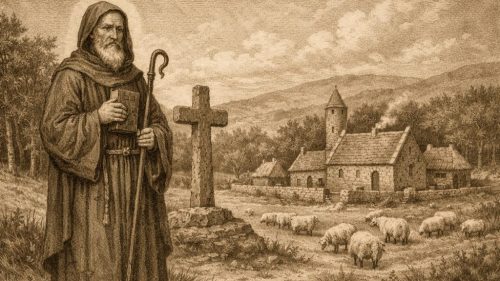
Saint Fursa, also known as Fursey or Furseus in Latin tradition, was an Irish monk and missionary of the seventh century. The surviving evidence identifies him in a Life of St Fursey in Harley MS 5041, a parchment codex in the British Library. From those sources, a limited sequence can be stated with confidence: he was from Ireland, he gained patronage in East Anglia, he later moved to northern France, and the Life was copied in the eighth century. Because the sources differ in level of detail, it is safest to keep the biographical statement brief.
Dateline
Saint Fursa, also known as Fursey or Furseus in Latin tradition, was an Irish monk and missionary of the seventh century. The surviving evidence identifies him in a Life of St Fursey in Harley MS 5041, a parchment codex in the British Library. From those sources, a limited sequence can be stated with confidence: he was from Ireland, he gained patronage in East Anglia, he later moved to northern France, and the Life was copied in the eighth century.
Irish Origins
Because the sources differ in level of detail, it is safest to keep the biographical statement brief. Fursa is represented as an Irish religious figure, and the British Library catalogue identifies a Life of St Fursey among the contents of Harley MS 5041. The evidence does not provide a fuller reconstruction of his early formation than that. What can be said is that the later tradition located his origins in Ireland and linked him with monastic life and preaching.
French Patronage
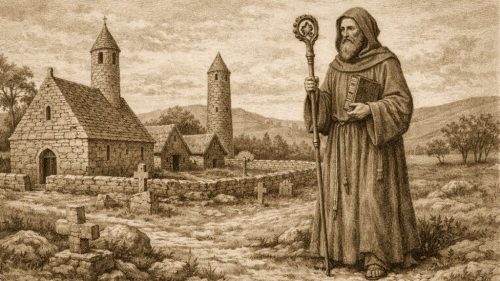
After his time in East Anglia, both sources place Fursa in northern France. The British Library record says that he received protection from Erchinoald, mayor of the palace under Clovis II, and that Erchinoald encouraged him to establish the Benedictine monastery of Lagny-sur-Marne in Seine-et-Marne. The CCEL entry similarly says that Erchinoald gave him land at Latiniacum, identified there as Lagny-sur-Marne, where he built a monastery in 644. These statements identify Lagny-sur-Marne as a site associated with his activity in Francia.
East Anglia
The British Library catalogue gives the basic outline of Fursa’s activity outside Ireland. It says that after gaining the patronage of Sigebert, king of East Anglia, he travelled to northern France in the 640s. The CCEL entry places him in East Anglia in 637 or 638 and says he was received by King Sigbert and assisted him and Bishop Felix in establishing Christianity among the only half-converted people. Both sources therefore agree on the main point that Fursa was associated with East Anglia and with royal patronage, even though they give slightly different wording and date ranges.
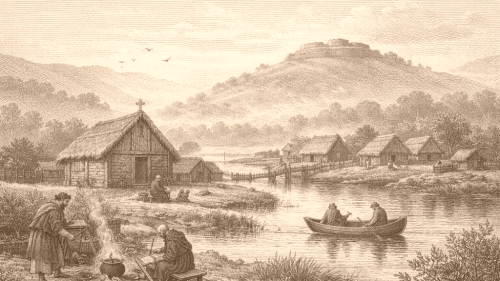
The CCEL entry adds that he built a monastery at Cnoberesburg and later retired to a hermitage with a single companion. The British Library record does not name that monastery, so any further identification should not be treated as settled in this article. What can be retained safely is the narrower point that the sources link Fursa to work in East Anglia under royal patronage. That is enough to establish that his remembered career included travel from Ireland to Anglo-Saxon England before his move to Francia.
Death Memory
The CCEL entry states that Fursa died at Macerie, identified as Mazeroeles on the Authie, in Ponthieu, in northern France, on January 16, probably in 650. It also says that he was buried at Péronne and was honored there. The British Library record gives a shorter date range, saying only that he died around 649. These statements are compatible in general outline, and they locate his death in northern France rather than in Ireland or East Anglia.
Source References
Hover over a number to see the source. Select it to open the source.
Beyond that, the sources also preserve the fact that his life was copied in the eighth century in Harley MS 5041. That manuscript contains not only the Life of St Fursey but also prayers and chants, showing that his memory had a place in liturgical or devotional book culture as well. The evidence supplied here is enough to support a restrained biographical summary: Fursa was an Irish monk-missionary remembered in a continental manuscript, associated with East Anglia and Lagny-sur-Marne, and later represented in a life that preserves his reputation as a noble-born monk and preacher. Those are the claims that the sources directly support.