Saint Canice
Saint Canice, also known in Irish tradition as Cainneach and in later English usage as Kenny, is remembered as an early Irish saint whose life belongs more to the world of ecclesiastical memory than to securely documented contemporary record. The surviving accounts place him in the sixth century, but the details of his birth, education, travels and death are not firmly established by modern historical standards. What can be said with confidence is that he became one of the best-known Irish saints associated with Ossory and Kilkenny, and that his name remained attached to churches, devotional traditions and local memory across the centuries.
Dateline
Saint Canice, also known in Irish tradition as Cainneach and in later English usage as Kenny, is remembered as an early Irish saint whose life belongs more to the world of ecclesiastical memory than to securely documented contemporary record. The surviving accounts place him in the sixth century, but the details of his birth, education, travels and death are not firmly established by modern historical standards. What can be said with confidence is that he became one of the best-known Irish saints associated with Ossory and Kilkenny, and that his name remained attached to churches, devotional traditions and local memory across the centuries.
Early Memory
Later biographical tradition gives differing particulars about his origins. Some accounts state that he was born in Ulster, while others place his birthplace in County Derry or at Glengiven. These variants should be treated cautiously, because they come from much later compilations rather than from contemporary evidence. One nineteenth-century biographical notice records him as the son of Laidec, described as a poet, and Mella, and gives a birth date in the early sixth century; however, such details are not securely verifiable from early sources alone. The broad chronological framework is usually presented as approximately c. 520 to 599, though even those dates remain approximate rather than certain.
According to traditional accounts, Canice studied in Ireland and later in Wales. Some versions say that he was sent abroad as a young man and studied under St Docus; another tradition places him under Finian at Clonfert and under Mobhi at Glasnevin. Such educational claims reflect the common medieval pattern of attaching saints to noted teachers and monastic centres. They show how Irish hagiography linked holy men to a wider network of learning, discipline and spiritual authority.
Monastic Foundations
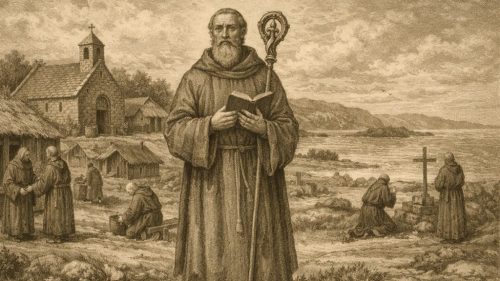
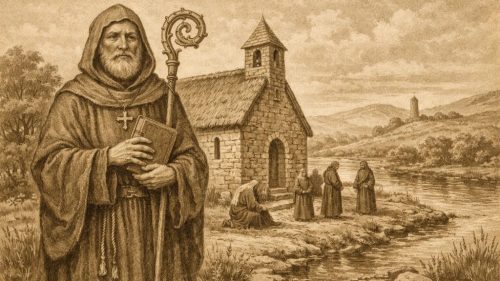
The most durable historical association of Canice is with Aghaboe in Ossory. Tradition credits him with founding a monastery there, and this site became central to his cult. In later memory Aghaboe was described as his principal church, and it was also said to have become the seat of the bishop of Ossory. That development belongs to the longer history of Irish ecclesiastical organisation, and not simply to Canice’s own lifetime, but the association with Aghaboe is foundational to his historical reputation.
Another important later association is with Kilkenny. He became patron of the city and of St Canice’s Cathedral, yet the surviving historical notices also caution that the events of his life are only slightly, if at all, connected with Kilkenny itself. In other words, Kilkenny’s devotion to him reflects the later transfer and growth of his cult, rather than a securely documented personal residence there. The cathedral and parish dedication nevertheless ensured that his name became permanently woven into the civic and religious identity of the town.
Friendship Traditions
Canice is also remembered in the rich tradition surrounding St Columba, or Colmcille. The two saints are said to have been close friends, and Columba’s Life is reported to mention Canice frequently. One well-known story tells of Columba at sea during a storm, when he said he would leave the praying to Canice in distant Aghaboe. Canice is then said to have rushed to church so quickly that one shoe flew off, and the storm immediately abated. This is a vivid devotional narrative and should be read as saintly tradition rather than as literal history. Its importance lies in what it reveals about medieval piety: the holiness of one saint could be invoked as effective intercession for another.
Another traditional claim is that Canice worked to suppress the remnants of paganism in Ireland after his ordination. That kind of statement belongs to the moral and missionary framework of hagiography. It may reflect the way later communities imagined the saintly ideal of conversion and reform, but it cannot be verified as a specific historical campaign in the modern sense.
Lasting Cult
Canice’s feast day is traditionally observed on 11 October. The persistence of that commemoration, together with dedications in Kilkenny and Aghaboe, shows how a saint’s memory could endure even when biographical detail remained uncertain. The evidence suggests a figure remembered above all as a founder, teacher and friend of other saints, rather than as a political actor or doctrinal writer. His legacy survives through ecclesiastical place names, local devotion and the stories that medieval and later writers preserved about him.
For historians, Saint Canice is therefore best approached through the overlap of tradition, cult and local identity. The early life is uncertain, the dates are approximate, and many familiar episodes belong to legend. Yet the strength of the tradition itself is historically significant. It shows how early Irish saints were remembered not only through texts, but through the churches, monasteries and civic communities that continued to honour their names long after the original age of foundation had passed.
Source References
Hover over a number to see the source. Select it to open the source.