Saint Munchin
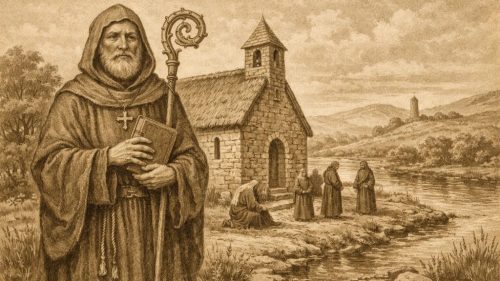
Saint Munchin is a shadowy early Irish saint whose historical outline is difficult to recover with confidence. The surviving evidence does not provide a secure contemporary biography, and no firm dates for his birth or death can be established from the sources available. What can be said with caution is that he belongs to the devotional history of Limerick, where his name has long been preserved in parish and institutional traditions. In the later history of Limerick, Saint Munchin became one of the city’s most familiar local saints. A parish in medieval Limerick bore his name, and the dedication continued in later ecclesiastical usage.
Dateline
Saint Munchin is a shadowy early Irish saint whose historical outline is difficult to recover with confidence. The surviving evidence does not provide a secure contemporary biography, and no firm dates for his birth or death can be established from the sources available. What can be said with caution is that he belongs to the devotional history of Limerick, where his name has long been preserved in parish and institutional traditions.
Historical Memory
In the later history of Limerick, Saint Munchin became one of the city’s most familiar local saints. A parish in medieval Limerick bore his name, and the dedication continued in later ecclesiastical usage. The name survives especially strongly in the city’s church history, where St Munchin’s parish is counted among the old urban parishes and where later reorganisations of parish boundaries retained his memory. The persistence of the dedication suggests a durable local cult, even though the origins of that cult are not clearly documented in early surviving narrative sources.
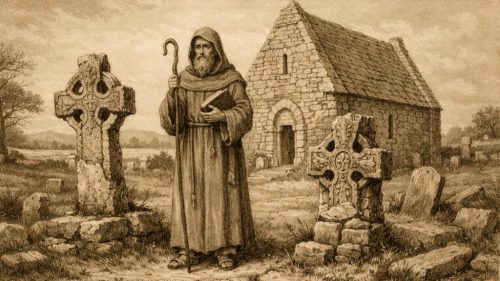
Tradition associates Saint Munchin with an early monastic presence in Limerick, and later local writing describes him as a sixth-century monk. That dating should be treated as traditional rather than securely proven. Likewise, the claim that he was a contemporary of Saint Patrick belongs to devotional tradition and later retelling, not to independently verified contemporary evidence. For a figure of this period, such uncertainty is not unusual: the history of many Irish saints was transmitted through place-names, church dedications, liturgical memory, and local legend rather than through biographical records in the modern sense.
Limerick Devotion
What stands out most clearly is the role of Saint Munchin in the religious identity of Limerick. The city’s ecclesiastical life preserved his name in parish structures, and later institutions also adopted him as patron. St Munchin’s College in Limerick explicitly places itself under his patronage, showing that the saint’s significance extended beyond the medieval period into the modern Catholic imagination of the city. Such patronage is an important clue to how a saint’s memory could remain active over centuries even when historical documentation was thin.
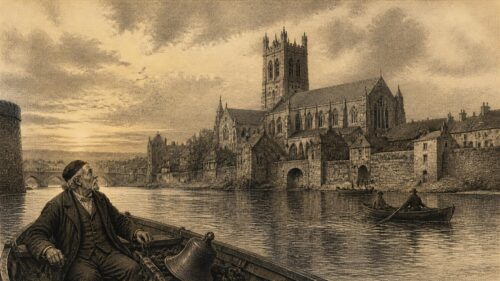
Local tradition also links Saint Munchin with a church site on King’s Island in Limerick. The surviving building history there reflects later rebuilding and changing use, but the association reinforces the saint’s deep connection with the city’s oldest sacred topography. In this sense, Saint Munchin is less a figure whose life can be reconstructed in detail than a name around which Limerick’s Christian memory coalesced.
Legendary Tradition
Because the evidence is sparse, it is important to distinguish between established historical fact and devotional tradition. Any miracles, missionary exploits, or personal details attributed to Saint Munchin belong to the saintly tradition of the region rather than to securely documented biography. The sources available here do not provide a reliable account of family background, monastic career, or an exact burial place. Nor do they establish a precise chronology.
Even so, the saint’s importance should not be underestimated. The endurance of his name in church dedications, parish identity, and educational patronage shows that he remained a meaningful figure in the religious landscape of Limerick. For historians, that endurance is itself significant. It reveals how early Irish sanctity often lived on through worship and memory, long after the historical person had become indistinct.
Enduring Presence
Saint Munchin’s biography is therefore best understood as a history of remembrance. He is a saint known primarily through tradition, local devotion, and the institutions that carried his name forward. The absence of secure dates and detailed early testimony means that caution is essential, but it does not diminish his place in Irish religious history. In Limerick especially, Saint Munchin has remained part of the city’s spiritual landscape, linking medieval parish life, later church organisation, and modern institutional identity to a single revered name.
Source References
Hover over a number to see the source. Select it to open the source.