Dicuil
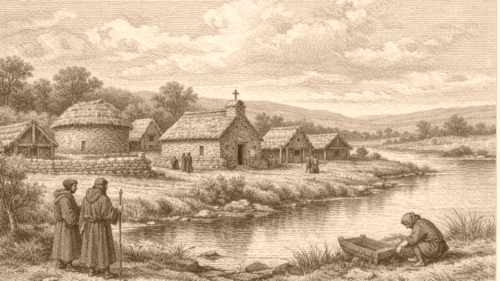
Dicuil was a ninth-century Irish monk who taught at the Carolingian school of Louis the Pious. He wrote a computus, or astronomical treatise, in Latin in about 814 to 816. The work contains a chapter on triangular and square numbers. Dicuil was an Irish monk who taught at the Carolingian school of Louis the Pious. He wrote a Computus, or astronomical treatise, in Latin in about 814 to 816. The work contains a chapter on triangular and square numbers. Dicuil was a ninth-century Irish monk who taught at the Carolingian school of Louis the Pious.
Dateline
Dicuil was a ninth-century Irish monk who taught at the Carolingian school of Louis the Pious. He wrote a computus, or astronomical treatise, in Latin in about 814 to 816. The work contains a chapter on triangular and square numbers.
Irish Learning
Dicuil was an Irish monk who taught at the Carolingian school of Louis the Pious. He wrote a Computus, or astronomical treatise, in Latin in about 814 to 816. The work contains a chapter on triangular and square numbers.
Dicuil was a ninth-century Irish monk who taught at the Carolingian school of Louis the Pious. He wrote a Computus, or astronomical treatise, in Latin in about 814 to 816. The work contains a chapter on triangular and square numbers, and it describes two methods for calculating triangular numbers: the simple method of summing the natural numbers, and a method of multiplication equivalent to the formula n ( n + 1 )/2. In the same chapter he states that a square number is equal to twice a triangular number minus the generating number, equivalent to n 2 = 2[ n ( n + 1 )/2 ] – n.
Computus Work
Dicuil wrote a Latin computus, or astronomical treatise, probably in about 814 to 816. Dicuil’s treatise survives in discussion because it contains a chapter on triangular and square numbers. In that chapter he describes two ways of finding triangular numbers, one by adding successive natural numbers and another by a multiplication method equivalent to the familiar formula for triangular numbers. He also explains the relationship between square numbers and triangular numbers.
Dicuil’s treatment includes two methods for calculating triangular numbers, one by summing the natural numbers and another by multiplication, equivalent to the formula n ( n + 1 )/2. He also states that a square number is equal to twice a triangular number minus the generating number, equivalent to n 2 = 2[ n ( n + 1 )/2 ] – n.
Geographical Writings
Dicuil is also associated with Liber de mensura orbis terrae, which Open Library lists as a work by Dicuil and classifies under the subject heading “Medieval Geography.” The record also lists several editions of the work.
The Open Library record lists Liber de mensura orbis terrae as a work by Dicuil and identifies it as a book in English and Latin. The record also notes bibliographical references and indexes in one edition, together with the subject classification “Medieval Geography.”
Historical Importance
Dicuil wrote a computus in Latin, probably in about 814 to 816, and he is also associated with Liber de mensura orbis terrae. Together these works show him as an Irish monk who wrote on computation and geography. His surviving writings include a chapter on triangular and square numbers, and they connect him with both mathematical and geographical learning in the early ninth century.
Dicuil was a ninth-century Irish monk who taught at the Carolingian school of Louis the Pious. He wrote a computus, or astronomical treatise, in Latin in about 814 to 816, and the work contains a chapter on triangular and square numbers. He is also associated with Liber de mensura orbis terrae, which Open Library lists as a work by Dicuil and classifies under “Medieval Geography.”
Source References
Hover over a number to see the source. Select it to open the source.

- [1] Dicuil (9th century) on triangular and square numbers - British Library Electronic Legal Deposit Catalogue
- [2] Dicuil (9th century) on triangular and square numbers - British Library Electronic Legal Deposit Catalogue
- [3] Liber de mensura orbis terrae - Open Library
- [4] Liber de mensura orbis terrae - Open Library
Primary Sources
- Dicuil (9th century) on triangular and square numbers – British Library Electronic Legal Deposit Catalogue
- Dicuil (9th century) on triangular and square numbers – British Library Electronic Legal Deposit Catalogue
- Liber de mensura orbis terrae – Open Library
- Liber de mensura orbis terrae – Open Library