Marianus Scotus
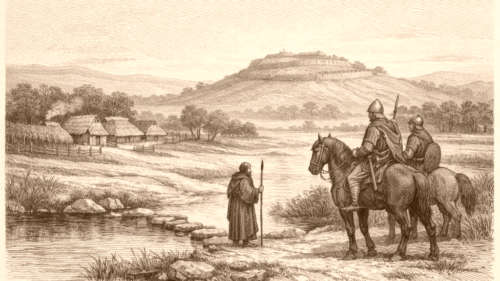
He appears in medieval scholarship under the Latinised name Marianus Scotus. He is described as an Irish chronicler, and the surviving catalogue notice for his work presents it as a world chronicle strongly shaped by chronological and computistical expositions. The surviving notices place his birth in 1028. One account says that he was a contemporary of Tigernach and that his teacher was Tigernach, whom the writer takes to be the annalist of that name. He became a monk in 1052 according to one source. The same tradition says that he left Ireland and entered the monastery of Irish monks at Cologne on Thursday 1 August 1056.
Dateline
He appears in medieval scholarship under the Latinised name Marianus Scotus. He is described as an Irish chronicler, and the surviving catalogue notice for his work presents it as a world chronicle strongly shaped by chronological and computistical expositions.
Irish Origins
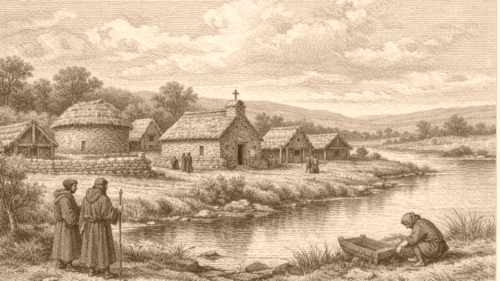
The surviving notices place his birth in 1028. One account says that he was a contemporary of Tigernach and that his teacher was Tigernach, whom the writer takes to be the annalist of that name.
He became a monk in 1052 according to one source. The same tradition says that he left Ireland and entered the monastery of Irish monks at Cologne on Thursday 1 August 1056.
Continental Life
From Cologne he later went to Fulda. One biographical notice states that he left Cologne on 12 April 1058, was ordained priest by Abbot Siegfried of Fulda at Würzburg on 13 March 1059, and on 14 May that year became a recluse at Fulda. He remained there for ten years. The same notice says that in 1069 he left Fulda by command of Siegfried, who by then was archbishop of Mainz, and settled at Mainz on 10 July 1069 as a recluse in the monastery of St Alban the Martyr.
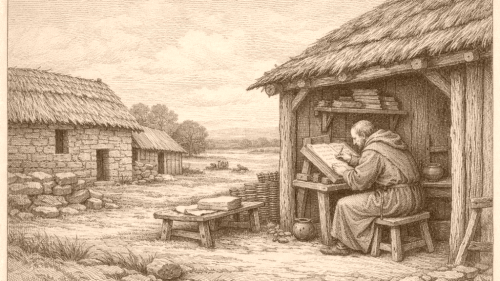
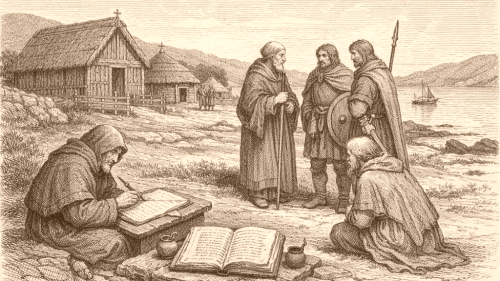
His life in these houses is tied in the sources to writing and copying. The surviving manuscript catalogue describes the chronicle as a part-autograph, and says that Marianus himself names himself in the text. It also identifies the writing as that of Marianus Scotus, and notes that a few short entries in Gaelic occur in the copy. The manuscript evidence therefore connects the work with an Irish monastic hand and with Marianus’s own participation in the text.
Chronicle Work
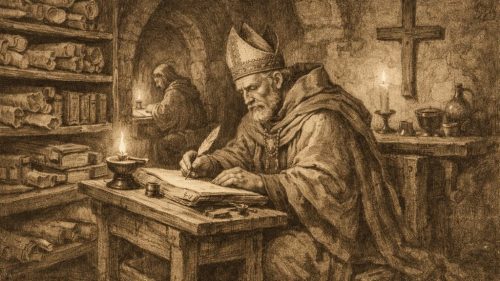
Marianus’s chief surviving work is a universal chronicle beginning from the Christian era and continuing to 1082. The surviving catalogue description says that it was written by Marianus Scotus and that it is strongly shaped by his chronological and computistical expositions. It further states that the clean copy was made in 1072 and 1073, mostly by one hand, and then completed by Marianus himself. In the following years he and another hand added further material, and Marianus later carried the continuation forward to 1082.
His chronicle is also notable for the dual chronology he attached to it. The Dictionary of National Biography states that he believed the Dionysian date of Christ’s nativity to be twenty-two years too late, and therefore added two chronological systems, one according to the Gospel and one according to Dionysius, with tables and arguments in support of his view. William of Malmesbury is cited as saying that he had only a few supporters in his own time. The same biographical notice says that the chronicle contains many references to Britain and Ireland, and that its earlier sections draw heavily on earlier authorities, including Bede.
Florence of Worcester adopted it as the basis of his own chronicle, and the work became familiar to English writers through that channel. The same notice adds that English writers often cite Florence under the name of Marianus.
Death Record
The sources do not provide a single wholly secure death date. One biographical notice says that his death is said to have taken place on 22 December 1082 or 1083 at Mainz, while another Irish biographical entry gives 1086. What can be said from the surviving notices is that the chronicle reaches to 1082 and that the biographical tradition does not agree on the year of his death.
Marianus Scotus remains a figure known through manuscript evidence, later biographical notices, and the survival of a chronicle that combines historical narrative with calculations about chronology. His life is documented chiefly through the track of his monastic movements, his work as a chronicler, and the manuscript record of the text associated with his name.
Source References
Hover over a number to see the source. Select it to open the source.