Druim Meic Erca580 CE
The surviving annal notices for 580 CE do not all use the same dating frame, so the year must be handled through the printed headings in each record. One set places material under AD 580, another under the Age of Christ 580, while a third relevant notice appears in a nearby year block with an AD 580 heading. Across these entries, the evidence records a battle, a military expedition, and a royal death, with related notices in adjacent years kept separate here.
Dateline
Annal Entries
In the Annals of Ulster, U581.0 is headed AD 580. In the Annals of the Four Masters, M580.0 is headed The Age of Christ, 580. These headings frame the relevant notices in each compilation, and they show that both texts preserve the year block in their own chronological systems rather than in a single modern format. [1] [3]
The Annals of Tigernach preserve a relevant notice in the same broad span, but with their own numbering and year marker. T580.0 introduces Annal T580, and T580.1 records a battle of Mano in which Aodhán son of Gabrán was the victor. Because the request is for 580 CE, this notice is treated here as a comparative entry rather than as a replacement for the records explicitly headed 580. The surrounding Tigernach sequence also helps confirm that these annalistic notices are grouped by year blocks and not presented as a continuous narrative. [2]
Battle Record
M580.2 states that Fearghus Scannal, King of Munster, was slain. This is a compact death notice, but it is placed under the year heading for 580 in the Four Masters, so the year association is clear even though the entry itself is brief. [3]
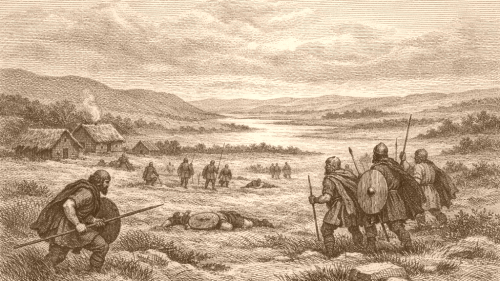
A second battle record appears in the Ulster annals under the printed heading AD 580. U581.1 gives the battle of Druim Meic Erca, while U581.2 adds the death of Baetán son of Cairell. These notices are associated here with the year block as printed, not reassigned to another date. The same annal section also records the expedition to Innsi Orc, so the year block combines conflict, movement, and death in close succession. [1]
T580.1 names the battle of Mano, in which the victor was Aodhán son of Gabrán. In Tigernach, the same battle tradition is linked with the following entry, T580.2, which says that Feargna son of Caiblene died and this is the truth of it. The wording suggests that the compiler wished to present the notice as confirmed, but the annal remains terse and gives no further battlefield detail. [2]
Military Motion
The Ulster annals place a military movement in the same printed AD 580 block. U581.3 records the expedition to Innsi Orc. The entry appears alongside the battle notice and the death notice in the same year heading, so the text preserves a cluster of events under the printed label without supplying further detail about participants, route, or outcome. The notice is therefore best read as evidence of movement rather than as a fuller campaign narrative. [1]
The Tigernach sequence gives a useful comparison for how such brief entries are arranged. T579.3 says that Baedán son of Cairell, king of Ulaid, died, and T580.2 repeats the death of Feargna son of Caiblene. Nearby entries also place the battle of Mano and the victor Aodhán son of Gabrán in the same compact year block. Taken together, these notices show that the annals often preserve only the essential event label, with names and outcomes but little elaboration. [2]
Royal Deaths
Royal death is the other major category in the year-specific notices. In the Ulster annals, U581.2 records the death of Baetán son of Cairell. In the Four Masters, M580.2 records the slaying of Fearghus Scannal, King of Munster. The two texts therefore preserve different named deaths in proximate year blocks, and they are not combined here into a single dated event. Their proximity, however, suggests a period in which the annal compilers were especially attentive to political turnover. [1] [3]
U580.0 is headed AD 579. U580.1 records the battle of Druim Meic Erce, U580.2 the expedition to Innsi Orc, and U580.3 the death of Cennalath, king of the Picts. These entries lie immediately before the year heading used for AD 580 in the same manuscript sequence, so they provide adjacent context for the notices under discussion without altering their date labels. [1]
Adjacent Context
M579.2 records the battle of Druim Mic Earca. M581.2 records the death of Aedh, son of Suibhne, chief of Maenmagh. These notices occur in the surrounding sequence, but they are separate entries with their own year headings. They show that the nearby years continue to contain comparable military and death notices, which helps situate the 580 material in the broader annalistic run. [3]
The surrounding material in the Four Masters is especially useful because it extends the pattern beyond one year. The record for 581 preserves a named death, while the record for 579 preserves a battle. The annalistic form is therefore consistent: a dated heading, followed by a small cluster of notices, and then the next year. That pattern supports a restrained reading of the 580 notices as part of a larger sequence rather than as isolated reports. [3]
Limits Noted
The notices are brief event statements. They name a battle, an expedition, and several deaths. They do not explain causes, troop numbers, or wider consequences, and they do not provide a continuous narrative. Any fuller reconstruction would therefore be interpretation rather than direct report, and the annals themselves remain deliberately compressed. [1] [2] [3]
The Ulster annals attach entries to AD 580. The Four Masters use The Age of Christ, 580. Tigernach preserves Annal T580 with associated notices. Across these works, the relevant years are recorded in parallel but not identically, and the safe conclusion is limited to the events actually named in each annal. Even where the same figures recur, the wording differs enough to caution against over-merging the records. [1] [2] [3]
Source References
Hover over a number to see the source. Select it to open the source.