Annal Year623 CE
The surviving annal entries associated with 623 CE are brief and uneven, but they still allow a careful account of what is securely attested. This narrative compares the placement of named deaths, reposes, a monastery notice, and one armed action across the Annals of Ulster, the Annals of Inisfallen, and the Annals of the Four Masters. It distinguishes events securely dated in each text from broader nearby context, and it avoids harmonizing entries beyond what the passages themselves support. Where the annals differ in year headings, that difference is noted as an observable feature of the record only.
Dateline
Yearly Frame
The year 623 CE survives in the annals as a cluster of short notices rather than a continuous narrative. In the Annals of Ulster, the annual slot marked AD 622 includes the death of Fergna, abbot of Í, the repose of Mac Laisre, abbot of Ard Macha, and Finnia, abbot of Ner, before the storming of Ráth Guala by Fiachna son of Baetán. The sequence is compact and factual, with no explanatory link between the items. [3]
The Annals of Inisfallen and the Annals of the Four Masters place nearby notices under their own year labels rather than under a single shared heading. Inisfallen gives the repose of Mac Laisre, bishop of Ard Macha, under AI624 with a cross-reference to AU 623, while the Four Masters places the death of Colman Mac Ua Bardani under M623 and later records other notices in M624. The observable point is the movement of entries, not any harmonized chronology. [2] [1] [3]
Monastic Notices
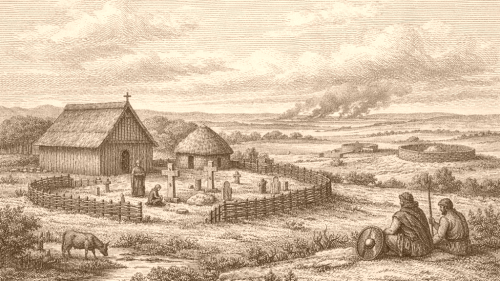
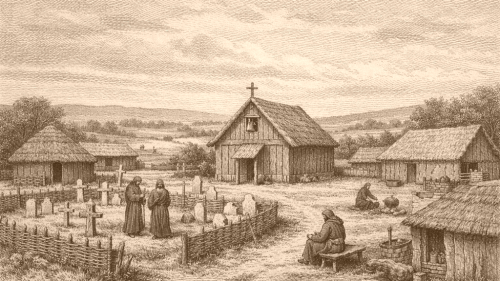
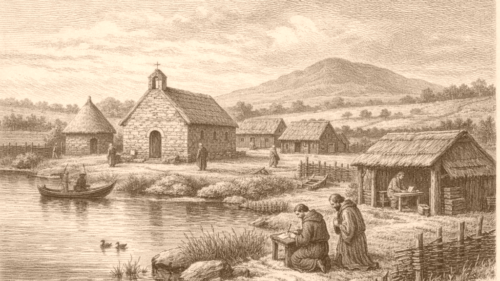
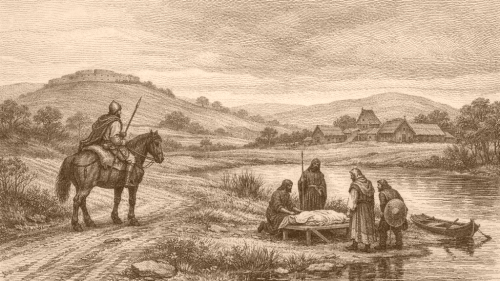
The clearest ecclesiastical notices connected with this year cluster around deaths and reposes. Ulster records Fergna, abbot of Í, and Mac Laisre, abbot of Ard Macha, while Inisfallen records the repose of Mac Laisre, bishop of Ard Macha. The Four Masters adds Colman Mac Ua Bardani, of the tribe of Dal Barrdainne and abbot of Cluain Mic Nois, who is said to have died in the 623 entry. Each notice is brief and self-contained. [3] [2] [1]
These passages differ in office titles and in the level of detail. Ulster gives abbot titles for Fergna, Mac Laisre, and Finnia; Inisfallen calls Mac Laisre a bishop; the Four Masters adds tribal affiliation for Colman Mac Ua Bardani. The wording itself is the only safe basis for comparison here. The notices do not provide a narrative of ecclesiastical succession, only individual death or repose entries. [3] [2] [1]
Battle Entries
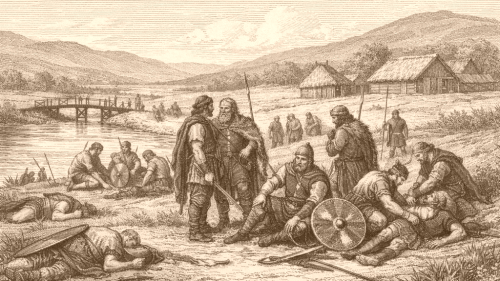
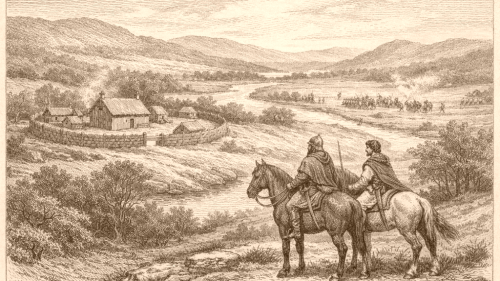
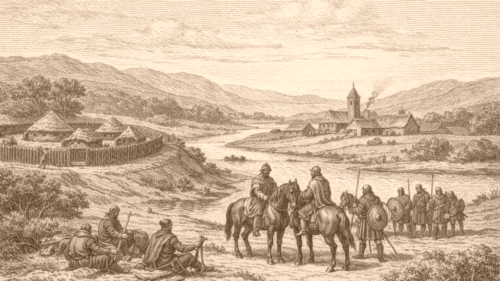
For armed action, the most direct notice in this material is the storming of Ráth Guala by Fiachna son of Baetán in Ulster. The entry is spare, naming only the action, the place, and the actor. In the same source, the notice follows the ecclesiastical deaths within the annual slot. No casualty list, motive, or outcome beyond the storming itself is supplied in the passage. [3]
A different annal places a closely related Ráth Guala notice under another heading. Inisfallen records the destruction of Ráth Guala by Fiachna son of Baetán under AI624, with a cross-reference to AU 623. The difference between storming and destruction is visible in the wording, and the different year labels are equally visible. Those are the only secure observations available from the excerpts themselves. [2] [3]
Dating Patterns
The year headings do not line up perfectly across the annals, and that mismatch is itself an observable feature. Ulster marks AD 622 before the notices for Fergna, Mac Laisre, Finnia, and Ráth Guala, while Inisfallen uses AI624 for the repose of Mac Laisre and the destruction of Ráth Guala, both with cross-references to earlier Ulster years. The sources show placement differences, not a single uniform chronology. [3] [2]
The Four Masters also presents its notices within its own sequence. Its M623 entry contains the death of Colman Mac Ua Bardani and the killing of Suibhne Meann by Congal Claen at Traigh Brena, while M624 begins with the first year of Domhnall, son of Aedh, son of Ainmire. Because these entries stand in different annual slots within that compilation, they cannot be rearranged by default into Ulster's or Inisfallen's dating. [1]
Four Masters
The Four Masters entry for M623 is especially compact. It begins with the age formula for 623, then notes the death of Colman Mac Ua Bardani, followed by the statement that Suibhne Meann had been thirteen years in the sovereignty of Ireland before he was slain at Traigh Brena by Congal Claen. The passage combines ecclesiastical death and royal killing, but it does so without further elaboration. [1]
The neighboring Four Masters entries show the transition to later years, but they should remain separate from M623. M624 opens as the first year of Domhnall, son of Aedh, son of Ainmire, and then lists other notices such as the deaths of St. Colman Stellan and St. Maedhog, the death of Ronan son of Colman, and the battle of Dun Ceithern. Those are later entries in that same compilation, not part of the 623 line. [1]
Ulster Context
Ulster's annual sequence around this period offers a broader context of deaths, battles, and reign notices, but the evidence must stay within each entry's own date. The same source gives AD 621 with the battle of Cenn Deilgthen, AD 622 with the death of Fergna and the storming of Ráth Guala, and AD 623 with the death of Rónán son of Colmán, Colmán of Stiallán, and the killing of Dor son of Áed Allán. These are adjacent annual slots, not one continuous narrative. [3]
The same source then continues with AD 623 and the births of Adamnán in the following annual slot, but that notice belongs to Ulster's own chronology and should not be transferred to other annals. The record also moves on to AD 624, where it reports a dark year and other deaths. This lets us observe the source's yearly sequence, yet it does not justify merging its headings with those of the other compilations. [3]
Inisfallen Reading
Inisfallen preserves another small cluster of notices around this period. Under AI623 it records the battle of Cenn Delgthen, in which the two sons of Librén son of Illedan son of Cerball fell, and says that Conall son of Suibne son of Colmán was victor. The entry is concise and named, with the battlefield, the casualties, and the victor all explicitly stated. [2]
The same compilation then moves to AI624, where it records the repose of Mac Laisre, bishop of Ard Macha, the repose of Fergna, abbot of Í, and the destruction of Ráth Guala by Fiachna son of Baetán. Because these notices are grouped under one heading in Inisfallen, they provide a clear example of the source's own yearly arrangement without requiring any reconstruction beyond the text. [2]
Secure Limits
The securely dated material for 623 CE is limited but real. Across these annals it includes named ecclesiastical deaths or reposes, one notice of Ráth Guala being stormed or destroyed by Fiachna son of Baetán, and a few nearby battle and death notices that remain tied to their own annual headings. The evidence supports comparison of placement and wording, not a fuller narrative of causation or outcome. [3] [2] [1]
A careful account of Ireland in this year therefore stays close to each entry's own wording and date label. The sources show that the same broad period can be divided differently across compilations, and they show that some notices are shared in theme while differing in office title or year heading. Beyond that, the passages themselves remain silent, and that silence is part of the historical record here. [3] [2] [1]
Source References
Hover over a number to see the source. Select it to open the source.