
Baltimore Raid — Raid Night
At a Glance
Harbour Setting
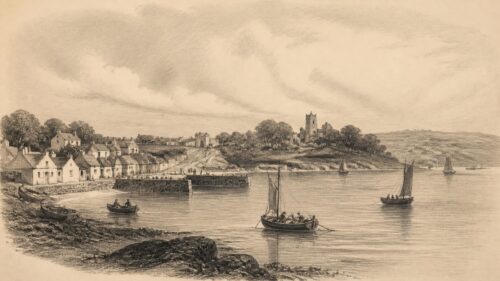
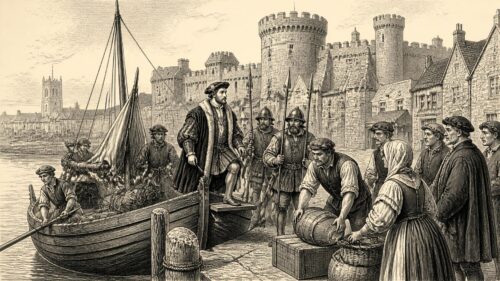
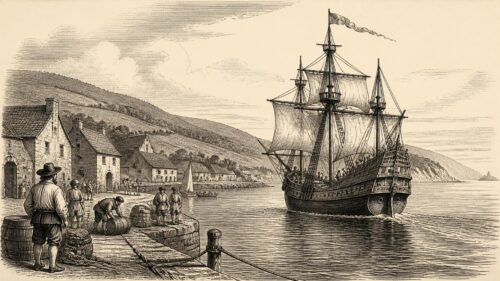
The accounts place Baltimore on the Cork coast as a fishing community tied to the sea and to summer traffic in pilchards. One narrative describes neat rows of houses beside the harbour, a cove settlement below, and a second group of dwellings inland, with stalls, alehouses, workshops, a church, fairs, and a weekly court. Another says the place depended on the pilchard industry and that its summer life began with watchers on the cliffs looking for the first shoals. The settlement appears, in these descriptions, as busy rather than remote. [7] [5]
The setting also includes older layers of ownership and trade. One account says the Protestant colony had been planted there at the start of the century and that its wealth rested on pilchards rather than piracy. Another notes that Baltimore was not entirely reformed, since merchants still bought goods without asking too closely where they came from. In these passages, the village stands between an ordered civic life and a more shadowed coastal economy, though the texts do not fully resolve how far the two overlapped. [7]
Raid Night
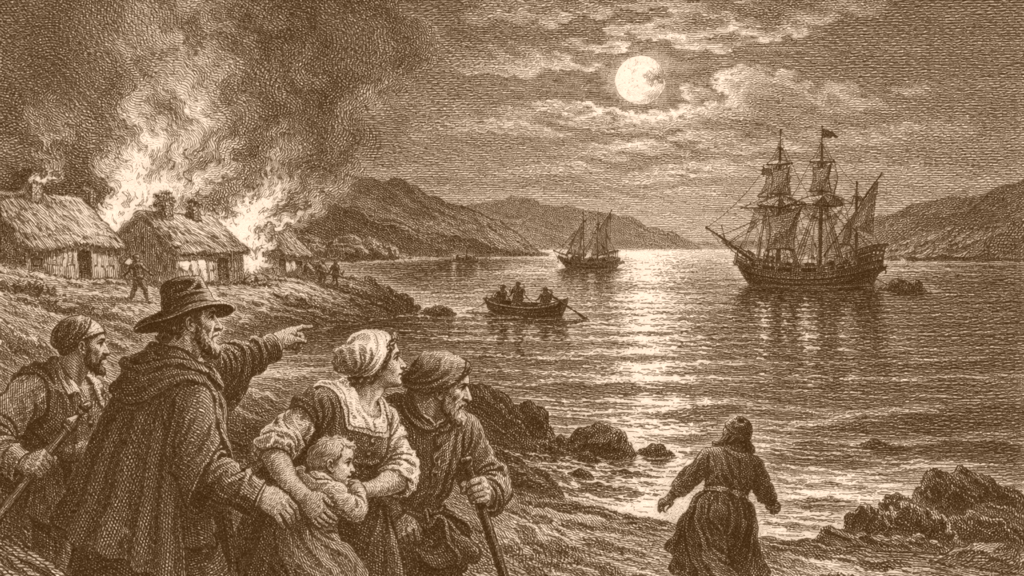
The raid is described as a night attack in June 1631. One account says the residents of Baltimore Cove woke in the early hours of June 20 to find the village in flames and armed men in the streets. Another gives a more minute sequence: ships anchored near the harbour mouth, a landing before dawn, and men sent ashore with firebrands and tools for breaking doors. The timing is consistent across the passages, even where the exact hours are not identical. [4] [6]
The attacking force is also presented in broadly similar terms. One passage calls them Barbary pirates and says the captives were carried to North Africa, while another says the boats were manned with Turks and renegadoes. A later account identifies the leader as Morat Rais and names Janissaries among the attackers. These descriptions overlap in portraying an Islamic North African raiding force, but they do not offer a single uniform label for every participant. [5] [6] [4]
Village Life
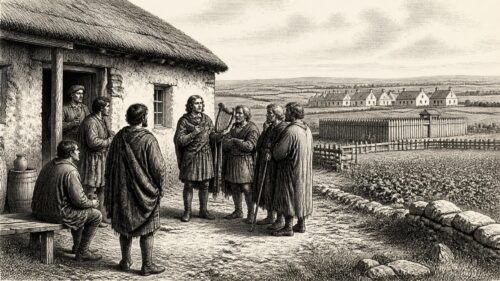
The narratives make clear that Baltimore was not an empty shore settlement. One account says that around two hundred people lived beside the harbour and another hundred a little lower down, among alehouses, workshops, and market activity. A different retelling refers to the village as an English settlement founded by Protestant dissenters seeking freedom and fisheries. The passages therefore show a community that was both commercial and settler-based, though they stop short of explaining every social relation within it. [7] [5]
Family loss is visible in the lists and summaries attached to the raid. One article notes that 107 captives were taken and that women and children formed the great majority, including eight members of one family. Another says about 100 people were seized from the cove and that more were taken from the inland part of the village. These figures are not identical, but both records point to a broad sweep through domestic space rather than a single targeted seizure. [4] [6]
Defence Response
Resistance appears in the accounts as improvised and local. One version says a villager fired musket shots and another beat a military tattoo on a drum, after which the attackers withdrew from the inland village. Another says William Harris, awakened by the noise, fired shots and rallied neighbours who sounded the drum, forcing the raiders back to their ships. The common element is not organised military defence but alarm, noise, and the use of a few immediate weapons. [4] [6]
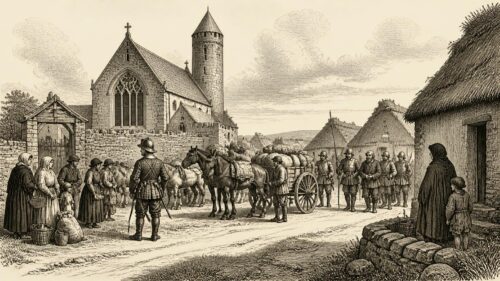
The accounts also show how far help was from hand. One says the nearest garrison lay more than fifty miles away, and another relates that messages went to Castlehaven, Kinsale, and Mallow before a response could be organised. Even then, the ship sent to pursue the attackers could not regain sight of them. The evidence here emphasizes delay, distance, and the limited reach of local authority at the moment of attack. [4] [6]
Captives Fate
Both the shorter and fuller accounts agree that the captives were taken away by sea and headed for North Africa. One says they were dragged off to waiting ships and bound for the slave markets of Algiers; another says the men, women, and children were carried away by the Turk. The later summary also states that only two would see Ireland again. These are stark claims, but the excerpts do not trace each individual’s later life in equal detail. [4] [5] [6]
The later commentary adds a little more about captivity without resolving it entirely. It says that little is known about the prisoners’ lives in North Africa, though some men may have ended up in the galley and some women in harems, while others could earn freedom. It also notes that by 1634 an English consul in Algiers reported many of the Baltimore prisoners dead or turned Turk. This remains a partial picture, built from analogy and one later report rather than a full captive record. [4]
Historical Memory
The raid survives through more than one kind of text. The annals files identify editorial work, manuscript traditions, and the use of translations for the Annals of Ulster and the Annals of the Four Masters, while other pages list Baltimore in modern retellings and summaries. The surviving material therefore comes to the reader as edited annalistic text alongside later narrative and journalistic versions, not as a single uninterrupted witness. That difference matters when weighing detail against reliability. [1] [3] [2]
In these materials, the Baltimore story is not presented as a single settled formula. One article frames it as a famous pirate raid, another as an exotic chapter of Irish history, and a longer retelling expands it into a social world of markets, fisheries, and maritime networks. The evidence supports comparison, not certainty on every point. What can be said securely is that Baltimore was remembered as a coastal settlement overwhelmed at night and drawn into a wider Mediterranean slave-trading world. [4] [5] [7]
Source References
Hover over a number to see the source. Select it to open the source.

- [1] Annals of Ulster
- [2] List of Irish Texts at CELT
- [3] Annals of the Four Masters
- [4] An Irishman's Diary – The Irish Times
- [5] Pirates of the Cork coast – The Irish Times
- [6] Sack of Baltimore, Co. Cork, 1631
- [7] Fishers of Men: The Sack of Baltimore - Pirates of Barbary: Corsairs, Conquests and Captivity in the 17th-Century Mediterranean


How do the surviving annalistic and later narrative accounts describe the 1631 raid on Baltimore, and where do they diverge on the attackers, the capture, and the aftermath?