

Gonna Cam at Rosreagh1555 CE
In 1555 An Calbhach Ó Domhnaill, aided by Archibald Campbell’s Scottish troops and artillery, overthrew and imprisoned his father Manus, lord of Tír Chonaill, initiating prolonged conflict and devastation in Donegal. The coup demonstrated Gaelic rulers’ reliance on maritime alliances, mercenaries, castles and gunpowder. Elsewhere, Hugh Ó Néill of Upper Clandeboye was killed by Scottish gunfire, amid enduring MacDonnell expansion in Ulster. Dublin’s authority remained limited, while annalistic dating of official campaigns requires caution. Marian restoration included papal recognition of Philip and Mary and St Patrick’s cathedral’s revival. Notices from Thomond and Youghal reveal negotiated regional politics and overseas links.
Dateline
In 1555, the most consequential Irish development securely associated with the calendar year occurred in the north-west: An Calbhach Ó Domhnaill used Scottish assistance, sea power and artillery to overthrow his own father, Manus, lord of Tír Chonaill. The episode was both a family seizure of power and a sharp illustration of Ireland’s wider political world. Gaelic lordships were not isolated survivals from an older age. Their rulers negotiated across the North Channel, hired professional soldiers, maintained castles, used written agreements and understood the value of gunpowder weapons. Yet authority could remain intensely personal, resting on kinship, hostages, military followings and the ability to protect — or devastate — a countryside.
A Coup Across the North Channel
Calvagh was the eldest son of Manus Ó Domhnaill, a long-established ruler of Tír Chonaill, broadly corresponding to much of modern County Donegal. Manus had combined lordship with considerable cultural ambition. He had sponsored learned men, compiled a life of St Colum Cille and governed through a household capable of making agreements and preserving records. That background makes the events of 1555 especially striking: succession was not a smooth inheritance, and a formidable father could be displaced by an adult son with stronger allies and more immediate military resources.
In 1555 Calvagh crossed to Argyll. There he concluded an agreement with Archibald Campbell, fourth earl of Argyll, for military assistance. The reported terms were exacting: a perpetual annual payment of 400 Scots marks in return for 500 Campbell soldiers. The bargain reminds us that the sea between Donegal and western Scotland was a route rather than a frontier. Gaelic-speaking communities on both sides were linked by lordship, marriage, mercenary service, trade and raiding. Scottish redshanks and island warriors could be recruited for campaigns in Ireland, while Irish political disputes offered Highland magnates both profit and influence.
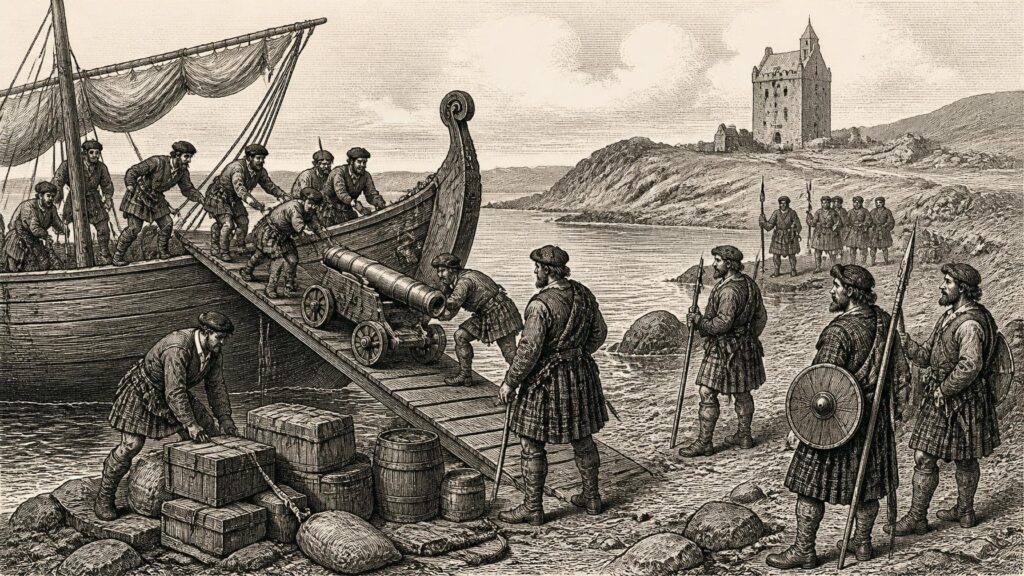
Calvagh returned by sea to Inishowen with the Campbell force and a piece of artillery remembered as Gonna Cam, the ‘crooked gun’. The Annals of the Four Masters credit it with demolishing Newcastle in Inishowen and the castle of Eanach. Such claims should not be treated as a technical report of a single bombardment, but they are valuable evidence for what contemporaries considered decisive: artillery could make even a lordly stone stronghold vulnerable. Castles remained centres of residence, storage, detention and local command, but their defensive meaning was changing where a ruler could obtain cannon, powder, shot and trained operators.
Rosreagh and Lifford
Calvagh then captured Manus at Rosreagh, near Kilmacrennan. He confined his father in Lifford Castle, where Manus remained until his death in 1563. This was not simply an English or Scottish intervention imposed upon an Irish society from outside. Calvagh initiated the enterprise, used external allies for a dynastic purpose and took control within the political forms of his own lordship. His Scottish troops nevertheless made the change of rule exceptionally destructive. The Four Masters say that Calvagh returned with a large body of Scots to ravage Tír Chonaill; the chroniclers’ language registers the cost borne by communities whose cattle, food stores, dwellings and labour could be consumed by a lord’s struggle for mastery.
The chronology deserves care. The annals place the whole sequence under 1555 and add that the Scottish force arrived around All Hallows, remaining until the following feast of St Brendan. That last span plainly runs into 1556. It is therefore responsible to place Calvagh’s Scottish expedition, artillery and seizure of Manus in 1555, as modern biographical research does, while recognising that the occupation and its effects extended beyond the year. The coup was not a moment frozen at Rosreagh; it began a prolonged and bitter contest within Tír Chonaill.
Its political consequences were immediate. Manus had been a major northern lord, and his imprisonment removed a ruler whose authority had been built through warfare, diplomacy and patronage. Calvagh acquired the title and the castles, but not uncontested security. His brother Aodh opposed him, and the weakening of Tír Chonaill invited the ambitions of neighbouring powers, above all the Ó Néills of Tyrone. The struggle that followed would make Donegal a central theatre in Ulster politics. For 1555 itself, however, the essential fact is the successful deposition of Manus by his son, backed by a calculated Scottish alliance.
Gunfire in Clandeboye
Another annalistic notice from 1555 records a different encounter between Ulster’s Gaelic rulers and Scottish incomers. Hugh, son of Niall Óg Ó Néill, lord of Upper Clandeboye, was killed by Scots “with the shot of a ball”. He was remembered as a powerful defender of his territory, a ruler who had received hostages rather than surrendered them. The phrasing is revealing. Whether the projectile came from a handgun or heavier ordnance cannot safely be recovered from the entry, but it shows that firearms had become part of political violence in Ulster. A chief’s death by shot carried a significance beyond the battlefield: it unsettled succession, alliances, landholding and the security of dependants.
Clandeboye, around the lower Bann, Lagan and Belfast Lough districts, was already divided between rival branches of the Ó Néill kindred. This fragmentation limited the ability of local rulers to resist the advancing MacDonnell interest from the Hebrides and western Highlands. By the middle of the decade, the MacDonnells had established themselves in the Glens of Antrim and Dufferin and were pressing towards the Route and northern Clandeboye. They were not merely temporary raiders: their movement involved settlement, castles, marriages, mercenary followings and claims to territorial authority. Hugh’s death therefore belongs to a regional shift in which Scottish Gaelic power was becoming an enduring fact in north-east Ireland.
Authority Beyond Dublin
The year also exposes the limits of Dublin government. The Four Masters place under 1555 the arrival of Thomas Radcliffe, Lord Fitzwalter, as lord justice and a campaign against the MacDonnells and other Scots. Modern administrative evidence, however, dates Radcliffe’s appointment to 27 April 1556 and his major Antrim campaign to July 1556. That discrepancy matters. The annal entry is important testimony to how later Irish chronicle tradition organised events, but the campaign should not be claimed as a firmly dated event of 1555. It is a useful warning against turning every annal heading into an exact modern date.
What can be said for 1555 is that the crown’s position was uneven. Mary I was queen of Ireland under the title created by the Irish parliament in 1542, but effective royal administration was concentrated in Dublin, the Pale, garrisoned places and allied lordships. Elsewhere, political order was negotiated with magnates rather than simply commanded. In Munster, the annals report that an armed meeting between Donnell Ó Briain of Thomond and the lord justice ended in peace, with an agreement described in broad territorial terms between the Barrow and the Shannon. Even allowing for the compressed language of the chronicle, the episode shows diplomacy working through regional rulers and armed assemblies, not through a uniform state apparatus.
At Rome, Pope Paul IV issued a bull dated 7 June 1555 recognising Philip and Mary jointly as king and queen of Ireland. It was a diplomatic and ecclesiastical confirmation of a royal title whose legal basis in Ireland dated from 1542, and it also repudiated the Henrician and Edwardian break with papal obedience. Its practical reach should not be exaggerated. The bull did not settle lordship in Tír Chonaill, halt Scottish expansion in Antrim or make Dublin’s authority uniform. Its importance lay in the language of legitimacy: Ireland was placed within the Marian Catholic restoration and within the international claims of the papacy and the Habsburg-linked monarchy.
Churches, Towns and Households
Religious life in 1555 cannot be reduced to the bull. The Marian restoration was being expressed in institutions: St Patrick’s in Dublin was restored to cathedral status during the year. In Gaelic regions, meanwhile, ecclesiastical patronage, learned families and older devotional networks continued to matter. Manus Ó Domhnaill’s earlier literary and religious patronage had helped to make Tír Chonaill a centre of Gaelic learning, and his imprisonment did not erase the scribes, clerics, poets or hereditary professionals attached to such a lordly world. The violence of succession, however, made their livelihoods precarious, since hospitality, payments in livestock and the protection of patrons were essential to cultural work.
One small urban notice offers a contrasting glimpse of coastal Ireland. William Annyas was mayor of Youghal in 1555. Later tradition identifies him as a Portuguese Jewish refugee or converso, while the surviving evidence is thinner than the confident modern claim that he was certainly Ireland’s first Jewish mayor. The office itself is secure enough to illuminate Youghal’s character: a chartered port town with municipal government, merchant networks and connections reaching beyond local Cork society. The Annyas name also points towards the Atlantic and Iberian worlds that touched Irish ports through commerce, migration and service.
For most people, the year’s larger movements were experienced in practical terms. Armies and mercenary bands needed cattle, grain, lodging, boats, labour and intelligence. A campaign or a dynastic coup could mean forced quartering, the removal of herds to safety, damaged crops, disrupted markets and fear of castle-based reprisals. Yet the same landscape sustained exchange: harbours connected Donegal and Antrim to Scotland, while towns such as Youghal linked Munster to wider commercial routes. In 1555, cannon at Rosreagh, a ruler’s captivity at Lifford, a fatal shot in Clandeboye and a papal act in Rome all formed part of an Ireland whose local worlds were increasingly entangled with the Irish Sea, Europe and the ambitions of rival dynasties.
Primary Sources
- Annals of the Four Masters, Part 6: Annal M1555
- CELT: Annals of the Four Masters — Document Details
- O'Donnell (Ó Domhnaill), An Calbhach — Dictionary of Irish Biography
- O'Donnell, Manus (Ó Domhnaill, Maghnas) — Dictionary of Irish Biography
- O'Neill, Niall Mór — Dictionary of Irish Biography
- MacDonnell, James — Dictionary of Irish Biography
- MacDonnell, Colla — Dictionary of Irish Biography
- MacDonnell, Sorley Boy — Dictionary of Irish Biography
- Radcliffe, Thomas — Dictionary of Irish Biography
- St Leger, Sir Anthony — Dictionary of Irish Biography
- O'Brien, Conor — Dictionary of Irish Biography
- O'Gallagher, Redmond — Dictionary of Irish Biography
- Añes, William — Dictionary of Irish Biography
- Copy of the Bull of Pope Paul IV by Which He Makes Over the Kingdom of Ireland to Philip and Mary, June 7, 1555 — National Library of Ireland Catalogue
- Bull of Pope Paul IV, 1555 — Documents on Ireland
- Fiant: 3 & 4 Philip and Mary, Item 118, 5 September 1555 — Virtual Treasury
- Archbishop Dowdall and the Restoration of Catholicism in Dublin, 1553–5
- A History of Worship on the Site — Saint Patrick's Cathedral, Dublin
- Timeline Events: Jewish Mayor of Youghal in County Cork — Irish Jewish Museum
- Submission of Brien Mac Maghon and Hugh Oge Mac Maghon; Orders Taken Between Manus, Calvagh and Hugh O'Donnell — National Library of Ireland Sources Database
- Council Books of the Corporation of Youghal — Irish Archives Resource
- Youghal — Irish Historic Towns Atlas