
Tara Assemblies
At a Glance
Assembly Context
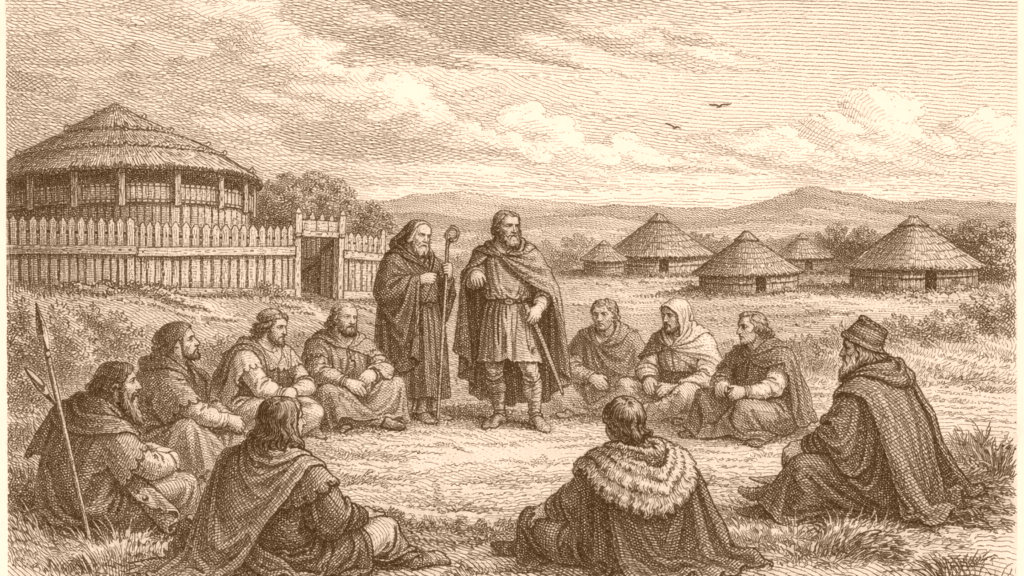
The clearest directly described setting in the retrieved material is Geoffrey Keating’s account of the Feis of Tara and the related gatherings at Eamhain and Cruachain. He presents these as general assemblies in Ireland, and he distinguishes the purposes assigned to them. Tara is mentioned as a place whose earlier business had already been set down, while the other two gatherings are linked to the approval of craftsmen and to the distribution of masters across districts. [3]
Within the same passage, Keating gives the assemblies a social and administrative role by saying that masters were selected and then sent throughout Ireland, with restrictions on who could practise a craft. The language is concrete rather than seasonal: no annual feast or autumn calendar marker appears in these lines. For that reason, these excerpts support discussion of assembly and regulation, but not a direct claim about Samhain itself. [3]
Royal Time
Keating’s narrative then places kings, battles, and deaths within reigns rather than within a named seasonal framework. He says that in the time of Oilill Molt, Benignus died, that the Leinstermen fought the Battle of Dumha Aichir, and that the Battle of Ocha was fought against Oilill Molt. These notices give a sequence of royal time and conflict, but the excerpt does not connect them to Samhain or any other festival name. [3]
The same stretch of text also ties several events to reign-years and succession. Keating states how long Lughaidh son of Laoghaire held the sovereignty of Ireland and gives comparable durations for other kings. He also records the death of Patrick in the nineteenth year of Lughaidh’s reign. These are chronological markers, yet they remain broad and dynastic; they do not narrow the events to an autumn observance. [3]
Battle Notices
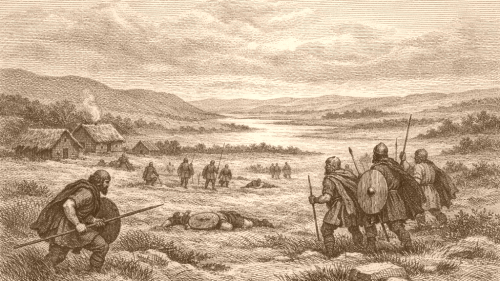
The battle notices in Keating’s passage are numerous and specific. He names Dumha Aichir, Ocha, Ceall Osnadh, Graine, Sleamhain Mhidhe, Seaghais, and Lochmhagh, often with the victors and the fallen. This material is useful because it shows how the text clusters warfare around reign narratives. Yet the evidence remains literary and chronological, not calendrical, and it does not provide a direct samhain entry. [3]
Some passages add remembered poetic lines to the prose record, especially for Ocha, Ceall Osnadh, and Seaghais. Those inserted verses reinforce the same events while giving them a commemorative form. Still, the excerpts only establish that the compiler is capable of embedding verse inside historical narrative. They do not show that the battles were dated to a feast, nor do they identify a seasonal observance behind them. [3]
Chronicle Form
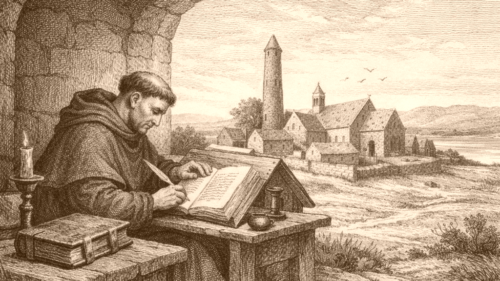
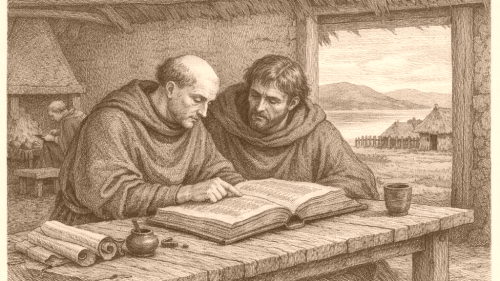
The Annals of Ulster and the Annals of the Four Masters are described here mainly through editorial and manuscript information. The Annals of Ulster are linked to several manuscripts, lacunae, multiple scribes, and a modern edition; the Four Masters are likewise presented through manuscript sources, scribal hands, and later editions. These descriptions are bibliographical rather than historical narrative, but they show the documentary setting in which Irish chronology survives. [2] [1]
The manuscript notices also make clear that the chronicles survive in imperfect and overlapping forms. The Annals of Ulster have lacunae for several year ranges, while the Four Masters are preserved in autograph or transcript traditions spread across multiple libraries. These facts matter for caution, because they show that the present excerpts are mediated by complex textual histories. They do not, however, authorize any specific inference about Samhain from the surviving descriptions alone. [2] [1]
Textual Limits
A notable feature of the retrieved evidence is what it does not say. None of the cited excerpts names Samhain, explains its rites, or places an event explicitly on that feast. Instead, the material alternates between assembly, kingship, battle, manuscript description, and editorial notes. That absence is important, because it prevents a confident seasonal reconstruction and keeps the historical discussion within the bounds of the actual passages. [3] [2] [1]
The safest interpretation is therefore comparative rather than identificatory. Keating supplies named assemblies and reign-linked events; the annals supply the framework of chronicle preservation; neither set of excerpts provides a direct Samhain narrative. Any stronger conclusion would go beyond the evidence. The most that can be said is that later readers interested in Samhain may find adjacent material on Irish assembly time, but not the feast itself. [3] [2] [1]
Historical Reading
Read together, the passages illustrate how medieval Irish historical writing can organize memory around assemblies, reigns, and battles while later editorial work preserves the textual scaffolding around them. Keating’s narrative is the only one in the set that describes a social institution in any detail, and even there the emphasis falls on the function of assemblies. The annalistic excerpts contribute context through manuscript tradition rather than through samhain-specific narrative. [3] [2] [1]
From the evidence available here, the historical question is less about identifying Samhain than about tracing how Irish texts frame time without naming every season. The safest conclusion is modest: these excerpts preserve assembly culture, dynastic chronology, and battle memory, but they do not directly document a Samhain event. That restraint is itself part of responsible historical reading, because it distinguishes observable text from later expectation. [3] [2] [1]
Source References
Hover over a number to see the source. Select it to open the source.

How do the retrieved medieval and early modern Irish texts describe the convening and calendrical framing of major assemblies and reign events in relation to the seasonal markers that later readers may associate with Samhain?