
Storm Chandra Response
At a Glance
Storm Landfall
Storm Chandra entered the record as a severe weather event that brought strong winds, heavy rain, flooding, and power outages across the country. RTÉ’s coverage described widespread disruption and the start of major clean-up operations after the storm. The Irish Times account likewise noted that Met Éireann had issued a Status Yellow rainfall warning for six counties, placing the event within an active sequence of weather alerts and response reporting. [1] [3]
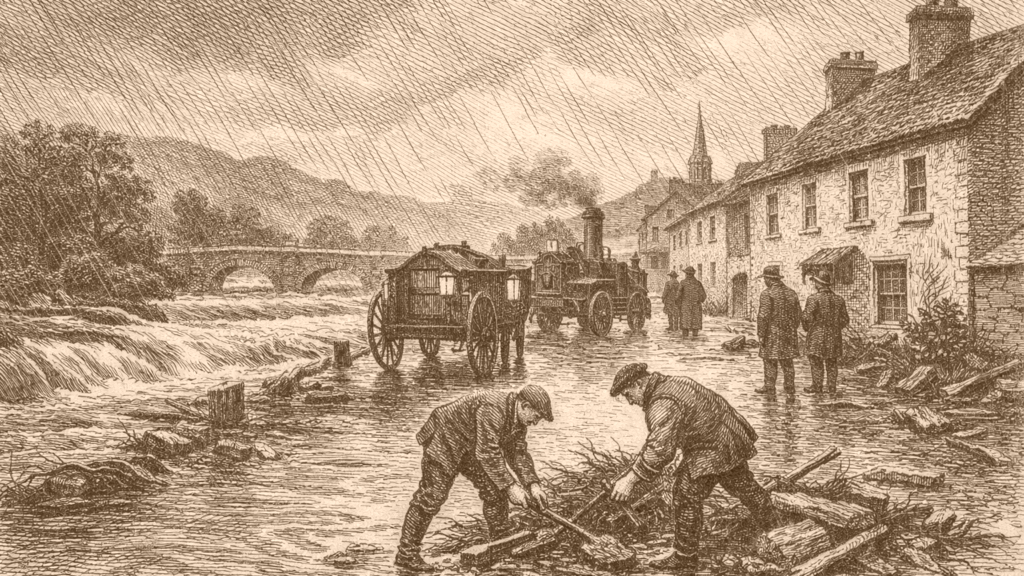
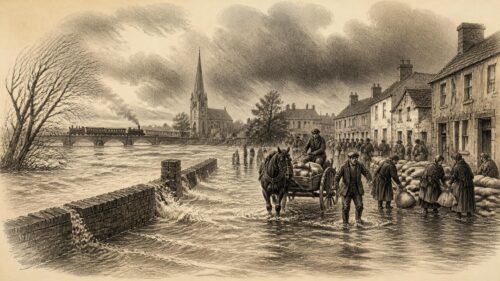
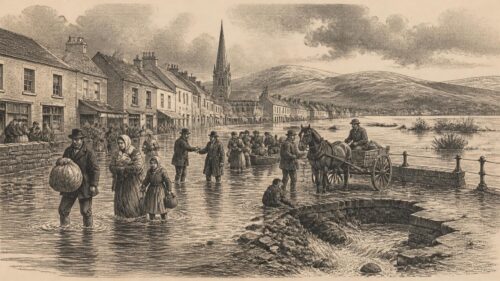
The first phase of response was practical and local. RTÉ reported on overnight facilities in Wicklow for people affected by flooding, while the Irish Times followed the clean-up as it began. In Enniscorthy, drone footage showed the scale of flooding after the River Slaney burst its banks, giving a visual measure of the damage that local authorities then had to assess and begin to repair. [1] [3]
Flood Damage
Damage was not confined to one town or one kind of infrastructure. RTÉ reported that councils estimated almost €59 million in damage to local and regional roads after Storm Chandra and the wet weather that followed. The same reporting noted flooding across several parts of the country, while the Irish Times recorded reopened roads in Wexford and Kilkenny after closures caused by flooding. [1] [3]
The list of affected places in the news reports makes the response look partly municipal and partly regional. Wexford County Council reopened the N80 leading in and out of Bunclody, and Kilkenny’s L1825 Ardaloo Road also reopened. RTÉ’s coverage of Enniscorthy and Wicklow shows that the storm’s impact was spread across the east and southeast, where local authorities were left managing multiple flood sites at once. [3] [1]
Roads Reopen
Reopening roads became a visible sign that the immediate emergency phase was easing. The Irish Times reported that roads had reopened as clean-up got underway, while RTÉ noted that Bunclody’s N80 and Kilkenny’s L1825 Ardaloo Road were back in use. These notices suggest a response centred on restoring normal movement as soon as conditions allowed, rather than leaving communities cut off for an extended period. [3]
Transport disruption was also treated as a wider systems problem. Trinity College Dublin’s engineering commentary described Storm Chandra as exposing weak points in Ireland’s transport and flood readiness. It argued that the storm caused serious disruption across the country and pushed the transport network toward breaking point, linking the flood event to infrastructure resilience rather than to a single local failure. [2]
Warning Debate
Public discussion quickly turned to warnings and communication. The Irish Times reported that Minister for Housing James Browne said Met Éireann needed to make “greater use” of judgment calls and that information should be put out more openly. The same coverage quoted him saying there needed to be “a greater use of that judgment call” in how yellow, orange and red warnings are issued. [3]
The response also drew criticism from opposition voices and local representatives. RTÉ reported that Labour’s climate spokesperson Ciarán Ahern called the minister’s comments a distraction from his own failure to hold a preparedness briefing before the storm. Another report quoted criticism that flood defence funding had been lacking. These remarks belong to the politics of response rather than to the storm’s physical damage itself. [3]
Funding Measures
Storm Chandra also prompted the announcement of flood protection funding. RTÉ reported that more than €6.5 million had been approved for eight local authorities to introduce interim flood protection measures. In the same news cycle, the service reported support for uninsured businesses affected by floods rising from €20,000 to €100,000, showing that financial response formed part of the aftermath alongside repairs and cleanup. [1]
These measures did not end the argument over what kind of protection Ireland needs. Trinity’s discussion said future planning should include improved forecasting, awareness raising, and, in some places, household-level preparedness where community defences may not be viable. The Irish Times likewise carried the view that flooding risks would remain into the following days because rain was falling on already saturated ground. [3] [2]
Aftermath Lessons
The aftermath of Storm Chandra was therefore recorded in two registers: immediate recovery and longer-term reflection. Reporting described roads reopening, families coping with flooded homes, councils tallying damage, and extra funds being approved. At the same time, commentators and officials framed the storm as a test of transport resilience, flood preparedness, and the quality of warning systems rather than as an isolated weather episode. [1] [3] [2]
The evidence also leaves some limits. These reports show the first news cycle of response, not a complete account of later rebuilding or policy change. What can be said with confidence is narrower: Storm Chandra caused flooding and disruption, authorities reopened roads and organised support, and public debate immediately shifted toward warning practice, transport capacity, and flood protection funding. RTÉ reported more than €6.5 million in interim flood protection funding for eight local authorities, while councils said repairs to damaged local and regional roads could cost almost €59 million. Trinity College Dublin also said the storm exposed weak points in Ireland’s transport and flood preparedness. [1] [2] [3]
Source References
Hover over a number to see the source. Select it to open the source.

- [1] News | Latest Breaking News Stories & Headlines | RTÉ
- [2] Storm Chandra commuter chaos is made far worse by a dysfunctional transport system - Electronic & Electrical Engineering | Trinity College Dublin
- [3] Storm Chandra as it happened: Met Éireann issues Status Yellow rainfall warning for six counties – The Irish Times
How did public warnings, transport disruption, and flood-response measures shape the immediate response to Storm Chandra in Ireland?