Tara Assembly559 CE
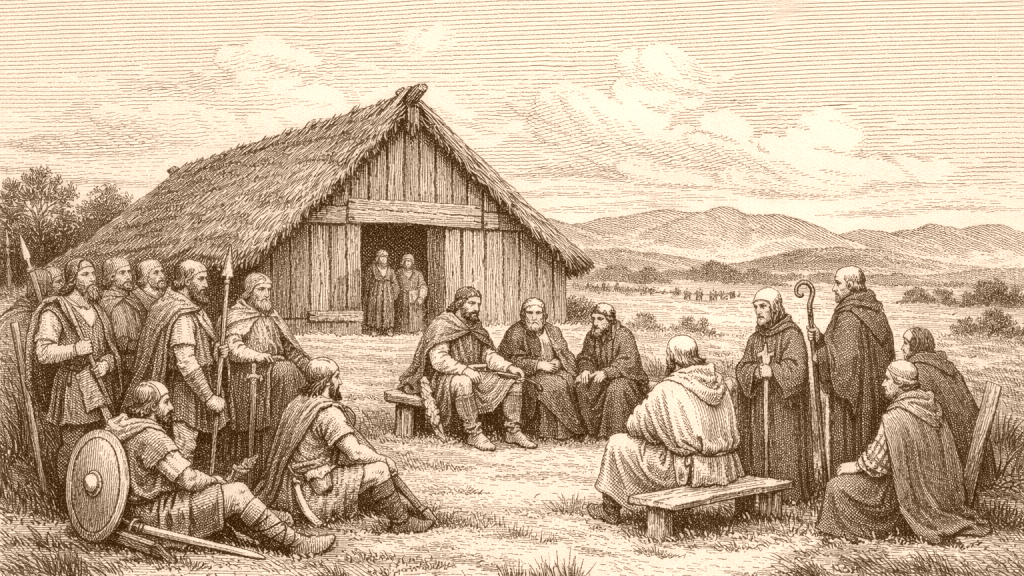
The annalistic notices attached to 559 CE are not identical across the surviving Irish chronicles. The Annals of Ulster place an entry under printed AD 559 that includes the Feast of Temair, the death of Gabrán son of Domangart, a migration before Máelchú’s son, and the battle of Cúil Dreimne. The Annals of Tigernach under Annal T559 record the last Assembly of Tara, Gabrán’s death, flight before Bruide son of Maelchon, and Curnán’s death. The Four Masters under the Age of Christ, 559, record the first year of Domhnall and Fearghus and the battles of Gabhra Liffe and Dumha Aichir.
Dateline
Ulster Notice
The Annals of Ulster present the year-marked notice U560.1 under printed AD 559. In that entry, the text names the Feast of Temair held by Diarmait son of Cerball, the death of Gabrán son of Domangart, the migration before Máelchú’s son, identified there as king Bruide, and the battle of Cúil Dreimne. The notice is compact, and it places these items together in one year heading without separating them into different dated notices. [1]
The same Ulster sequence shows that the year’s notice follows U559.1, which has printed AD 558 and records the foundation of the church of Bennchor. The immediately adjacent placement of U560.1 under printed AD 559 is visible in the text itself, but the excerpt does not provide any further explanation of why these items appear there. What can be stated securely is only the order and content of the surviving wording in this printed sequence. [1]
Tigernach Record
The Annals of Tigernach give a different version of the year under Annal T559. Their notice begins with the last Assembly of Tara by Diarmaid son of Cearball. It then records the death of Gabrán son of Domangort, king of Alba, followed by flight of the Scots before Bruide son of Maelchon, king of the Picts. The entry continues with the death of Curnán son of Aodh son of Eochaidh Tirmcarna by Diarmaid son of Cearball while under Columcill’s protection. [2]
The Tigernach wording also states that Curnán’s death is one of the causes of the battle of Cúil Dremne. That statement appears within the same year notice rather than as a separate dated event. The excerpt gives the causal phrase, but it does not expand on the battle itself or supply any additional dated detail for 559 beyond the notice’s own sequence. [2]
Masters Notice
The Annals of the Four Masters assign their 559 notice to the Age of Christ, 559. They describe this as the first year of the two sons of Muircheartach, son of Muireadhach, in the kingdom of Ireland, naming Domhnall and Fearghus. The same entry then records the battle of Gabhra Liffe and the battle of Dumha Aichir, saying that these were fought by Domhnall and Fearghus against the Leinstermen. [3]
The Four Masters entry adds a verse summary after the prose notice. That summary says that men fell in both battles and names Colgu and his father. It also gives numerical language for losses at Gabhra, but the excerpt itself does not attach that verse to any separate dated sub-entry. The evidence here is limited to the contents of the printed 559 notice as it stands. [3]
Shared Lines
Across the three annal traditions, the 559 notices are not worded alike. Ulster refers to the Feast of Temair, Tigernach to the last Assembly of Tara, and the Four Masters to the first year of two rulers in Ireland. Ulster and Tigernach both place Gabrán’s death in the 559 entry, though they differ in spelling and surrounding material. The Four Masters notice does not include Gabrán in the 559 entry shown here. [1] [2] [3]
The notices also differ in the additional events each one gathers. Ulster includes the migration before Máelchú’s son and the battle of Cúil Dreimne. Tigernach includes flight before Bruide and the death of Curnán, then links that death to Cúil Dremne. The Four Masters instead give the Gabhra Liffe and Dumha Aichir battles. These are separate recorded combinations, and the texts do not make them identical. [1] [2] [3]
Dating Forms
The printed year headings themselves differ in form. Ulster uses a Kalends formula and then gives printed AD 559 in the sequence surrounding U560.1. Tigernach gives Annal T559 with the year marker K. iiii. The Four Masters use the heading The Age of Christ, 559. These are different editorial presentations of year numbering within the surviving texts, and each should be read in its own format. [1] [2] [3]
The Ulster and Tigernach notices also differ in how they frame the surrounding chronology. Ulster places the 559 material immediately after a notice headed AD 558 and before later material headed AD 560. Tigernach places its 559 material between Annal T558 and Annal T560. The Four Masters place their 559 material between entries headed 558 and 560. The excerpts show sequence, but they do not on their own resolve every calendrical problem. [1] [2] [3]
Year Context
The notices for 559 sit within a broader annalistic sequence that includes earlier church foundations, later battles, and later deaths, but those surrounding items belong to their own year notices. For Ulster, the immediately adjacent material includes the foundation of Bennchor under U559.1 and later entries for Cúil Dreimne and related deaths. For Tigernach, the 559 notice is followed by a separate 560 notice. For the Four Masters, the 559 notice is followed by a 560 entry beginning the second year of Domhnall and Fearghus. [1] [2] [3]
Nothing in these excerpts justifies merging the three traditions into a single uniform account of 559. The secure statement is narrower: in one manuscript tradition the year carries a Feast of Temair notice, in another an Assembly of Tara notice, and in a third notices for the opening year of Domhnall and Fearghus and the battles of Gabhra Liffe and Dumha Aichir. The documents preserve overlap in some names and divergence in others, and they should be read as separate records of the same nominal year. [1] [2] [3]
Source References
Hover over a number to see the source. Select it to open the source.