Diarmait Mac Murchada
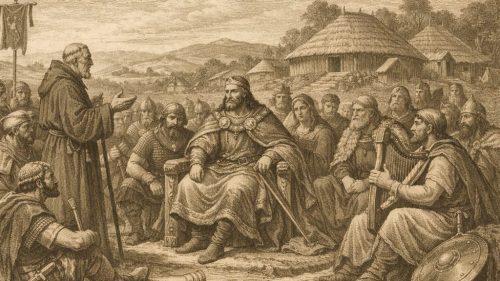
Diarmait Mac Murchada was king of Laigin in the twelfth century. The surviving annalistic record places him in that role in 1166, when he was banished eastwards over sea after the foreigners of Áth Cliath and the Laigin had turned against him. The same record notes that Ruaidrí Ua Conchobuir then took the kingship of Ireland. A later historical reference work identifies Diarmait as king of Leinster and gives the form Diarmaid MacMurrough as an equivalent rendering of his name. The annals describe Diarmait as son of Mac Murchada and as king of Laigin.
Dateline
Diarmait Mac Murchada was king of Laigin in the twelfth century. The surviving annalistic record places him in that role in 1166, when he was banished eastwards over sea after the foreigners of Áth Cliath and the Laigin had turned against him. The same record notes that Ruaidrí Ua Conchobuir then took the kingship of Ireland. A later historical reference work identifies Diarmait as king of Leinster and gives the form Diarmaid MacMurrough as an equivalent rendering of his name.
Royal Position
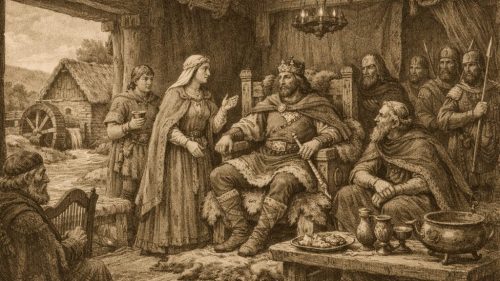
The annals describe Diarmait as son of Mac Murchada and as king of Laigin. In the surviving notice for 1166, his expulsion is not presented as a brief local disturbance but as a political reversal in which both the foreign community of Dublin and the Laigin had turned against him. The wording is terse, but it is enough to show that his authority had been contested and then overturned. The same sequence of annal entries places Ruaidrí Ua Conchobuir’s accession to the kingship of Ireland immediately after Diarmait’s banishment.
A nineteenth-century dictionary entry gives a fuller retrospective account. It says that Diarmait was king of Leinster and that he became king in 1126, when he was only fifteen years old. That reference also states that his education was entrusted to Aedh mac Crimthainn, abbot of Terryglass. Because this comes from a much later biographical compilation, it should be read as a historical claim preserved by an editor rather than as a contemporary record. Still, it is one of the specific pieces of evidence attached to his early career in the available sources.
Military Conflict
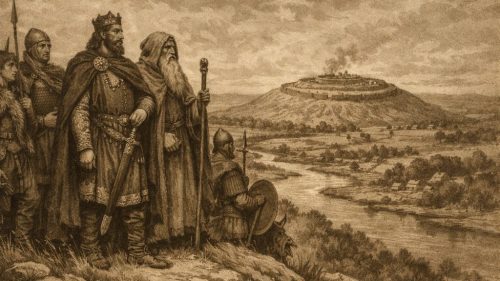
The same reference work links Diarmait with a series of armed actions in the 1130s and 1140s. It says he invaded Ossory in 1134, besieged Waterford in 1137, and plundered the stone church of St Cianán of Meath in 1149 with the assistance of the Danes. It also says Laurence O’Toole, then a boy of ten, was delivered into his hands and treated with such cruelty that Laurence’s father threatened retaliation unless the boy was restored. These details appear in the later biographical tradition rather than in the annal extract, but they are presented there as part of Diarmait’s recorded career.
The same source also says that Diarmait forcibly abducted the Abbess of Kildare at about the age of twenty-two and that, when the religious community resisted, he killed 140 of them and set fire to the monastery. As with the other episodes in that account, the wording is that of a nineteenth-century historian summarising earlier material. It is best treated as a historical report transmitted through later scholarship, not as a verbatim contemporary statement. The annal extracts supplied here do not independently repeat those incidents.
Exile Return
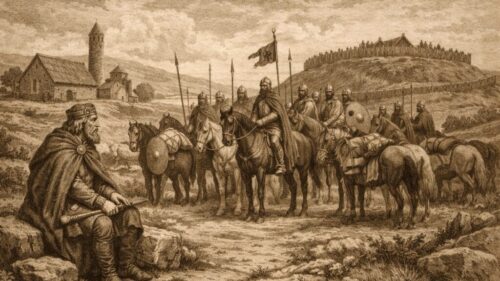
The annals provide the clearest fixed points for the end of his rule. In 1166, Diarmait son of Mac Murchada, king of Laigin, was banished eastwards over sea after the foreigners of Áth Cliath and the Laigin had turned against him. In 1167, Diarmait Mac Murchada returned from overseas, and Uí Cheinnselaig was taken by him. Those two notices show both exile and restoration of a local political base within a very short span of time.
The later dictionary account gives an extended version of the same period.
Historical Record
The available material does not offer a single continuous contemporary biography. Instead, it preserves Diarmait Mac Murchada through brief annal entries and later historical retellings. The annals establish his kingship of Laigin, his banishment in 1166, and his return in 1167. The nineteenth-century reference work adds family background, early accession, and several episodes of conflict and patronage. Taken together, these sources show a ruler whose career was closely bound up with the contest for power in Leinster and with the political upheavals of the mid-twelfth century.
Source References
Hover over a number to see the source. Select it to open the source.