Deputy Government
Gerald FitzGerald inherited the earldom of Kildare in 1477 and entered public life at a moment when the struggle for authority in Ireland depended heavily on great noble houses. He was appointed Lord Deputy in that same year, but his first appointment did not last. Lord Grey of Codnor replaced him on the view that an Englishman would be better fitted to the office. That change of government provoked resistance among the Lords of the Pale, who set up a breakaway parliament in protest. Edward IV then restored FitzGerald to the deputyship, and he resumed office under conditions that showed how closely the administration of Ireland was bound up with the power of his family.
Dateline
Gerald FitzGerald inherited the earldom of Kildare in 1477 and entered public life at a moment when the struggle for authority in Ireland depended heavily on great noble houses. He was appointed Lord Deputy in that same year, but his first appointment did not last. Lord Grey of Codnor replaced him on the view that an Englishman would be better fitted to the office. That change of government provoked resistance among the Lords of the Pale, who set up a breakaway parliament in protest. Edward IV then restored FitzGerald to the deputyship, and he resumed office under conditions that showed how closely the administration of Ireland was bound up with the power of his family.
Deputy Government
FitzGerald remained a central figure in Irish rule after his restoration. The sources describe him as continuing in office through the later years of Edward IV and into the next reign. He held authority again when Henry VII became king, and his position under the new dynasty shows the practical importance of his standing in Ireland. The same account states that he supported Lambert Simnel, the pretender to the English throne. That support gave Henry VII further reason to distrust him, yet the king also needed his capacity to govern in Ireland. Henry therefore pardoned both Simnel and FitzGerald after the failed rising, and the relationship between crown and deputy remained one of dependence and caution.
Tower Imprisonment
FitzGerald later fell from favour and was imprisoned in the Tower of London. His wife Alison died soon after, reportedly of grief at his arrest. The account records that he was tried in 1496. At that trial he answered the king with a remark that has been preserved in the tradition of his biography: when asked whether he had counsel, he replied that he had “the ablest in the realm” and named the king himself. He was also accused by the Archbishop of Cashel of burning down a cathedral. FitzGerald replied that he would not have done so if he had not been told that the archbishop was inside. Henry VII was amused by this answer, and immediately appointed him again as Lord Deputy of Ireland. The same episode shows how quickly punishment and restoration could follow one another in his career.
Return Office
After his return to office, FitzGerald acted with the force expected of a man entrusted with the government of Ireland. In 1500 he suppressed a rebellion in Cork by hanging the city’s mayor. In 1504 he led forces against rebels in Connacht and defeated them at the Battle of Knockdoe. This battle secured his position and confirmed the strength of his authority. The record of his service presents him as a deputy whose power could be exercised through direct action, severe punishment, and military command. The same years show him as an administrator who remained indispensable to the crown even after open conflict with royal policy.
Final Wounding
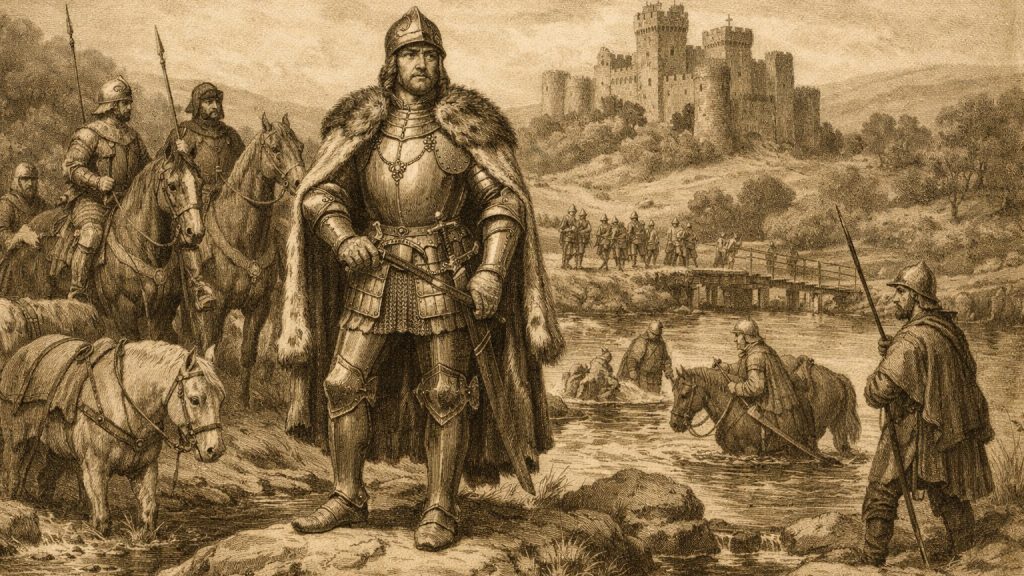
FitzGerald’s career ended on campaign. In 1513, during an expedition against the O’Carrolls, he was mortally wounded while watering his horse in the River Greese at Kilkea. He was carried back to Kildare, where he died on or around 3 September 1513. The sources record these final events plainly and leave his long service to be measured by the offices he held, the rebellions he suppressed, and the repeated decisions of the crown to restore him after dispute. In this way Gerald FitzGerald stands in the record as a powerful Irish noble whose authority was repeatedly contested, yet repeatedly renewed.
Source References
Hover over a number to see the source. Select it to open the source.