Portrush
Portrush is securely identifiable as the north Antrim seaside settlement recorded in historical references as a sea-port and later a market town. The Placenames Database of Ireland gives the modern Irish-language form as Port Rois and places the town in county Aontroim/Antrim, under the barony of Dún Libhse Íochtarach/Dunluce Lower and the civil parish of Baile an Mhuilinn/Ballywillin 1. Samuel Lewis likewise places Portrush in the parish of Ballywillin, barony of Lower Dunluce, county of Antrim, province of Ulster, confirming the historical county assignment 2. The spelling history is also clear in the sources.
Dateline
Settlement and county identity
Portrush is securely identifiable as the north Antrim seaside settlement recorded in historical references as a sea-port and later a market town. The Placenames Database of Ireland gives the modern Irish-language form as Port Rois and places the town in county Aontroim/Antrim, under the barony of Dún Libhse Íochtarach/Dunluce Lower and the civil parish of Baile an Mhuilinn/Ballywillin 1. Samuel Lewis likewise places Portrush in the parish of Ballywillin, barony of Lower Dunluce, county of Antrim, province of Ulster, confirming the historical county assignment 2.
The spelling history is also clear in the sources. Logainm presents the official Irish-language form Port Rois alongside the English form Portrush, while Lewis records the anglicised English name in the nineteenth century without an alternate spelling in his entry 12. The settlement is therefore not a doubtful or displaced place-name: it is the same Antrim town known historically in English as Portrush and in Irish as Port Rois 1.
Early description and local setting
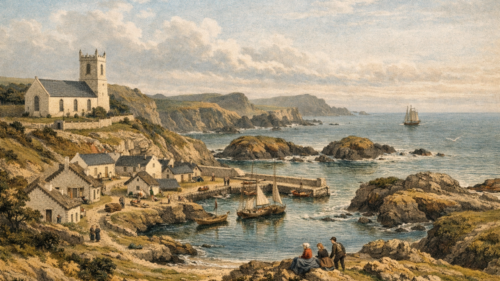
Lewis’s 1837 account describes Portrush as a sea-port with only 337 inhabitants, situated at the north-western extremity of County Antrim, on a basalt peninsula jutting into the sea toward the Skerries, with a small deep bay on the western side 2. This is useful historical evidence because it shows the settlement already functioning as a compact maritime place rather than a later resort invention. The entry also notes that it had a penny-post to Coleraine, which indicates its integration into regional communications by the early nineteenth century 2.
Lewis adds a valuable note on local historical memory: according to the early annalists, the place was the chief landing-place in the territory of the Rowte or M’Quillan’s country, and Sir John Perrot chose it as the landing-place for artillery during the siege of Dunluce Castle 2. That places Portrush within the military and territorial history of north Antrim long before its later leisure reputation. These references do not make the town famous in themselves, but they show that its harbour approach and peninsula were historically strategic 2.
Nineteenth-century recognition
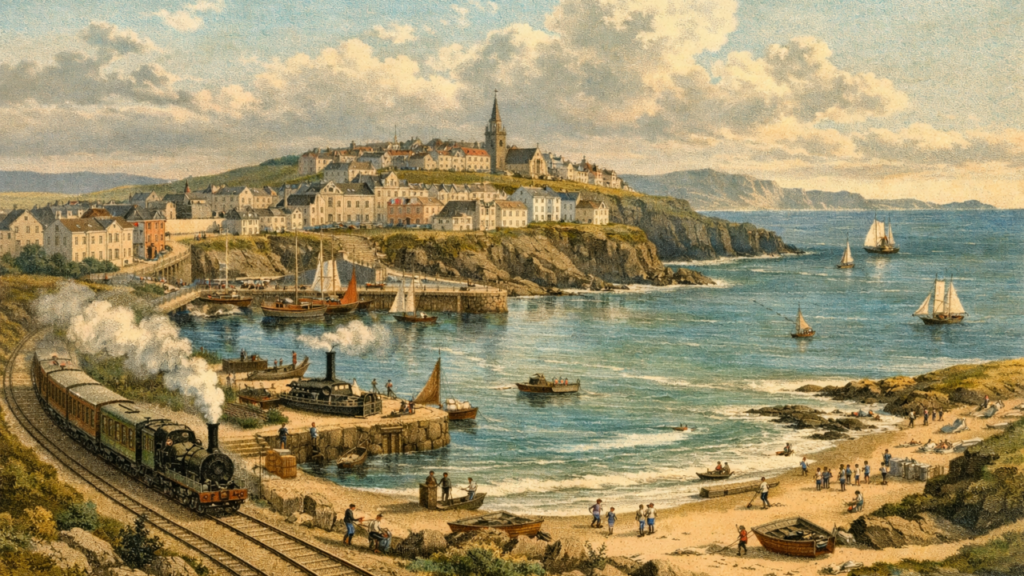
By the later nineteenth century, Portrush appears in gazetteer literature as a larger and more developed place. A Vision of Britain reproduces John Bartholomew’s 1887 description of Portrush as a market and seaport town with railway station in north County Antrim, with bathing, tourist traffic to the Giant’s Causeway, and salmon shipping for Liverpool and Glasgow 3. That description confirms the town’s continued county identity and shows its transformation from a small seaport into a transport-linked coastal town with a dual fishing and visitor economy by the Victorian era 3.
The historical record therefore supports three points: the settlement is Portrush; its historical county is Antrim; and its authoritative Irish-language form is Port Rois 123.