Toome
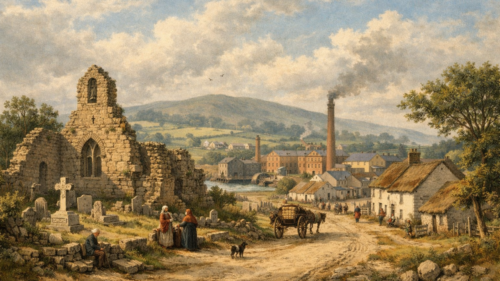
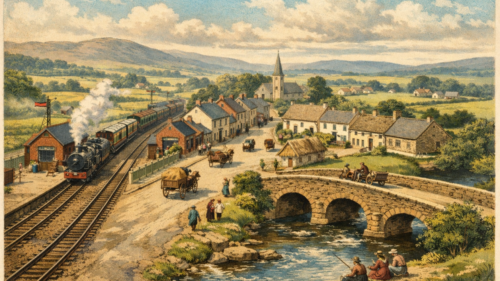
Toome is a documented settlement in County Antrim: Samuel Lewis described it in 1837 as “a post-town, in the parish of Duneane, barony of Upper Toome, county of Antrim,” with 122 inhabitants 1. The modern Placenames Database of Ireland likewise places Toome in County Antrim, in the barony of Toome Upper and civil parish of Duneane, and gives the Irish form as Tuaim 2. The placename is therefore not only a modern village name but also the name of the surrounding townland and of the historic barony, showing long local importance 2.
Dateline
Settlement and name
Toome is a documented settlement in County Antrim: Samuel Lewis described it in 1837 as “a post-town, in the parish of Duneane, barony of Upper Toome, county of Antrim,” with 122 inhabitants 1. The modern Placenames Database of Ireland likewise places Toome in County Antrim, in the barony of Toome Upper and civil parish of Duneane, and gives the Irish form as Tuaim 2. The placename is therefore not only a modern village name but also the name of the surrounding townland and of the historic barony, showing long local importance 2.
Early importance on the Bann
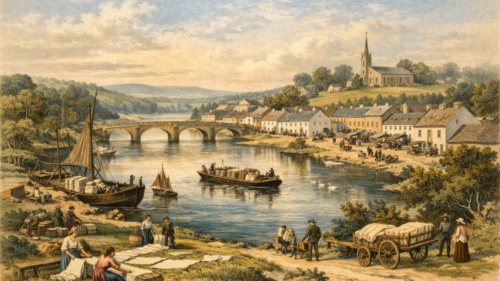
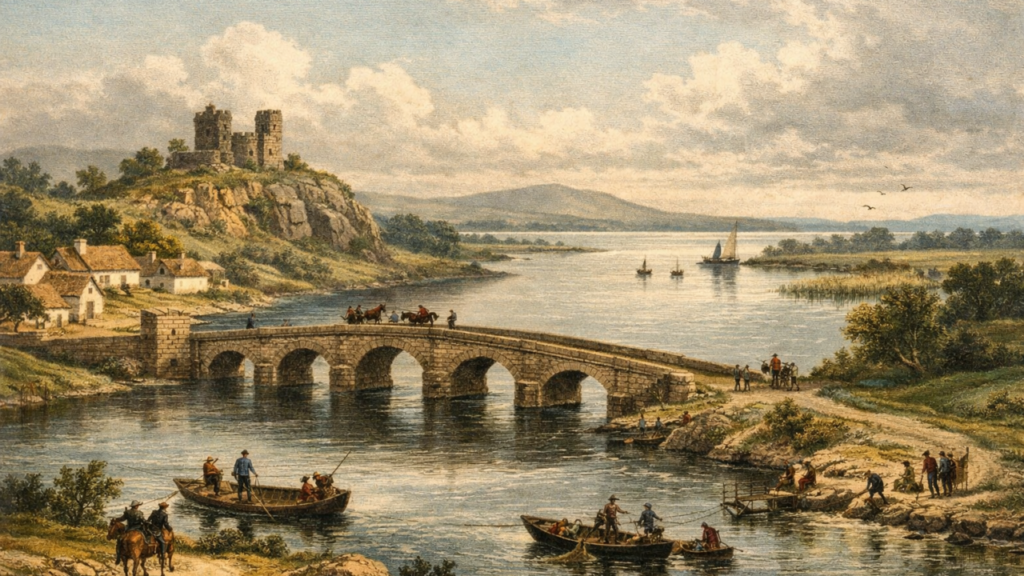
Lewis’s account preserves the older historical role of Toome at the crossing of the River Bann. He says the place “had at a very early period a ford or ferry across the river Bann,” which was “the only pass from one part of Ulster to the other,” and that John de Courcy built a castle there for its protection 1. That combination of ford, ferry, and castle explains why Toome developed as a strategic point rather than an ordinary rural locality. Lewis also notes that the castle later figured in the parliamentary wars, was taken in 1650, and was then dismantled; he further links the place to the 1798 disturbances, when insurgents retreated there after Antrim and broke one of the bridge arches to hinder pursuit 1.
Historical county and spelling evidence
The county assignment is straightforward in the surviving authorities: Toome is in County Antrim, not merely by modern usage but in the nineteenth-century topographical tradition and in the Irish placename record 12. The Irish-language form Tuaim is given by Logainm, while the English historical spelling remains Toome 2. In the same Antrim placename hierarchy, Logainm also records the related bridge settlement as Droichead Thuama/Toomebridge, which helps confirm that Toome was the older base name from which the bridge-name later developed 2. The eighteenth-century and nineteenth-century records therefore show a stable settlement identity: Toome in Antrim, centred on the Bann crossing, with the Irish form Tuaim preserved in official placename scholarship 12.
Barony and local continuity
The Civil Survey barony material confirms the wider historic geography in which Toome sat. The barony of Toome was already recognised as a distinct administrative unit in the seventeenth century, bounded by the Bann and Lough Neagh on the west and by neighbouring Antrim territories on other sides 3. That administrative naming reflects the same local prominence noticed by Lewis: Toome was important enough not only to be a settlement, but to give its name to the barony itself 13.