Whiteabbey
Dateline
Settlement identity
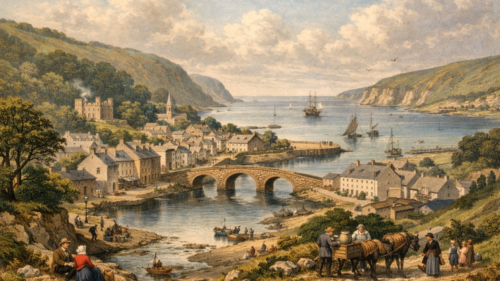
Whiteabbey is securely attested as a settlement in the parish of Carnmoney, barony of Lower Belfast, county of Antrim, in Samuel Lewis’s 1837 Topographical Dictionary of Ireland. Lewis gives it as “WHITEABBEY, a village,” placing it “on the shore of Belfast Lough” and explicitly assigning it to County Antrim 1. The same work also distinguishes the related parish of Carnmoney, where White Abbey is named as a local industrial place and landscape feature within the parish 2.
Historical county and setting
The county assignment is straightforward in the historical record: Whiteabbey lay in County Antrim, not Down or Belfast county district, and it belonged to the Lower Belfast barony and Carnmoney parish in nineteenth-century administrative geography 1. Modern Irish placename authority records likewise place “Whiteabbey” in county Aontroim/Antrim and identify it as both a population centre and a townland within Carnmoney parish, confirming continuity between the older printed gazetteer and the later placename database 3.
Name forms and spelling variants
The English settlement name appears in nineteenth-century sources as “Whiteabbey,” while Lewis also writes “White Abbey” when referring to the abbey ruins and the adjacent industrial establishment in the parish text 12. That spacing reflects a descriptive older form rather than a different place: the entry for Whiteabbey says the village “takes its name from an old abbey,” and the parish article says the ruins of “White Abbey” gave the townland its name 12. In the Irish-language record, the Placenames Database of Ireland lists the settlement as “An M h ainistir Fhionn / Whiteabbey” in its Carnmoney sub-units page 3. Even allowing for the typographic spacing visible on the webpage, the form clearly preserves the meaning “white abbey,” matching the historical English name and Lewis’s derivation 13.
Historical character
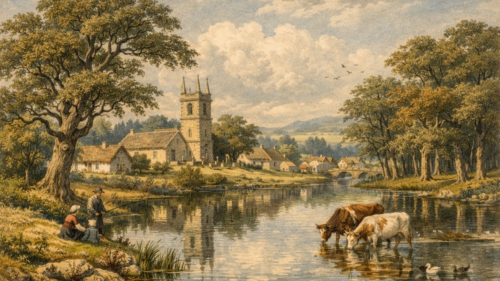
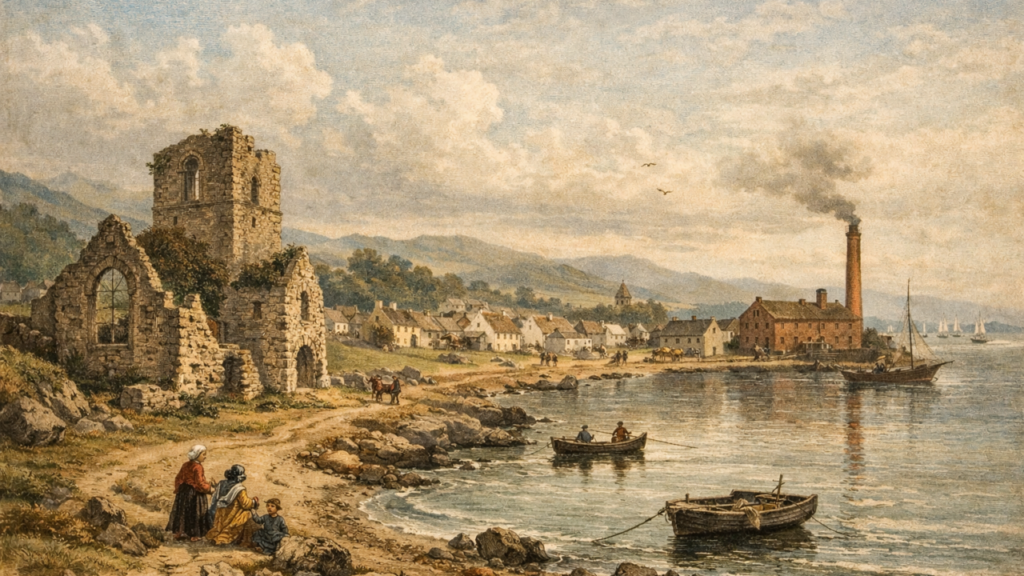
The settlement’s early historical identity was shaped by the abbey ruins beside the shore. Lewis describes the remains as “picturesque” and notes that the surviving chapel showed an early English architectural style, while the foundation date and founder were unknown 1. The parish article adds that the house was “probably the original establishment that was removed to Wood-burn,” which is a useful nineteenth-century local tradition, though Lewis presents it cautiously rather than as settled fact 2. By the 1830s, Whiteabbey was already part of an industrial shoreline landscape, with a cotton and flax-spinning manufactory identified in the parish description 2. That is the historical Whiteabbey most clearly visible in the sources: a small named settlement on Belfast Lough, anchored by abbey remains and embedded in the expanding manufacturing belt north of Belfast 12.