Home Rule Deferred
Limerick Archives — Thursday, 6 December 1900
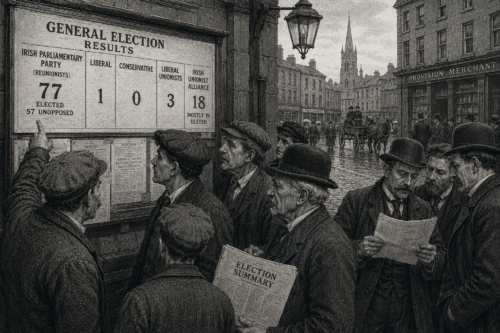
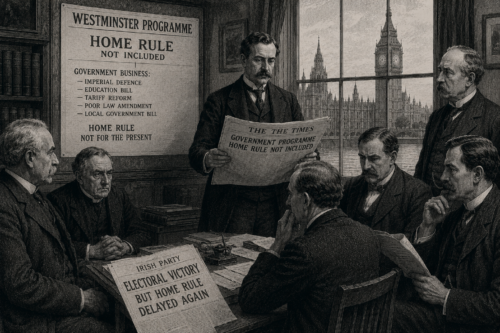
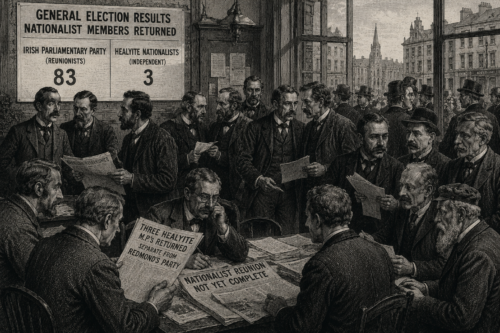
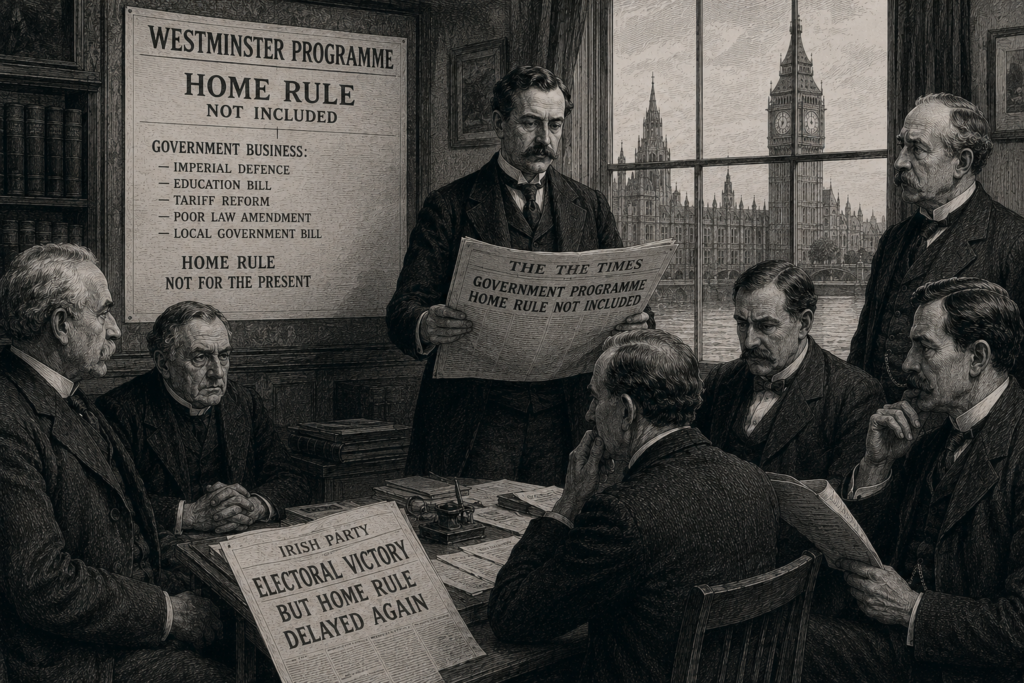
LIMERICK, Thursday — The opening of the new Parliament has confirmed that Home Rule remains outside the immediate programme of the government, despite the strong electoral recovery of John Redmond’s reunited Irish Parliamentary Party. Nationalists returned seventy-seven members from Ireland’s 103 constituencies, giving the demand for an Irish legislature a commanding parliamentary voice. Yet the administration of Lord Salisbury, strengthened by its general-election victory, has offered no proposal for restoring domestic government in Dublin. In Limerick city and county, where nationalist representatives were returned and Home Rule remains central to organised political life, the omission will be received as a deliberate refusal to recognise Ireland’s electoral verdict.
Two Home Rule Bills have already failed at Westminster. William Ewart Gladstone’s first measure was defeated in the House of Commons in 1886, while the second passed that chamber in 1893 only to be rejected overwhelmingly by the House of Lords. The Liberal defeat of 1895 then removed Home Rule from practical government business. During the years that followed, Irish nationalism was weakened by the divisions arising from Charles Stewart Parnell’s downfall. The reunion of the principal factions under Redmond in 1900 restored parliamentary discipline, but it did not alter the Conservative and Unionist majority governing Britain and Ireland.
Redmond’s party now possesses renewed strength but lacks the Westminster balance of power required to force constitutional change. The Conservatives and their Liberal Unionist allies won a substantial majority in the election fought during the South African War. Their coalition remains committed to maintaining the legislative union and is supported by eighteen Irish Unionist MPs, chiefly representing north-eastern Ulster. The government may consider land purchase, local administration, education and other Irish questions separately, but such reforms do not concede the nationalist demand for a legislature controlling Ireland’s domestic affairs. Parliamentary recovery has therefore restored the Irish Party’s voice without restoring its immediate influence over government policy.
The omission presents Redmond with a difficult strategic choice. His members can press Home Rule through debates, amendments and parliamentary obstruction, but the government possesses sufficient numbers to defeat them. Cooperation with the Liberal opposition offers another course, although the Liberals themselves remain weakened and cannot promise early office. Meanwhile, William O’Brien and the United Irish League will continue linking constitutional nationalism with land agitation and local organisation. Success on the land question might bring practical relief to tenants, yet it could also allow ministers to argue that Irish grievances can be addressed without creating a separate parliament. Home Rule remains the declared objective but not an approaching government measure.
For Limerick nationalists, the contrast between electoral success and parliamentary exclusion will reinforce the belief that Irish majorities carry limited weight within the Union. Local branches of the United Irish League, public representatives, tenant organisations and nationalist newspapers may use the omission to strengthen meetings, subscriptions and political discipline. Unionists will answer that the government’s majority, together with determined opposition in Ulster, gives ministers a clear authority to resist constitutional separation. Limerick’s returned members can speak for Home Rule in the Commons, but they cannot place it upon the government programme. The election has revived nationalist organisation while leaving the central constitutional demand unanswered.
- Parliamentary Debates, House of Commons, “Address in Answer to Her Majesty’s Most Gracious Speech,” 6 December 1900. The debate records the programme presented at the opening of Parliament and contemporary responses to its treatment of Irish affairs. Relevant columns should be confirmed before formal citation.
- Her Majesty’s Most Gracious Speech to Both Houses of Parliament, 6 December 1900, reproduced in the official parliamentary debates. The speech can verify which legislative matters the government announced and the absence of an immediate Home Rule proposal. Relevant columns should be confirmed before formal citation.
- Parliamentary Election Returns, General Election of 1900, House of Commons Parliamentary Papers, Irish constituency returns. These official returns verify the election of seventy-seven Irish Parliamentary Party members and the government’s wider parliamentary majority. Exact volume and page references should be confirmed before formal citation.
- Freeman’s Journal and Daily Commercial Advertiser, 7 December 1900. Contemporary reporting can verify nationalist reaction to the Queen’s Speech, Redmond’s parliamentary position and criticism of the government’s Irish programme. Exact page and column should be confirmed before formal citation.
- The Irish Times, 7 December 1900. Contemporary coverage can verify Unionist and government interpretations of the parliamentary programme and the opening debates following the election. Exact page and column should be confirmed before formal citation.