Health and Medicine

Historical stories concerning hospitals, doctors, nurses, disease, epidemics, public health, maternity care, mental health, sanitation and medical change in Limerick and Ireland between 1900 and 2000, including the impact of illness and healthcare on individuals, families and communities.

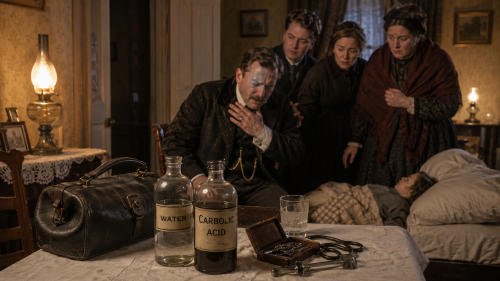
Fatal Confusion

Cappamore and the surrounding district lost a medical practitioner in early February 1900 when Dr Charles Philip Tennant died after accidentally swallowing carbolic acid during an evening visit to a family at Rath. Tennant served patients across the Cappamore and Murroe area, where a country doctor might travel considerable distances to reach sick people in their homes. The surviving reports describe no deliberate act and no dispute over the cause. An ordinary medical call ended in tragedy because two liquids carried to the house were confused, turning a customary gesture of hospitality into a fatal emergency.

Terminus Tragedy

A serious accident at Limerick railway terminus left labourer James Davoren requiring the amputation of his right leg. The Irish Times reported on 2 January 1900 that Davoren had gone to the station to see his brother, described as a solicitor, depart by train for Fermoy. During the farewell, he fell from the platform onto the permanent way and was caught beneath the passing train. Railway staff and bystanders found him lying on the rails after the carriages had cleared. He was removed without delay to Barrington’s Hospital, where surgeons determined that the injured limb could not be saved.

Health Inquiry

A government investigation into the causes of exceptionally high death rates in Irish cities was extended to Limerick, according to an announcement published on 27 January 1900. The Local Government Board was expected to apply machinery similar to that already established for examining public health in Dublin. The proposed scrutiny would reach beyond mortality statistics and examine how Limerick Corporation discharged its sanitary responsibilities. Drainage, cleansing, water supply, dairies and slaughterhouses were all identified for investigation. The announcement placed the city’s everyday environment under official examination and signalled that preventable illness and premature death would be treated as failures of administration as well as private misfortune.

Statistician Dies

Thomas Wrigley Grimshaw, physician, public-health reformer and former registrar-general for Ireland, died at his residence in Carrickmines, County Dublin, on 23 January. Born near Belfast in 1839, he had spent much of his professional life examining the relationship between disease, poverty, housing and mortality. His death removed one of the country’s most influential medical statisticians at a time when Irish towns still faced recurring epidemics, tuberculosis, overcrowding and poor sanitation. Grimshaw believed that accurate records of births, deaths and illnesses could reveal conditions that anecdote, prejudice and political argument often concealed.

Now Sharing: Articles (154) Images (306) Total Items Archived (460)
Our Mission: 100,000 Items Total Percentage Achieved (0.46%)