Purchase Delayed
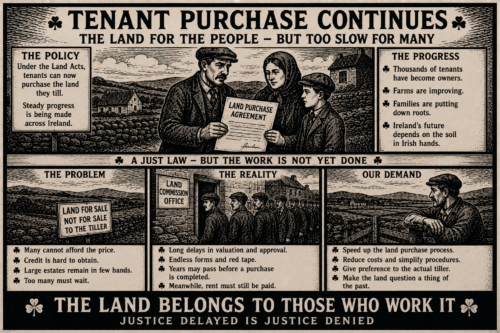
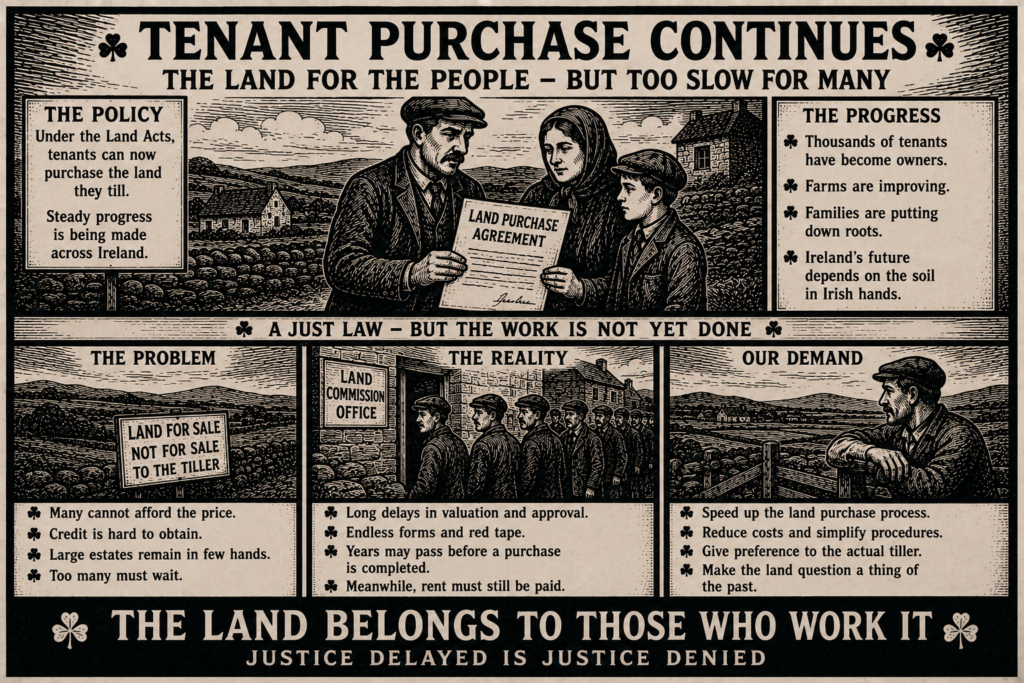
LIMERICK — Tenant purchase continues under the existing Irish Land Acts, allowing some farmers to replace rent payments with annual instalments towards ownership of their holdings. The principle has won broad support among tenants who believe possession of the soil would provide greater independence, security and confidence in improving their farms. Yet the number of completed sales remains insufficient to satisfy many rural communities. In County Limerick, farmers continue to wait upon negotiations between landlords, tenants, the Irish Land Commission and the Treasury, while political organisers argue that a reform intended to settle the land question is proceeding far too slowly.
Limerick Archives — 1900
LIMERICK — Tenant purchase continues under the existing Irish Land Acts, allowing some farmers to replace rent payments with annual instalments towards ownership of their holdings. The principle has won broad support among tenants who believe possession of the soil would provide greater independence, security and confidence in improving their farms. Yet the number of completed sales remains insufficient to satisfy many rural communities. In County Limerick, farmers continue to wait upon negotiations between landlords, tenants, the Irish Land Commission and the Treasury, while political organisers argue that a reform intended to settle the land question is proceeding far too slowly.
The purchase system depends upon an agreement between landlord and tenant, followed by official examination and the advancement of state funds. Earlier legislation, including the Ashbourne Acts and subsequent measures, enabled tenants to borrow the purchase price and repay it through long-term annuities. Where agreement is reached, the annual charge may compare favourably with the former rent and eventually leaves the occupier as owner. Difficulties arise when landlords refuse to sell, demand prices tenants consider excessive, or possess estates complicated by mortgages, family settlements and other legal interests. Each obstacle can delay negotiations before the proposed sale reaches formal completion.
Farmers complain that voluntary purchase leaves the pace of reform largely dependent upon the willingness of individual landlords. One estate may be sold while neighbouring tenants remain unable even to begin negotiations. Administrative investigation, valuation and the examination of title can prolong the process further, leaving households uncertain whether ownership will arrive within months or remain beyond reach for years. Parliamentary criticism of the existing system continued into 1901, with Irish members arguing that the Land Acts had not provided a sufficiently rapid or comprehensive transfer of ownership.
The delay carries consequences beyond the payment of rent. A tenant unsure of future ownership may hesitate before draining fields, repairing buildings or making costly improvements whose value could later become disputed. Younger family members considering whether to remain upon the farm must judge whether it can support another generation. Shopkeepers, agricultural labourers and local tradesmen are also affected because confidence in farming influences rural spending and employment. In Limerick, the promise of purchase is therefore measured not simply by the number of legal agreements completed but by whether ownership strengthens households, encourages investment and reduces the pressure towards emigration.
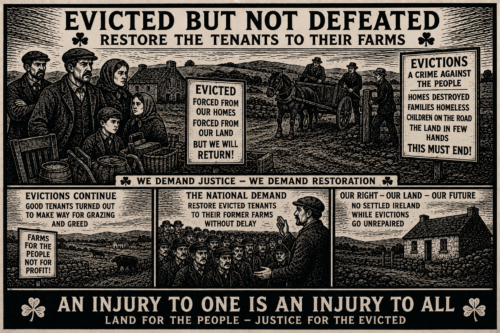
Nationalists increasingly argue that piecemeal purchase cannot resolve the wider land question. Existing tenants may become owners while evicted families remain displaced, labourers remain landless and uneconomic holdings remain too small to support their occupants. The slowness of transfer also allows disputes over rent, grazing farms and landlord power to continue. Farmers welcome every completed purchase, but many demand legislation capable of transferring entire estates more quickly and upon affordable terms. Until the machinery becomes faster, broader and less dependent upon voluntary agreement, tenant purchase will remain a valued reform whose limited progress has not matched the urgency felt across rural Ireland.
- Irish Land Commission, Annual Report for 1900, recording purchase agreements, advances and administration under the Irish Land Acts. Exact parliamentary-paper number and page should be confirmed before formal citation.
- Parliamentary Debates, House of Commons, Irish Land Acts, 21 February 1901, vol. 89, debate concerning the operation and limitations of existing land legislation. Exact relevant columns should be confirmed before formal citation.
- Limerick Chronicle, Limerick, 1900, reports concerning estate sales, tenant purchase negotiations, rents and land agitation in County Limerick. Exact issue, page and column should be confirmed before formal citation.
- Freeman’s Journal, Dublin, 1900, reports and editorials concerning tenant purchase, the Irish Land Commission and demands for more rapid land transfer. Exact issue, page and column should be confirmed before formal citation.
- Irish Land Commission purchase records and estate files relating to County Limerick under the Land Purchase Acts before 1903. Exact estate, record number, file and folio should be confirmed before formal citation.