Land Grabbers(c.1900s)
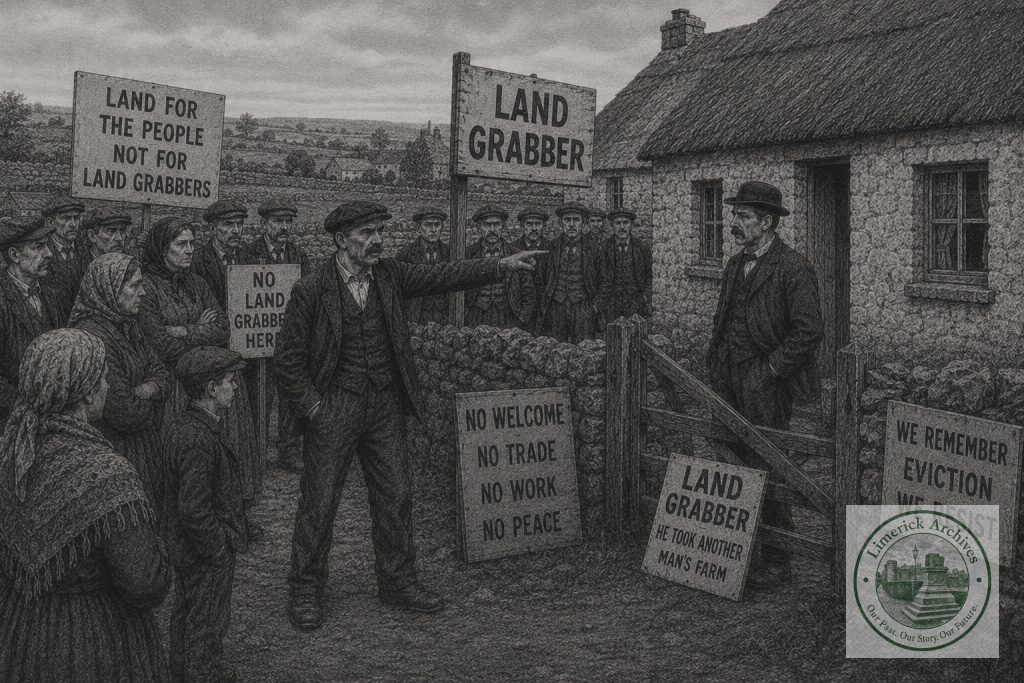
The hostile term “land grabber” continues to be directed against tenants who enter farms from which earlier occupiers have been evicted or otherwise displaced. Across rural Ireland, such men may possess legal agreements with landlords, yet neighbours frequently regard their occupation as a betrayal of the former tenant and the wider land campaign. The description carries consequences extending beyond political criticism. Those branded with it may face public condemnation, social isolation and organised pressure intended to make the disputed holding difficult to retain. In County Limerick, the label remains inseparable from memories of eviction, rent conflict and agrarian resistance.
The expression became particularly powerful during the Land War, when campaigners sought to prevent vacant or evicted farms from being taken by new tenants. A person accepting such land was accused of profiting from another family’s removal and weakening the collective discipline required to resist landlord authority. Branches of nationalist organisations could pass resolutions condemning both the farm and its new occupier, while neighbours might refuse ordinary social or commercial dealings. Supporters compared the land grabber with a strike-breaker who undermined fellow workers. Opponents argued that lawful tenants were being punished for exercising rights recognised by existing land law.
The United Irish League has revived these pressures as it expands agitation over grazing farms, evicted tenants and the concentration of land. League speakers maintain that disputed holdings should be restored where possible and that extensive grasslands ought to be divided among small farmers and landless families. A tenant who competes for land claimed by an evicted family or opposed by the local branch may therefore attract the damaging designation. Public meetings and local resolutions allow communities to enforce an unwritten code governing who may bid for, rent or occupy particular farms, even when no court has prohibited the transaction.
Such methods remain controversial. Nationalists defend social pressure as a peaceful weapon available to communities lacking control over land policy. Government officials, landlords and unionist critics describe the same conduct as intimidation designed to override individual liberty and legal contracts. The consequences may affect a tenant’s ability to hire labour, sell livestock, obtain supplies, attend markets or maintain ordinary relations with neighbours. The term itself functions as punishment before any formal offence has been proved. Once attached to a household, it may also affect wives, children and employees who played no part in the original decision to occupy the farm.
For Limerick farmers, the controversy reveals how deeply landholding remains governed by communal judgement as well as statute and contract. An available farm may promise security to one family while representing dispossession to another. The label “land grabber” compresses that conflict into two bitter words, dividing lawful possession from accepted local legitimacy. Its continued use shows that the settlement of the land question requires more than purchase legislation. Evicted tenants, contested farms and competing claims must be addressed in ways considered just by rural communities, or the occupation of disputed land will continue to provoke resentment, exclusion and political agitation.
- Parliamentary Debates, House of Commons, “Civil Service Estimates, 1900–1901,” 25 May 1900, discussion of United Irish League meetings condemning a “land-grabber or a grazier”; exact relevant columns should be confirmed before formal citation.
- Parliamentary Debates, House of Commons, “Irish Grievances,” 22 February 1901, comparison of the Irish land grabber with the English industrial strike-breaker; exact relevant columns should be confirmed before formal citation.
- Parliamentary Debates, House of Commons, “Irish Land Acts,” 21 February 1901, discussion of hostility and boycotting directed against persons taking evicted farms; exact relevant columns should be confirmed before formal citation.
- Limerick Chronicle, 1900–1901, reports concerning disputed farms, evicted tenants, boycotting and United Irish League activity in County Limerick. Exact issue, page and column should be confirmed before formal citation.
- Royal Irish Constabulary, County Inspector’s monthly reports for Limerick, 1900–1901, concerning agrarian disputes, intimidation, boycotting and United Irish League organisation. Exact file, report and folio should be confirmed before formal citation.