Railway Resistance
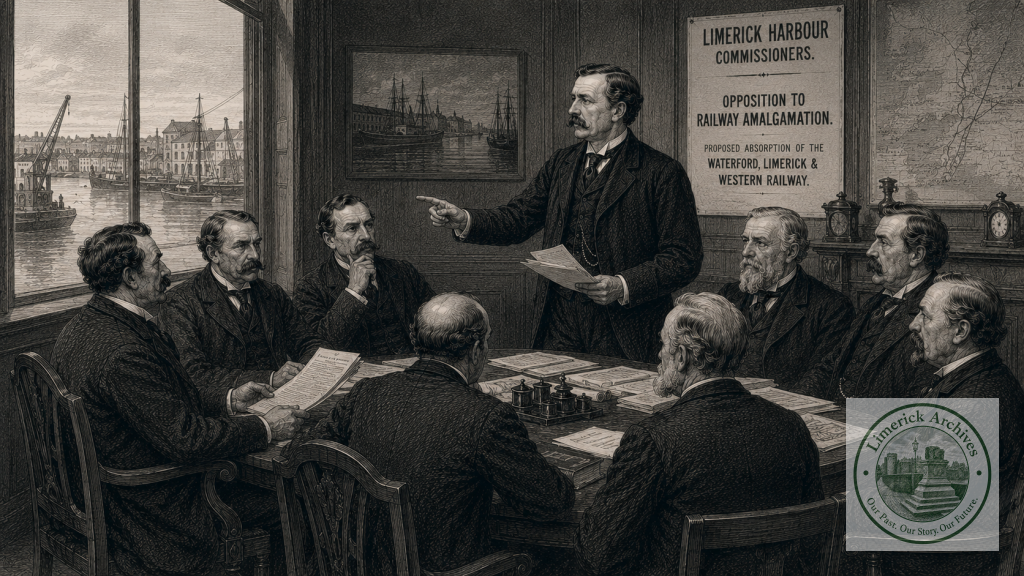
On 2 January 1900, the Freeman’s Journal reported that the Limerick Harbour Commissioners had again engaged Mr Fottrell, a Dublin solicitor, to organise opposition to the renewed railway amalgamation scheme. He was also instructed to retain senior counsel on the Commissioners’ behalf. The proposed arrangement would absorb the Waterford, Limerick and Western Railway into the larger Great Southern and Western Railway system. By appointing legal representatives before the parliamentary contest developed further, the Harbour Commissioners signalled that they regarded the scheme not as a private commercial transaction, but as a matter affecting the future prosperity of Limerick and its port.
The Waterford, Limerick and Western Railway provided a direct commercial artery between the Shannon and the south-east, while its branches connected Limerick with important agricultural and trading districts across the west. Opponents feared that amalgamation would remove one of the few substantial competitors to the Great Southern and Western Railway. Parliamentary debate had already highlighted the reductions in freight charges produced by competition on routes serving Limerick, Tuam, Thurles, Tralee and the Fergus district. Harbour interests consequently worried that a dominant railway company might increase rates, redirect traffic or favour routes and ports better suited to its wider corporate strategy.
The Commissioners’ intervention reflected the close relationship between rail transport and the working life of Limerick Harbour. Grain, livestock, provisions, coal and manufactured goods depended upon reliable connections between the docks, merchants, inland producers and distant markets. A railway monopoly could influence not only the price of carriage but the volume and direction of trade reaching the quays. Local merchants and public representatives therefore viewed railway competition as protection for employment, shipping and commercial independence. Their opposition was shared by other Limerick bodies, including the Corporation and County Council, although individual businessmen and commissioners differed over the merits of the proposed sale.
Retaining a Dublin solicitor and senior counsel transformed local resistance into an organised parliamentary campaign. The Commissioners required legal advice, statistical evidence and representation capable of challenging a private bill promoted at Westminster. Their expenditure later became controversial when the Irish Board of Works warned them against incurring further costs without authority. On 8 March 1900, Patrick O’Brien raised the matter in the House of Commons, arguing that the Harbour Commissioners should remain free to oppose legislation affecting Limerick. The Treasury acknowledged that their finances had recently been kept within revenue, while maintaining that the legality of the expenditure remained relevant.
The opposition ultimately failed to prevent amalgamation. Parliament passed the Great Southern and Western and Waterford, Limerick and Western Railways Amalgamation Act in August 1900, and the smaller company lost its independent existence at the beginning of 1901. The Harbour Commissioners’ decision nevertheless demonstrated how seriously Limerick regarded the danger of railway concentration. Their campaign joined commercial self-interest with a broader defence of competition across southern and western Ireland. By retaining legal specialists at the outset, the board ensured that the city’s concerns about freight charges, harbour traffic and economic dependence would be formally presented during the parliamentary struggle.
- Freeman’s Journal, “The Railway Amalgamation Proposals: Action of Limerick Harbour Commissioners,” 2 January 1900, p. 6.
- Limerick Harbour Commissioners Collection, IE LA P2, Board and Secretary records, including minute books P2/1/1–28, Limerick Archives.
- House of Commons Debates, “Irish Railway Amalgamation—Limerick Harbour Commissioners,” 8 March 1900, vol. 80.
- House of Commons Debates, “Great Southern and Western and Waterford, Limerick, and Western Railway Companies Amalgamation Bill,” 1 August 1900, vol. 87.
- Reports from the Joint Select Committee on the Great Southern and Western and Waterford, Limerick, and Western Railway Companies Amalgamation Bill, Parliamentary Papers, 1900, paper 196, vol. X, p. 19.
- Great Southern and Western and Waterford, Limerick and Western Railways Amalgamation Act 1900, 63 & 64 Vict., c. ccxlvii.
- Irish Times, “Limerick Corporation Railway Amalgamation Question,” 24 January 1900, p. 3.
- Irish Times, “Southern Railway Amalgamation Scheme,” 29 January 1900, p. 6; 30 January 1900, p. 7.