Branches Demand(c.1890s)
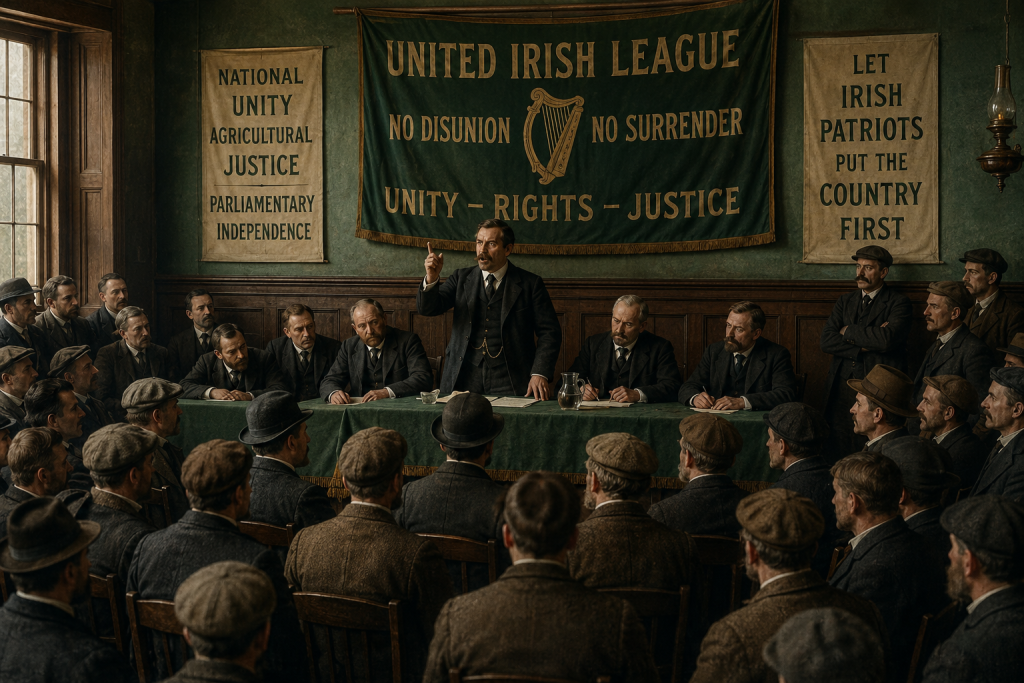
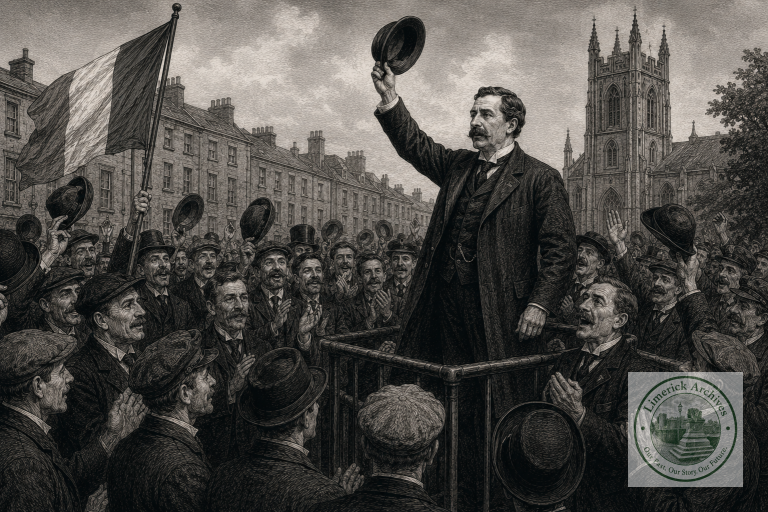
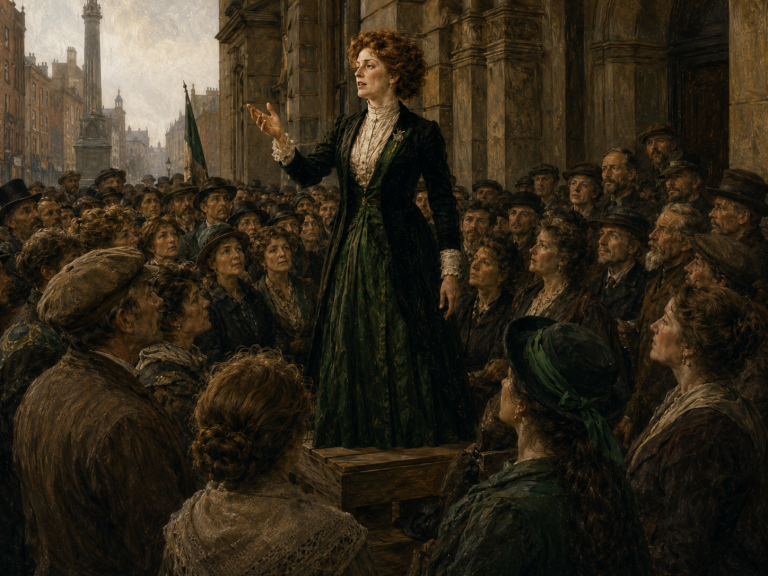
United Irish League branches pressed nationalist MPs to place national unity above personal disagreement as the organisation expanded during 1899. Founded at Westport in January 1898, the League combined agrarian agitation with a campaign to reconstruct the divided parliamentary movement. Local meetings and resolutions allowed tenant farmers, organisers and constituency workers to express impatience with leaders whose rivalries had weakened Irish representation since the fall of Charles Stewart Parnell. Branches possessed no constitutional power to command MPs, but their subscriptions, electoral labour and influence over candidate selection gave their appeals a force that Westminster politicians could not safely dismiss.
The demand for reunion was directed towards several competing groups. John Redmond led the principal Parnellite body, John Dillon dominated much of the anti-Parnellite majority, and Timothy Healy retained an independent following shaped by localism and personal hostility towards former allies. William O’Brien used the United Irish League to argue that these distinctions had become less important than the need for an effective national organisation. Resolutions favouring unity placed moral and electoral pressure upon representatives to accept common discipline. They also warned that members who prolonged factional conflict might face opposition from candidates supported by the growing network of League branches.
The branch campaign joined political unity to the practical needs of rural Ireland. League supporters demanded enlarged holdings, restoration of evicted tenants and stronger action against the concentration of grazing land, but such objectives required coordinated parliamentary pressure. A divided group of Irish MPs could be ignored, outmanoeuvred or courted separately by British parties. Local resolutions therefore treated reunion not as an act of personal forgiveness, but as the necessary machinery through which land reform and Home Rule might be pursued. The movement’s strength rested upon its ability to turn dissatisfaction in villages and market towns into instructions addressed directly to elected representatives.
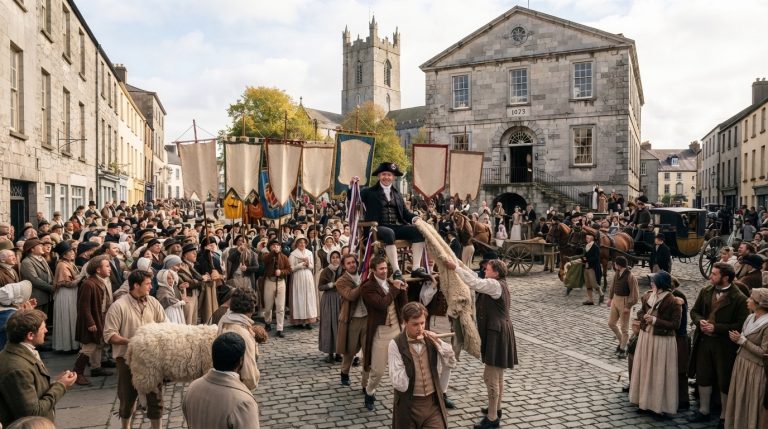
The argument had a defensible connection to Limerick, where political participation broadened significantly during the first local elections held under the Local Government (Ireland) Act of 1898. Limerick City’s municipal electorate rose from 709 to 5,521, while elected county and rural bodies replaced institutions previously dominated by property and appointment. The surviving evidence does not establish which Limerick League branches passed particular reunion resolutions during this campaign. Nevertheless, nationalist MPs representing the city and county operated within a political culture increasingly shaped by organised voters who expected land, housing, public works and Home Rule to receive disciplined parliamentary representation.
The accumulated pressure helped bring the rival parliamentary sections together in Committee Room 15 at Westminster on 30 January 1900. John Redmond became chairman of the reunited Irish Parliamentary Party, although the agreement did not remove the tensions among Redmond, Dillon, Healy and O’Brien. League branches had succeeded in making continued division politically dangerous, but reunion opened another dispute over whether authority belonged primarily to MPs or to the organisation sustaining them in the constituencies. The settlement restored outward unity and coordinated representation, while confirming that local branches and ordinary supporters had become active participants in determining the direction of constitutional nationalism.
Primary Sources
- Freeman’s Journal, 18 April 1899.
- Freeman’s Journal, 6 May 1899.
- Freeman’s Journal, 20 May 1899.
- Freeman’s Journal, 22 May 1899.
- Freeman’s Journal, 3 August 1899.
- Mayo News, 15 April 1899.
- The Times, 12 April 1899.
- Michael Davitt to William O’Brien, 6 April 1899, National Library of Ireland, MS 913, ff. 621–623.
- McInerney to William O’Brien, 3 and 6 May 1899, William O’Brien Papers, University College Cork, AJB.9 and AJB.11.
- John Dillon to William O’Brien, 1 June 1899, National Library of Ireland, MS 8555/11.
- T. P. O’Connor to John Dillon, 18 September 1899, John Dillon Papers, Trinity College Dublin, MS 6740/56.
- Philip Bull, “The United Irish League and the Reunion of the Irish Parliamentary Party, 1898–1900,” Irish Historical Studies, vol. 26, no. 101, May 1988, pp. 51–78.
- Local Government (Ireland) Act 1898, 61 & 62 Vict., c. 37.
- Martin Walsh, Limerick Local Government 1899–1942: An Online Exhibition Commemorating the 125th Anniversary of the Local Elections, 1899, Limerick Museum and Limerick Library Service, 2024.