Shannon Opposition
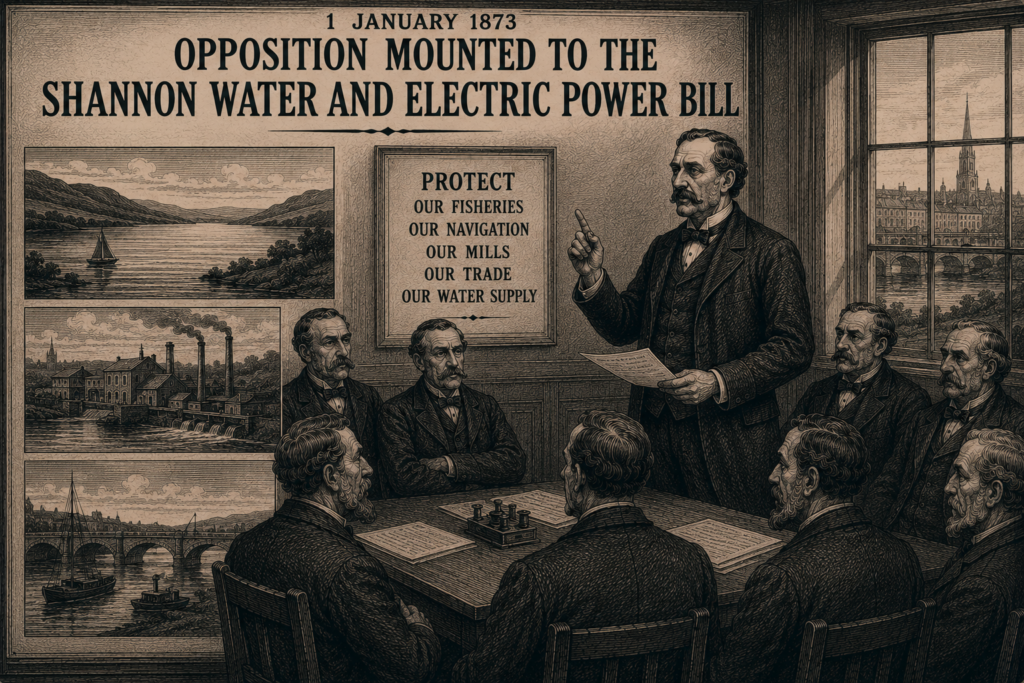
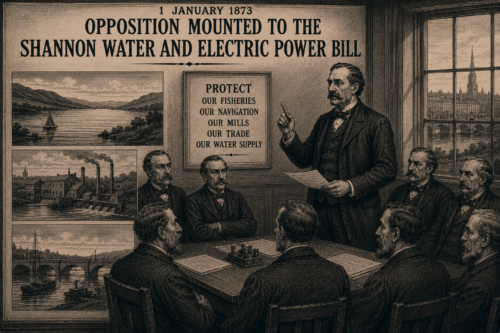
The surviving newspaper evidence dates this report to 2 January 1900 rather than 1 January, although the meeting itself may have occurred immediately beforehand. The Limerick Fishery Conservators, presided over by Lord Massy, unanimously resolved to oppose the Shannon Water and Electric Power Company’s proposed parliamentary bill. Promoters sought authority to harness Shannon water near Lough Derg and carry it through engineered channels to generate electricity at Clonlara. The Conservators regarded the project as a serious threat to interests already dependent upon the river and resolved to organise opposition before Parliament granted the company extensive powers.
Electricity promised cheaper power, new industry and improved municipal services, but opponents believed the proposed works placed established livelihoods at unacceptable risk. Diverting large quantities of water from the natural channel could alter the level of Lough Derg and reduce flows through important reaches of the Shannon. Fishery owners feared that salmon would be unable to reach tributaries and spawning beds, while mill and factory owners worried that machinery driven by river water might become unreliable. Navigation interests also questioned whether lower levels would obstruct boats, quays and commercial movement between lakeside communities and Limerick.
The Conservators’ resolution gathered several affected groups into a common campaign. Principal fishery owners, riverside proprietors, millers, factory owners and people using the Shannon for navigation were invited to resist the bill. Copies were to be sent to the Chief Secretary for Ireland, the Commissioners of Public Works, Limerick Corporation, parliamentary representatives and local authorities throughout counties connected with the river. The breadth of this circulation reflected the Shannon’s economic geography. A project centred near Clonlara could affect communities far beyond the generating station because fisheries, navigation, drainage and trade depended upon water conditions throughout the connected river system.
Limerick’s municipal water supply created another urgent concern. The city drew water from the Shannon system, and local officials feared that engineering works might interfere with the quantity or reliability of water reaching the urban population. Any disturbance could affect households, institutions, businesses and public health. The dispute therefore forced Limerick people to consider competing forms of progress. Electrical power might encourage industry and modern lighting, but the promised benefits appeared less attractive when measured against possible damage to drinking water, fishing employment, riverside mills, harbour traffic and the natural processes sustaining the river.
The campaign did not end the scheme. Official inquiries and parliamentary argument continued, while promoters later accepted clauses intended to preserve minimum river flows, fish passage, navigation and municipal water interests. Parliament eventually authorised a revised undertaking in 1901, though the private development was never completed. The Conservators’ unanimous opposition nevertheless established the central terms of Limerick’s early hydroelectric debate. Modern engineering would not be judged solely by the power it promised to generate. It would also be measured by whether fisheries, navigation, public water, existing industries and communities along the Shannon could survive the changes imposed upon the river.
- Irish Times, “Shannon Water and Electric Power Company,” 2 January 1900, p. 7.
- Irish Times, “Limerick Fishery Conservators: The Shannon Water and Electric Power Bill,” 5 January 1900, p. 3.
- Limerick Fishery Board of Conservators Collection, IE LA P48, Limerick Archives.
- House of Lords Debates, “Shannon Water and Electric Power Bill,” 23 July 1900, vol. 86.
- House of Lords Debates, “Irish Fisheries—Inspectors’ Reports,” 23 July 1900, vol. 86.
- Shannon Water and Electric Power Act 1901, 1 Edw. 7, c. cxxxvi, royal assent 26 July 1901.