Terminus Tragedy(c.1900s)
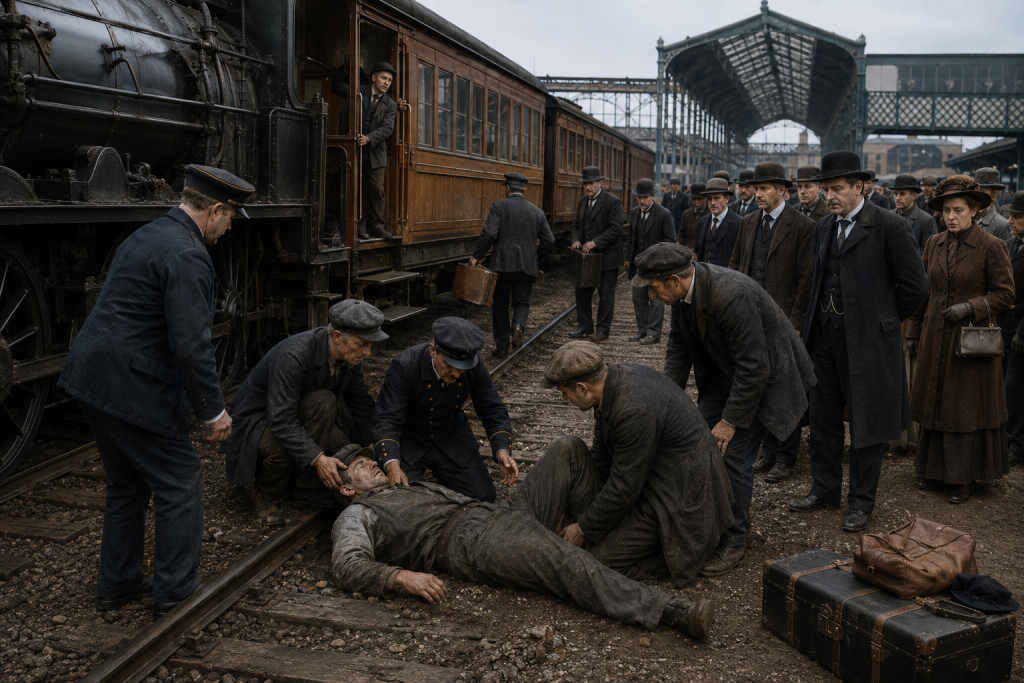
A serious accident at Limerick railway terminus left labourer James Davoren requiring the amputation of his right leg. The Irish Times reported on 2 January 1900 that Davoren had gone to the station to see his brother, described as a solicitor, depart by train for Fermoy. During the farewell, he fell from the platform onto the permanent way and was caught beneath the passing train. Railway staff and bystanders found him lying on the rails after the carriages had cleared. He was removed without delay to Barrington’s Hospital, where surgeons determined that the injured limb could not be saved.
A second contemporary account described Davoren as being pulled from the platform while bidding his brother goodbye. The precise movement that caused his fall remains uncertain, but both reports agree that he passed beneath the train and suffered catastrophic injury to one leg. The Freeman’s Journal stated that he was progressing as favourably as could be expected following the amputation. Its report also declared that no blame attached to railway officials. That conclusion did not lessen the severity of the event, but it indicates that the newspapers treated the accident as a sudden personal misfortune rather than alleging negligence by station employees.
The same report identified Davoren’s injury as the third serious accident at the Limerick terminus during the Christmas and New Year holidays. The surviving account does not provide details of the two earlier incidents, so their causes and consequences cannot safely be reconstructed. The statement nevertheless suggests that the station had experienced an alarming concentration of accidents during a period of increased passenger movement. Families, friends, porters and travellers crowded platforms as trains arrived and departed, while steam, noise, smoke and moving carriages created hazards for anyone standing too close to the platform edge or attempting a final farewell.
Rail travel had become essential to Limerick’s social and commercial life by the beginning of the twentieth century. The terminus connected local passengers with towns across Munster and linked the city’s shops, industries, cattle trade and agricultural hinterland with wider markets. Stations were also public meeting places where relatives accompanied departing passengers and often remained on the platform until trains moved away. Davoren was not reported as a passenger or railway employee; he was present because of a family departure. His injury demonstrated that the risks of rail travel extended to visitors as well as to those holding tickets or working upon the line.
The accident also placed Barrington’s Hospital within the city’s emergency response to industrial and transport injuries. Surgeons faced the immediate task of preventing further blood loss and infection after damage too extensive for the limb to be preserved. For Davoren, survival came with permanent disability at a time when a labourer’s livelihood depended heavily upon physical strength and mobility. Contemporary reporting ended with his postoperative condition and offered no account of his later recovery, employment or family circumstances. His case remains a stark record of how expanding transport networks brought convenience and opportunity while exposing ordinary Limerick people to sudden, life-changing danger.
- Irish Times, “Accident at Limerick,” 2 January 1900, p. 6.
- Freeman’s Journal, “Train Accident,” 3 January 1900, p. 7.
- Gerard Hannan, “Limerick — January 1900,” Irish Media Man, 28 February 2013, transcription reproducing the two contemporary newspaper reports and identifying their dates and page numbers.
- Regulation of Railways Act 1889, 52 & 53 Vict., c. 57, contemporary statutory background concerning railway safety and regulation.
- Barrington’s Hospital records and administrative collections, Limerick Archives; no specific surviving patient record for James Davoren has been confirmed.