
Fishamble Street’s Charity Messiah
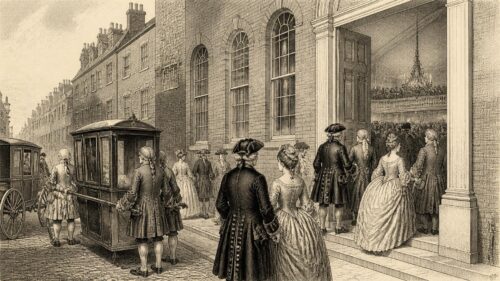
In 1742, Ireland remained weakened by the Great Frost famine, with hunger, disease and poverty continuing despite improving conditions. Recovery efforts included the Cope’s voyage carrying Tyrone coal to Dublin via the new Newry navigation, demonstrating improved transport and trade potential. Dublin’s cultural life produced Handel’s Messiah, first performed in Fishamble Street on 13 April for hospitals and imprisoned debtors. Government operated without a parliamentary session through Dublin Castle proclamations, while religious inequalities persisted. Jonathan Swift’s incapacity and Archbishop Hugh Boulter’s death marked losses within the established order. The year combined charitable action, infrastructure, cultural achievement and lingering social crisis.
View Record
Lucas and Dublin’s Aldermen
In 1743, Charles Lucas challenged Dublin aldermen's control over elections, accounts and patronage, arguing that the Corporation's wider body should choose aldermen. His April Remonstrance and demands to print accounts widened the dispute through print and legal argument, although recorder Eaton Stannard ruled for the aldermen in October. The conflict promoted civic accountability but remained confined to Protestant corporate citizens, excluding Catholics and Dissenters. Arthur Jones Nevill became Surveyor General, linking public works to Castle patronage. Proclamations addressed crime, ports and quarantine, while a linen bounty integrated Irish production into British Atlantic trade. Recovery from the Great Frost remained precarious.
View Record
Pill Lane and the Rot Year
Ireland in 1744 combined political control, social vulnerability and tentative institutional improvement. With the Anglican parliament prorogued, Dublin Castle governed through proclamations addressing foreign military recruitment, disorder, crime, war with France and maritime quarantine. In February, a house collapsed during Catholic Mass in Dublin’s Pill Lane, killing priest and nine worshippers, exposing hazards intensified by penal restrictions. Dublin also founded the Physico-Historical Society and Hospital for Incurables, while cultural life included Spranger Barry’s theatre debut and developing drawing instruction. Arthur Price became archbishop of Cashel. A wet, cold autumn damaged northern oats and potatoes, reviving fears after the 1740–41 famine.
View Record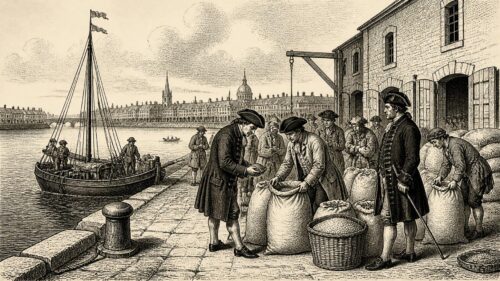
Swift’s Last Autumn
In 1745, Ireland remained peaceful during the Jacobite rising, yet was deeply implicated in the wider Stuart crisis. Lord Lieutenant Chesterfield combined surveillance and preparedness with relative restraint towards Catholics, while restricting provisions exports and proclaiming rewards, fasts and grain controls. Irish expatriates advised Charles Edward Stuart, and the French Irish Brigade distinguished itself at Fontenoy, though no Irish rebellion materialised. Food regulation, markets and linen petitions reflected wartime economic anxieties after scarcity. Dublin retained vitality: Thomas Sheridan managed Smock Alley Theatre, while Jonathan Swift died, leaving funds for St Patrick’s Hospital. Ireland’s calm concealed penal inequality and international entanglements.
View Record
Culloden and the Salt-Meat Embargo
In 1746, Ireland experienced the repercussions of Culloden rather than battle, as Irish exiles in French service fought for the Jacobites while Dublin Castle guarded against recruitment and disorder. Chesterfield’s administration ended amid continuing Catholic exclusion and official caution. Poor harvests, wartime demand and trade disruption prompted embargoes on provisions and salted meat, alongside grain imports and quarantine changes. Government proclamations targeted outlaws, organised fasts, and extended authority through local institutions. Westminster restricted Irish glass exports, while linen remained encouraged. John Cennick began Moravian work in Dublin, and Jonathan Swift’s bequest secured St Patrick’s Hospital’s legal foundation, illustrating charitable change.
View Record
Stone’s Primacy, Wesley’s Landing
In 1747, Ireland saw no single decisive event, but political, religious, cultural and social tensions were visible. George Stone became Church of Ireland archbishop of Armagh and a lord justice, strengthening Protestant administrative power under a restricted constitution. Catholic leadership changed through episcopal deaths and appointments, sustained by clerical and continental networks despite penal laws. John and Charles Wesley made their first Irish visits, while Edmund Burke helped found a Trinity debating club. Dublin’s Kelly riots exposed disputes over privilege and theatre authority. Proclamations addressed quarantine, rural crime, weavers’ unrest and rioting, reflecting hardship, trade and fragile order after famine.
View Record
Burgesses and Kildare House
In 1748, Ireland’s restricted Protestant political order was highlighted by the Newtown Act, which regularised non-resident burgesses and potentially strengthened borough patronage, while excluding Catholics and dissenters from power. Completion of James FitzGerald’s Palladian Kildare House demonstrated aristocratic wealth, influence and Dublin’s southward expansion. Wartime fasts and embargoes gave way to ceasefires and the Treaty of Aix-la-Chapelle, though rural households remained economically insecure within imperial trading constraints. Proclamations against robbery, intimidation and arson reflected official anxieties over order. Catholic organisation persisted despite Penal Laws, marked by Archbishop Ross Roe MacMahon’s death, while early Methodist preaching added to Ireland’s religious landscape.
View Record
Lucas’s Censor and Cork’s Swadlers
In 1749, Irish tensions appeared in political print, official measures, economic debate and religious conflict. Dublin apothecary Charles Lucas used The Censor and civic addresses to challenge municipal corruption, defend Protestant constitutional rights and question Dublin Castle’s authority. Parliament denounced his publications as seditious, ordered his arrest, and forced his flight. Government proclamations addressed quarantine, coin clipping and rural crime, reflecting administrative reliance on local institutions and military power. Thomas Waite’s account emphasised linen, restricted woollen trade and military spending, while improvement schemes favoured elite direction. In Cork, Charles Wesley’s Methodism provoked unrest, exposing intersecting confessional, civic and social rivalries.
View Record
The Dublin Society Charter
In 1750, George II chartered the Dublin Society for Promoting Husbandry and Other Useful Arts, formalising an elite-led body that encouraged agricultural, industrial and artistic improvement through premiums, advice and practical education. Its drawing-school association, though imprecisely dated, reflected efforts to train craftsmen. In December, the Duke of Dorset returned as lord lieutenant, reshaping political expectations before later conflicts over revenue and executive authority. Charles Lucas, writing from London, advanced civic arguments in print. Beneath these institutional developments lay restricted representation, Anglican privilege, penal disabilities, unequal commerce and rural insecurity, despite population growth, agricultural adaptation, and Ulster’s expanding linen economy.
View Record
Clements’s Phoenix Lodge
In 1751, Nathaniel Clements became ranger of Phoenix Park and began the lodge later transformed into Áras an Uachtaráin, embodying the Palladian authority of Ireland’s Protestant elite. The shortened legal year, preceding Gregorian reform, altered timekeeping. Architect Richard Castle died, while actor Peg Woffington returned to Dublin’s Theatre Royal, illustrating cultural connections. Debate over Burton’s Bank’s 1733 collapse exposed insecurity. Parliament, dominated by Protestant interests and excluding Catholics, considered revenue, commerce, law, roads and charitable medicine, including Cork Infirmary. These developments reveal a connected Georgian Ireland whose growth, administration and institutions rested upon inequalities of religious, property and political power.
View Record