Archived: 30 October 2026
Abstract
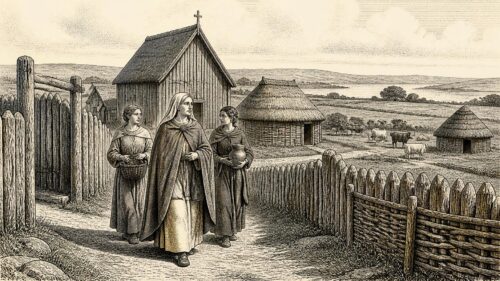
In 775, Irish annalistic evidence records deaths of ecclesiastical and learned figures, including Scannal, Maicníad, Augustin, Adarchu and Forbflaith, abbess of Clonbroney, alongside a battle at Uilleann Guaire that killed Flann son of Cellach and Scannlán son of Fínnechta. Dates and details remain uncertain because medieval annalistic chronologies differ. The year also saw Donnchad Midi, king of Tara, devastate Munster, demonstrating coercive but limited overlordship. These notices reveal interconnected political, religious and intellectual communities, in which churches held economic and social authority, women could lead religious houses, and rural households locally sustained kingdoms and monasteries through labour, rents, and service.
Read Article
Archived: 31 October 2026
Abstract
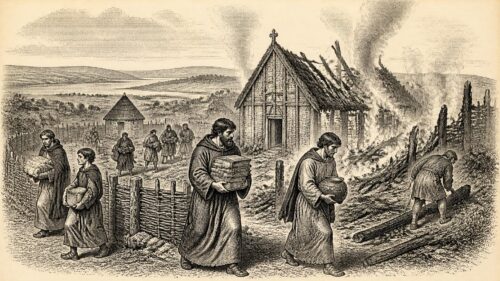
For Ireland in 756, the annals offer no single, all-embracing story. Instead, they preserve a sharp cluster of incidents: the burning of the great church settlement of Bangor on St Patrick’s Day; a military expedition which brought Leinster forces into Mag Muirthemne; the death of a Connacht overking; fighting in the midlands and Connacht; and a catastrophic wreck on Lough Ree. Read together, these terse notices reveal an island in which kingship, ecclesiastical authority and movement by water were all deeply consequential. They also demand care. Medieval annals did not record every event, and they often give outcomes without causes.
Read Article
Archived: 31 October 2026
Abstract
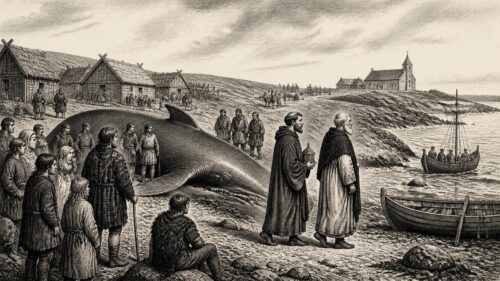
In 752, Irish annals recorded a darkened sun, the deaths of prominent abbots and scholars, and violence between the Uí Ailella and Grecraige. They also report that Domnall Midi, king of Tara, enforced the law of Colum Cille, linking royal authority with the Columban church’s claims to protection and prestige across Ireland and the Irish Sea. Most memorably, a whale stranded at Bairche in Ulaid was said to possess three golden teeth, one placed on Bangor’s altar. Though implausible literally, the tale reflects medieval connections between natural wonders, wealth, sanctity, political power, and ecclesiastical public memory within this fragmented record.
Read Article
Archived: 2 November 2026
Abstract
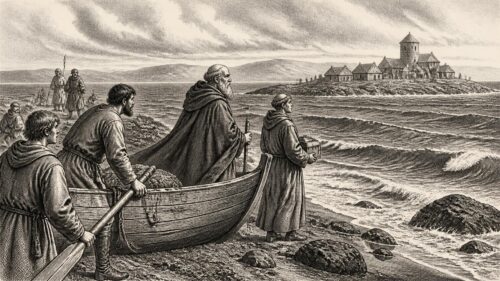
In 691 CE, the surviving Irish annals preserve a small but revealing cluster of notices: the death of Crónán moccu Cuailne, abbot of Bangor; a raid by Dál Riata upon the Cruithin and Ulaid; the death of Fidchellach son of Flann, king of Uí Maine; and a violent windstorm which drowned about six members of Iona’s community on 16 September. These entries do not amount to a continuous narrative of the year, and they should not be made to do so. Yet, set beside the political and ecclesiastical landscape of the late seventh century, they show an Ireland joined to
Read Article
Archived: 2 November 2026
Abstract
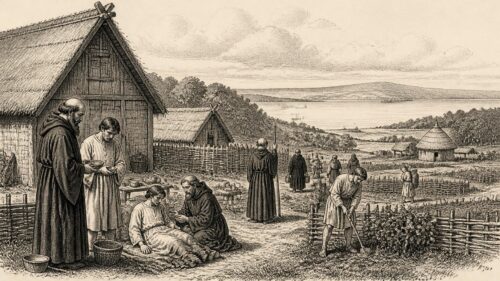
In 667 CE, Ireland was still living through the human consequences of a great mortality that had begun several years earlier. The clearest annalistic entry assigned to this year records a plague in which four abbots of Bangor—Berach, Cuimíne, Colum and Aedán—died. It also records fighting at Áine between the Araid and the Uí Fhidgeinti, in which Eógan son of Crunnmael was killed, and the slaying of Bran Finn, king of the Déisi of Munster. These brief notices are unusually revealing: disease could strike centres of authority as well as households; local warfare continued amid loss; and Ireland remained a
Read Article


