
Archived: 7 October 2026
Abstract
Labelled 30,130 BCE, this period falls in late Marine Isotope Stage 3, as Ireland moved towards, but had not reached, maximum glaciation. Conditions were cold, open and changing, with lower seas and unstable ice margins linking Ireland ecologically to north-west Europe. Castlepook Cave, County Cork, preserves Ireland’s principal pre-maximum vertebrate archive, including mammoth, giant deer, reindeer, bear, hyena, lemmings, Arctic fox and wolf. Its mixed, disturbed deposits cannot date all species together, though modern redating has revised ages older. The evidence indicates mobile Ice Age fauna in patchy tundra-like habitats, not human settlement. Secure human activity appears 12,800 years ago.
Read Article
Archived: 1 October 2026
Abstract
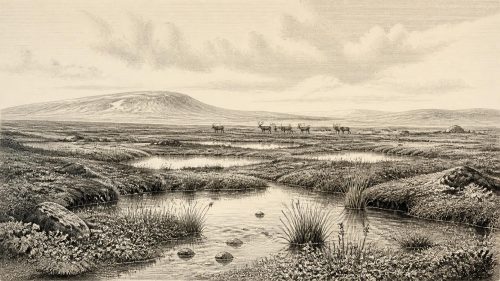
30,421 BCE is a modern label rather than a datable Irish event. Derryvree, County Fermanagh, preserves an ice-free interval between glacial tills, recording freshwater tundra with sedges, mosses, dwarf shrubs and aquatic plants. Castlepook Cave, County Cork, contains Ireland’s richest pre-Last Glacial Maximum fauna, including mammoth, reindeer, bear, wolf, Arctic fox, lemmings and spotted hyaena, accumulated over time. A possibly cut-marked reindeer femur may indicate Upper Palaeolithic butchery, but remains disputed and cannot prove settlement. Approaching the ice-sheet maximum, later glaciation eroded or buried much evidence. These sites reveal cold environments and ecological connections, rather than a recoverable human history.
Read Article

Archived: 22 September 2026
Abstract
Around 30,891 BCE, Ireland lay within the unstable cold conditions of Marine Isotope Stage 3, not a precisely datable historical moment. Derryvree, County Fermanagh, preserves organic sediments indicating ice-free, open tundra-like wetlands with herbs, sedges, mosses and shallow freshwater before renewed glaciation. Castlepook Cave, County Cork, contains a mixed, long-lived fauna including mammoth, reindeer, giant deer, bear, wolf, lemmings and hyaena, evidencing varied cold-stage ecosystems. A marked reindeer bone may suggest human butchery, but cannot prove settlement. No contemporary Irish tools, hearths, art, burials, political structures or trade are securely known. Environmental change and advancing ice dominate the sparse record.
Read Article

Archived: 18 September 2026
Abstract
Around 31,329 BCE, Ireland lay within the unstable late Ice Age. Derryvree in County Fermanagh preserves freshwater sediments between glacial tills, dated broadly to this interval, showing ice-free, tundra-like wetlands with Arctic-alpine plants. Castlepook Cave in north Cork yielded Late Pleistocene remains including mammoth, reindeer, giant deer, predators and lemmings, demonstrating changing open-country habitats but not a single contemporary fauna. A cut-marked reindeer femur may indicate Upper Palaeolithic butchery, yet no secure evidence confirms permanent human settlement. Environmental change, advancing ice and later erosion shaped a fragmentary record, while political, social and cultural history remain unknowable for this remote period.
Read Article

Archived: 10 September 2026
Abstract
31,826 BCE is a modern point within a broad, uncertain Late Pleistocene radiocarbon range, rather than a datable Irish event. Organic sediments at Derryvree, County Fermanagh, between glacial tills, record an ice-free, cold freshwater tundra with sedges, mosses, insects and sparse vegetation. Comparable sites confirm intermittent non-glacial conditions before expanding ice culminated later in the Last Glacial Maximum. Castlepook Cave, County Cork, preserves remains of mammoth, reindeer, giant deer, carnivores and smaller animals, evidencing productive open-country ecosystems. A possibly cut-marked reindeer bone raises, but cannot prove, early human presence. No secure evidence supports settlement or social organisation; evidence remains fragmentary.
Read Article

Archived: 9 September 2026
Abstract
Around 31,951 BCE, Ireland lay in the Late Pleistocene, before the Last Glacial Maximum, experiencing increasingly cold, unstable conditions rather than uniform ice cover. Southern areas may initially have remained ice-free, while changing sea levels and ice margins altered connections with Britain and Europe. Cave fauna, particularly from Castlepook, demonstrates reindeer, mammoth, hyaena, bears, wolves and other cold-adapted animals during this broad period. A marked reindeer bone may indicate brief Upper Palaeolithic butchery, but cannot prove settlement or continuous occupation. Glacial erosion, drowned landscapes and disturbed cave deposits explain the sparse record, leaving environmental change as the clearest documented development.
Read Article

Archived: 8 September 2026
Abstract
At about 31,991 BCE, Ireland lay within the climatically unstable later Marine Isotope Stage 3, before the Last Glacial Maximum. Growing ice, lower sea levels and changing coastlines transformed habitats and possible access routes, though any land connection with Britain remains uncertain. Castlepook Cave in County Cork preserves key evidence: reindeer, mammoth, giant deer, lemmings, predators and other fauna indicate varied cold open environments. A cut-marked reindeer bone suggests possible Upper Palaeolithic human activity, but cannot prove settlement or continuous occupation. Later glaciation destroyed evidence. Consequently, this period is understood through imprecise dating, cave deposits and reconstruction, not year-specific history.
Read Article




