Castlepook’s Ice-Age Fauna30421 BCE
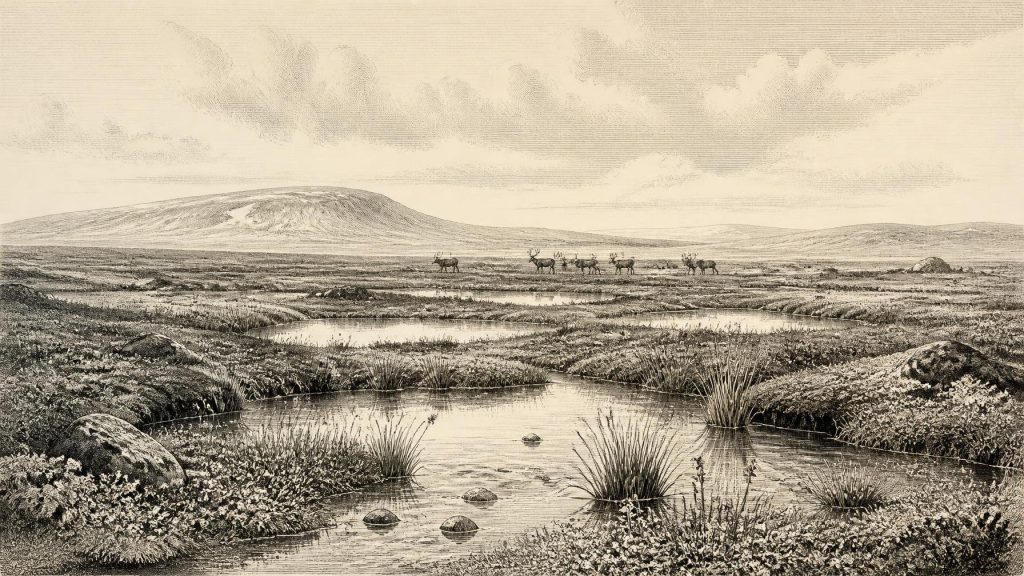
30,421 BCE is a modern label rather than a datable Irish event. Derryvree, County Fermanagh, preserves an ice-free interval between glacial tills, recording freshwater tundra with sedges, mosses, dwarf shrubs and aquatic plants. Castlepook Cave, County Cork, contains Ireland’s richest pre-Last Glacial Maximum fauna, including mammoth, reindeer, bear, wolf, Arctic fox, lemmings and spotted hyaena, accumulated over time. A possibly cut-marked reindeer femur may indicate Upper Palaeolithic butchery, but remains disputed and cannot prove settlement. Approaching the ice-sheet maximum, later glaciation eroded or buried much evidence. These sites reveal cold environments and ecological connections, rather than a recoverable human history.
Dateline
30,421 BCE is not a date at which Irish history can be narrated year by year. It is a modern calendar label, approximately 32,370 years before the radiocarbon convention of AD 1950, rather than a recoverable ancient anniversary. No document, settlement floor, hearth or securely dated tool allows us to identify an event in Ireland in this particular year. The responsible view is therefore broader: Ireland lay within the Late Pleistocene, during the unstable middle part of the last glacial cycle, and its history survives in layers of sediment, animal bones and changing landforms rather than in names or chronicles.
The evidence is powerful but uneven. A freshwater deposit at Derryvree near Maguiresbridge, County Fermanagh, is the clearest Irish environmental archive relevant to this broad period. Castlepook Cave, or Mammoth Cave, near Doneraile in north County Cork preserves the country’s richest known assemblage of pre-Last Glacial Maximum mammal remains. Neither site supplies a snapshot of 30,421 BCE itself. Together, however, they show that parts of Ireland supported cold-adapted plants and animals before later ice advances reshaped or destroyed much of the earlier landscape.
A Date Beyond Calendar Precision
Radiocarbon dating does not simply convert into a BCE year. The Derryvree organic material produced determination BIRM-166, conventionally reported as 30,500 radiocarbon years before present, with a substantial error range of +1,170 and −1,030 years. “Before present” means before AD 1950, and radiocarbon years differ from calendar years because atmospheric carbon-14 has varied through time. The internationally used IntCal20 curve permits calibration back to 55,000 calendar years before present, but it produces probability ranges, not a single exact year. A later review gives Derryvree an indicative age around 35.9 ± 1.1 thousand calibrated years before present. Thus the deposit is an essential guide to the wider cold-stage world, but probably predates the numbered year in this article by several millennia.
This distinction matters. Archaeological layers form over seasons, generations or longer intervals; cave collections can be mixed by animals, water, excavation and curatorial history; and even a well-dated bone dates the death of an animal, not necessarily a human visit. The closest language is therefore “around this period” or “within the environmental conditions that framed this date”. Claims about a particular camp, hunt or community in 30,421 BCE would go beyond the evidence.
Derryvree’s Open Wetland
In 1969, roadworks cut through a drumlin at Derryvree and exposed a remarkable sequence. Beneath lay one thick glacial till, sediment left by ice. Above it sat freshwater silts and fine sands rich in organic remains. A second till later sealed the deposit. The order of events is secure even where exact dating is not: glacier ice affected the locality; an ice-free interval allowed water, plants and animals to occupy a hollow; then a renewed advance buried the evidence beneath more glacial sediment. The deposit is an unusually eloquent survivor because later ice did not completely scour it away.
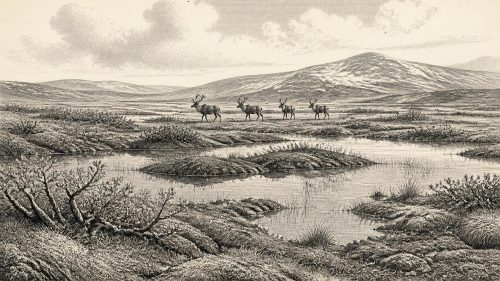
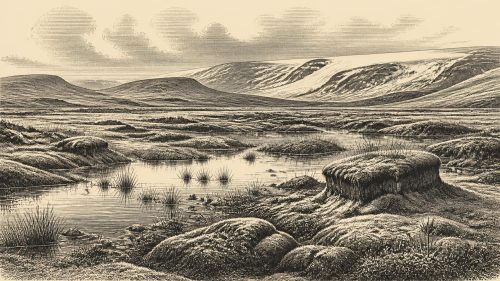
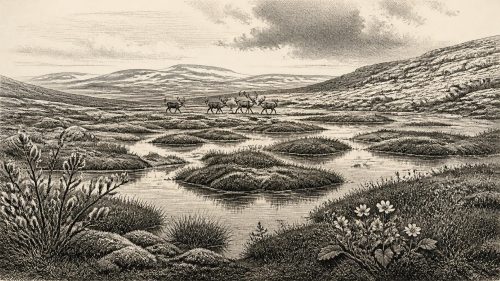
The plants and small animal remains point to open tundra vegetation and a periglacial regime, meaning a landscape subject to intense frost, thaw and seasonal cold near ice margins. This was not modern Fermanagh’s wooded, lake-dotted countryside. Grasses, sedges, mosses, dwarf shrubs and arctic-alpine herbs occupied exposed ground and wet margins. Aquatic evidence, including water-milfoil pollen, shows that shallow freshwater existed locally. The resulting scene was varied at a small scale: mossy ground and sedgy shallows around pools, with drier, sparsely vegetated surfaces beyond. It should not be turned into a uniform, snowbound wilderness; the flora instead records a living wetland ecosystem able to function during an ice-free interval.
The Cave Fauna of North Cork
Castlepook Cave provides a complementary, though differently formed, record. Excavations in the early twentieth century and later work recovered remains of woolly mammoth, reindeer, brown bear, wolf, Arctic fox, mountain hare, lemmings and spotted hyaena, among other animals. These remains do not prove that every species lived side by side in one season. The cave accumulated material over a long interval, and carnivores, natural deaths, water movement and early excavation practices all affected the collection. Yet the assemblage firmly establishes that Ireland was not biologically empty before the Last Glacial Maximum. It formed part of a wider north-west European world in which large herbivores and formidable predators could reach the island during favourable phases.
Spotted hyaena are especially revealing. At Castlepook, their skulls and other remains are evidence for a carnivore now absent from Europe and Ireland, while bone damage elsewhere in the assemblage indicates the practical importance of carcass scavenging and consumption. The cave may have offered shelter or a denning and feeding place, but it should not be imagined as a fixed “hyaena cave” throughout the entire Late Pleistocene. Its deposits instead record repeated use and accumulation within a changing animal landscape. Mammoth, reindeer and hyaena remains are evidence of ecological connections with Britain and the adjacent continental region; they do not, by themselves, demonstrate a permanent land bridge or a single migration route.
A Possible Human Trace
The most consequential, and most disputed, human clue is a reindeer femur from Castlepook reported to bear a deep incision consistent with a stone-tool cut during butchery. Public reporting associated the bone with an age of roughly 33,000 years ago, and zooarchaeologist Ruth Carden’s interpretation has prompted renewed investigation of the cave. If the mark proves to be humanly made on fresh bone and broadly contemporary with the animal’s death, it would push evidence for human activity in Ireland far back before the better-attested post-glacial record. It would show the processing of an animal, however, not automatically a settlement, a hunting party, a named population or continuous occupation.
Caution is essential because the original Castlepook collections came from excavations undertaken long before current standards of recording. Some deposits were disturbed, and a mark on a bone must be distinguished from carnivore damage, sediment abrasion, excavation damage or other natural alteration. Recent fieldwork has sought intact, stratified deposits in previously unexamined parts of the cave, precisely because controlled context is needed to test the older collection. At present, the cut-marked femur is best described as a potentially transformative indication of Upper Palaeolithic human activity, not as proof that Ireland possessed a resident human society in 30,421 BCE.
Life Without a Recorded Society
There is no evidence from Ireland at this point for villages, houses, graves, farming, pottery, exchange goods, monuments or a securely identified toolkit. Consequently, political affairs, warfare, diplomacy, law, formal religion and organised learning cannot be recovered. There were no recorded kingdoms or borders to describe, and it would be misleading to supply them by analogy with much later prehistory. Nor is there evidence for trade in the usual archaeological sense: no imported objects or commodities can be assigned to this date in Ireland.
If people did enter the island, their social world can only be discussed as a cautious inference from Upper Palaeolithic lifeways elsewhere in north-west Europe. Small, mobile groups may have followed animal movements, sought sheltered ground, shared food and knowledge, and carried portable equipment. Those possibilities are plausible in a severe seasonal environment, but they are not discoveries made at Derryvree or Castlepook. The Irish evidence at present supports ecology more strongly than social reconstruction. Its visible ‘economy’ is an ecological one: plants growing in shallow water, herbivores exploiting open ground, predators competing for carcasses, and frost and meltwater moving sediment.
Approaching the Ice Maximum
The broader trajectory was towards much more extensive glaciation. Reconstructions of the British–Irish Ice Sheet indicate that its maximum was reached by about 27,000 years before present, after the broad period represented by Derryvree and the older Castlepook fauna. At maximum extent, ice covered most of Ireland and extended onto surrounding shelves. This later advance transformed the island’s surface, depositing tills, moulding drumlins and removing many earlier land surfaces. It also explains why evidence for the period is so scarce: the archive is not merely undiscovered; much of it was physically eroded, transported or buried by ice.
Regional variation remains important. An ice-free wetland in Fermanagh during one interval does not tell us that all Ireland was ice-free, just as animal remains in a Cork cave do not map every habitat across the island. The Irish Ice Sheet was dynamic, responding to changing climate, ocean conditions, topography and its own internal flow. Around 30,421 BCE, the most defensible picture is therefore of an environmentally unsettled island: open cold landscapes existed in some phases and places; large mammals circulated through connected western European ranges; and advancing ice would soon erase or conceal much of their record.
Ireland’s story at this depth of time is not silent, but it speaks a language of silts, pollen, bones and ice. Derryvree supplies the strongest direct evidence for a treeless freshwater tundra environment; Castlepook preserves the animal world that moved through a later-lost landscape. A possible cut mark hints that people may have briefly joined that world. It does not yet allow history to name them, locate their homes or claim their descendants.
Primary Sources
- Middle Midlandian Freshwater Series at Derryvree, Maguiresbridge, County Fermanagh, Northern Ireland
- Middle Midlandian Freshwater Series at Derryvree, Maguiresbridge, County Fermanagh, Northern Ireland
- The Irish Quaternary Fauna Project
- The Irish Quaternary Fauna Project
- Spotted Hyena Skull
- Castlepook Cave
- Archaeology Research Excavation Grant 2022: Castlepook Cave, Co Cork
- 32564: Castlepook Cave, Castlepook South, Cork
- Archaeological Heritage of County Cork
- Heritage Artefacts of County Cork
- The IntCal20 Northern Hemisphere Radiocarbon Age Calibration Curve (0–55 cal kBP)
- IntCal Publications
- Pattern and Timing of Retreat of the Last British-Irish Ice Sheet
- Timing and Pace of Ice-Sheet Withdrawal Across the Marine–Terrestrial Transition West of Ireland During the Last Glaciation
- Exploring Controls of the Early and Stepped Deglaciation on the Western Margin of the British Irish Ice Sheet
- A Critical Review and Re-Investigation of the Pleistocene Deposits Between Cranfield Point and Kilkeel, Northern Ireland
- Dimensions and Chronology of the Last Ice Sheet in Western Ireland
- Britain and Ireland: Glacial Landforms from the Last Glacial Maximum
- Myriophyllum alterniflorum
- Palaeoecology
- Occurrence of Mammalia Relicts at Site Castlepook Cave
- Reindeer Bone Found in Cork Cave Shows Human Activity in Ireland 33,000 Years Ago