Ice Margins31951 BCE
Around 31,951 BCE, Ireland lay in the Late Pleistocene, before the Last Glacial Maximum, experiencing increasingly cold, unstable conditions rather than uniform ice cover. Southern areas may initially have remained ice-free, while changing sea levels and ice margins altered connections with Britain and Europe. Cave fauna, particularly from Castlepook, demonstrates reindeer, mammoth, hyaena, bears, wolves and other cold-adapted animals during this broad period. A marked reindeer bone may indicate brief Upper Palaeolithic butchery, but cannot prove settlement or continuous occupation. Glacial erosion, drowned landscapes and disturbed cave deposits explain the sparse record, leaving environmental change as the clearest documented development.
Dateline
“31,951 BCE” is a modern chronological label, not a year in which an event in Ireland can be dated with calendar precision. For so remote a period, archaeologists and Quaternary scientists normally work with radiocarbon ages expressed as years before present (BP, conventionally AD 1950), calibrated calendar ranges, stratigraphy and environmental proxies. This date lies roughly 33,900 calendar years before present, in the Late Pleistocene, within Marine Isotope Stage 3 and the wider Upper Palaeolithic age of Europe. It falls before the Last Glacial Maximum, not within a historical sequence of named rulers, peoples or recorded events.
The responsible question, therefore, is not what happened on one day or in one numbered year, but what the incomplete evidence can say about the island around this broad interval. The answer is necessarily cautious. Ireland was entering a colder, unstable phase of the last glacial cycle, and its landscape supported Ice Age animals at least during parts of the preceding and contemporary millennia. There is no securely excavated house, hearth, burial, stone-tool assemblage or human skeleton from Ireland that can be assigned to c. 31,951 BCE. Nor is there evidence for a continuously resident human population at this date.
A Pre-Maximum Ice Age
The date belongs to the long approach to the Last Glacial Maximum, when the British–Irish Ice Sheet eventually reached its greatest late-glacial extent, broadly between about 26,000 and 19,000 years ago. Its advance was neither instantaneous nor uniform. Research on southern Ireland indicates that substantial expansion of the last ice sheet followed initially ice-free conditions around 34,000 years ago, with ice reaching the south coast much later, after about 24,000 years ago. Other reconstructions emphasise regional complexity: mountain ice, advancing ice margins and changing sea conditions did not necessarily produce the same landscape in Cork, Fermanagh, the midlands and the northern coast at the same time.
Thus Ireland around 33,900 calibrated years ago should not simply be pictured as an island buried beneath a single, permanent sheet of ice. It was a cold north-western European landmass facing increasing climatic severity and, later, major glaciation. Low global sea levels enlarged the exposed coastal shelf and altered routes between Ireland, Britain and continental Europe, but the precise geography of crossings changed repeatedly with ice and sea level. Animal dispersal shows that connections or viable passages existed at intervals; it does not prove that a dry, easy land bridge was available at this exact moment, still less that people used one.
Landscape and Wildlife
The strongest direct evidence for this deep period comes from caves and from bones preserved in museum collections, especially in the south of the island. Castlepook Cave, near Doneraile in north County Cork, is exceptionally important: Geological Survey Ireland describes it as the country’s richest known site for vertebrate fauna leading up to the Last Glacial Maximum. Antiquarian excavations recovered a substantial but imperfectly documented collection, later studies showing that its deposits represent more than one episode and cannot be treated as a single frozen moment in time.
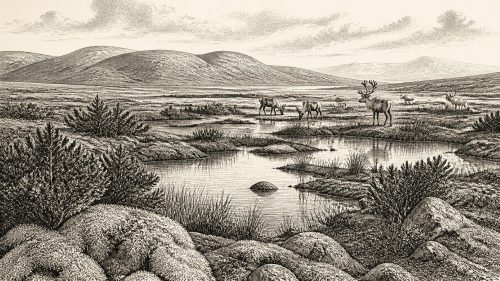
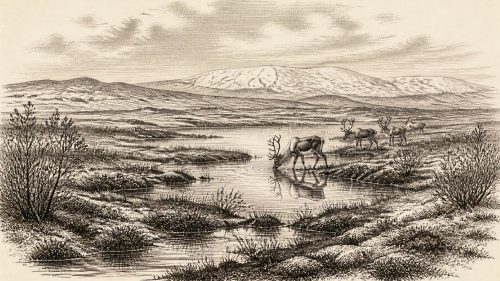
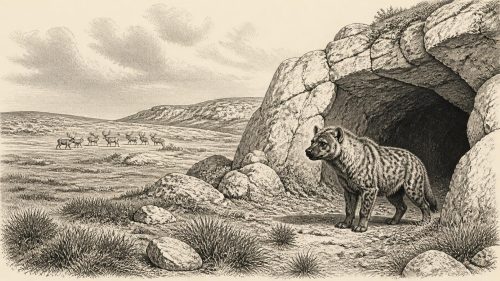
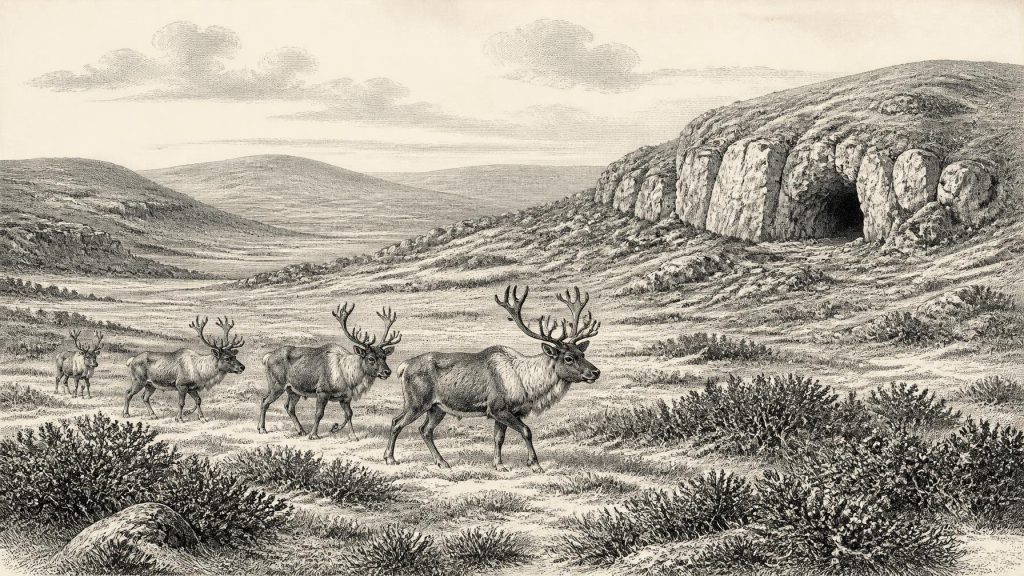
The Castlepook record includes animals associated with cold and open Pleistocene environments: reindeer, woolly mammoth, brown bear, spotted hyaena, wolf, Arctic fox, hare and lemmings, as well as deer. Not all need have lived together, and individual species have different date ranges, but the assemblage establishes that Ireland had supported a far richer large-mammal fauna than the later Holocene island. Redating of southern Irish cave material places important faunal evidence in Marine Isotope Stage 3; it suggests, for example, that giant deer and spotted hyaena may have disappeared locally before the climatic maximum.
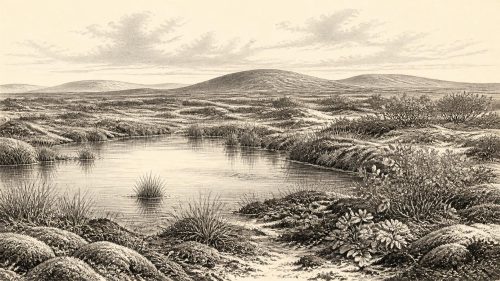
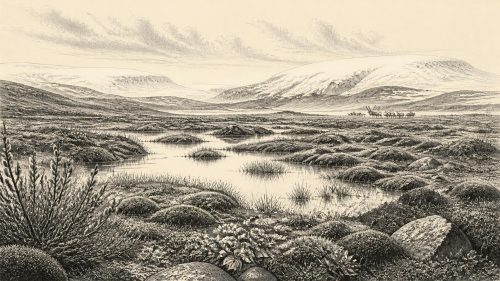
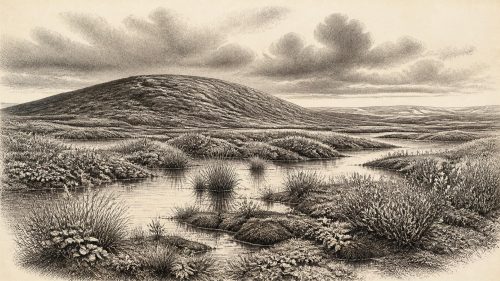
Plants are harder to reconstruct for precisely this date, because Ireland has comparatively few securely dated terrestrial environmental sequences from the middle of the last glaciation. A valuable northern comparison comes from Derryvree in County Fermanagh, where organic freshwater sediments dated to about 30,500 radiocarbon years BP contained floral and faunal evidence interpreted as open tundra under a periglacial climate. That evidence is later than the nominal year considered here and should not be mistaken for an annual report from 31,951 BCE. It nevertheless supports the wider interpretation that open, sparsely wooded or treeless cold-climate habitats were characteristic of the region during severe phases of this period, rather than the dense green woodland familiar in modern Ireland.
Such terrain would have been dynamic. Freeze–thaw action broke exposed rock; seasonal water and sediment moved through valleys and into caves; glaciers and ice streams later eroded, buried and redeposited parts of the older landscape. Many of the drumlins, eskers, corries, U-shaped valleys and widespread deposits of till now associated with Ireland record repeated Quaternary glaciations, though they do not individually date to this one year. The future shape of much of the island was being prepared by processes far more consequential than any recoverable human action.
The Fragile Human Clue
There is one potentially transformative clue close in age to this period. A reindeer femur from the old Castlepook collection has been reported as dating to about 33,000 years ago and as carrying a deep mark interpreted by its investigator as having been made by a sharp stone tool during butchery. County Cork’s heritage publication presents it as evidence for Palaeolithic hunters processing reindeer, while also noting that the animal may have been butchered outside the cave and the discarded bone later carried inside by hyaenas or wolves. This is the nearest direct evidence relevant to human activity in Ireland around the early 30,000s BCE.
Its importance must be matched by restraint. The specimen comes from an early excavation, not a modernly excavated occupation surface with recorded layers, tools and hearths. A radiocarbon result dates the animal’s death, within a statistical range; it does not alone date a human visit, establish where butchery occurred or identify the people involved. Cut marks require microscopic assessment and must be distinguished from carnivore damage, trampling, sediment movement, old excavation damage and later handling. Current investigation at Castlepook is explicitly seeking stratified deposits, lithics, cave art and further modified bone because those finds would test, refine or challenge the striking interpretation placed on this single specimen.
If the mark is confirmed as human-made, the most that can responsibly be inferred is a brief Upper Palaeolithic human presence or animal-processing episode somewhere in Ireland during the general pre-maximum Ice Age. It might represent a small mobile hunting party following reindeer, rather than a settlement. It cannot support claims for an Irish village, a permanent colony, a named ethnic group or a continuous ancestry from these visitors to later inhabitants. No securely dated Irish stone tools can yet tie such an episode to a particular Upper Palaeolithic tradition known from Britain or continental Europe.
No Polities, No Recorded Culture
Political affairs, diplomacy and warfare cannot be recovered for Ireland at this date. There are no written sources, monuments, settlements, graves or territorial markers from which to identify leaders, communities, alliances or conflicts. Terms such as “tribe”, “kingdom” and “Irish people” would import much later concepts into a record that does not justify them. Equally, there is no Irish evidence from c. 31,951 BCE for formal religion, ceremonial sites, cave art, schools, artistic traditions or systems of learning. Upper Palaeolithic societies elsewhere in Europe produced striking art and sophisticated technologies, but those continental achievements must not be projected automatically across the Irish Sea.
The same limit applies to economy and trade. The possible modification of a reindeer bone permits discussion of butchery, meat and perhaps hide, sinew or marrow extraction; it does not demonstrate a local economy, regular hunting system or exchange network. The cave fauna shows an ecosystem in which large herbivores and predators moved through the landscape. It does not prove that humans routinely exploited them. Nor can the movement of animals be converted into evidence for trade, seafaring or organised migration.
Why the Silence Matters
Ireland’s scarcity of early Palaeolithic evidence is itself historically significant. Later ice sheets were destructive agents: they scoured bedrock, reworked sediments and could remove or conceal open-air traces. Subsequent sea-level rise drowned extensive former coastal landscapes and shelf areas where people, if present, may have travelled or camped. Caves preserve bones unusually well, but their deposits can be mixed by water, slope wash, animals and generations of excavation. The result is an archive shaped as much by survival and discovery as by the actual distribution of life in the Late Pleistocene.
That is why museum collections and renewed cave work matter so greatly. The Irish Quaternary Fauna Project demonstrated that a broad range of mammals had reached Ireland between at least about 45,000 and 20,000 years ago, while modern accelerator mass spectrometry, sediment analysis and re-excavation continue to revise older assumptions. At Alice and Gwendoline Cave in County Clare, for example, later research has provided firm evidence for humans only in the terminal Pleistocene, around 12,700 calibrated years BP, illustrating both the potential and the chronological limits of Irish cave archives.
For 31,951 BCE, then, the central development was environmental rather than political: an increasingly cold Ireland on the threshold of the great ice advance, inhabited demonstrably by Ice Age fauna and perhaps visited by people. The reindeer bone from Castlepook is a compelling lead, not a complete human history. Its proper lesson is that deep Irish prehistory remains open to discovery, but that evidence, interpretation and speculation must remain carefully distinct.
Source References
Hover over a number to see the source. Select it to open the source.

- [1] The Irish Quaternary Fauna Project
- [2] A Reconsideration of the Radiocarbon Dating of the Marine Isotope Stage 3 Fauna from Southern Ireland
- [3] Castlepook Cave, County Cork Geological Site Report
- [4] Heritage Artefacts of County Cork 2021
- [5] Archaeology Research Excavation Grant 2022: Final Report
- [6] Trimlines, Blockfields and the Vertical Extent of the Last Ice Sheet in Southern Ireland
- [7] Stratigraphic and Palaeo-Geomorphological Evidence for the Glacial-Deglacial History of the Last British-Irish Ice Sheet in the North-Western Irish Sea
- [8] Late Pleistocene Chronostratigraphy and Ice Sheet Limits, Southern Ireland
- [9] The Colonization of Ireland: A Human Ecology Perspective
- [10] Anthropogenic Changes to the Holocene Nitrogen Cycle in Ireland
- [11] Palaeoecology
- [12] Quaternary
- [13] Ireland Through Geological Time
- [14] Themes: Quaternary Geological Heritage
- [15] New Insights on the Fauna of Ireland's Younger Dryas and Early Holocene from Alice & Gwendoline Cave
- [16] Lateglacial Vegetation and Environment in Ireland: First Results from Four Western Sites
- [17] The Antiquity of Man in Ireland
- [18] Ireland: Submerged Prehistoric Sites and Landscapes
- [19] The Mesolithic in Ireland: When Was It?
- [20] The Archaeology of Caves in Ireland
Primary Sources
- The Irish Quaternary Fauna Project
- A Reconsideration of the Radiocarbon Dating of the Marine Isotope Stage 3 Fauna from Southern Ireland
- Castlepook Cave, County Cork Geological Site Report
- Heritage Artefacts of County Cork 2021
- Archaeology Research Excavation Grant 2022: Final Report
- Trimlines, Blockfields and the Vertical Extent of the Last Ice Sheet in Southern Ireland
- Stratigraphic and Palaeo-Geomorphological Evidence for the Glacial-Deglacial History of the Last British-Irish Ice Sheet in the North-Western Irish Sea
- Late Pleistocene Chronostratigraphy and Ice Sheet Limits, Southern Ireland
- The Colonization of Ireland: A Human Ecology Perspective
- Anthropogenic Changes to the Holocene Nitrogen Cycle in Ireland
- Palaeoecology
- Quaternary
- Ireland Through Geological Time
- Themes: Quaternary Geological Heritage
- New Insights on the Fauna of Ireland's Younger Dryas and Early Holocene from Alice & Gwendoline Cave
- Lateglacial Vegetation and Environment in Ireland: First Results from Four Western Sites
- The Antiquity of Man in Ireland
- Ireland: Submerged Prehistoric Sites and Landscapes
- The Mesolithic in Ireland: When Was It?
- The Archaeology of Caves in Ireland