
Castlepook’s Late MIS 3 Fauna30130 BCE
Labelled 30,130 BCE, this period falls in late Marine Isotope Stage 3, as Ireland moved towards, but had not reached, maximum glaciation. Conditions were cold, open and changing, with lower seas and unstable ice margins linking Ireland ecologically to north-west Europe. Castlepook Cave, County Cork, preserves Ireland’s principal pre-maximum vertebrate archive, including mammoth, giant deer, reindeer, bear, hyena, lemmings, Arctic fox and wolf. Its mixed, disturbed deposits cannot date all species together, though modern redating has revised ages older. The evidence indicates mobile Ice Age fauna in patchy tundra-like habitats, not human settlement. Secure human activity appears 12,800 years ago.
Dateline
30,130 BCE is a useful modern label, not a date that can be matched to an event in an Irish calendar. There were no written records, named communities or year-by-year chronicles in Ireland at this depth of time. In scientific terms, the point lies roughly 32,080 calibrated years before 1950, within the later part of Marine Isotope Stage 3, a fluctuating phase of the Last Ice Age. Even that conversion must be treated cautiously: radiocarbon results come with statistical ranges, calibration curves are not exact clocks, and deposits may contain material of different ages. The responsible history of Ireland at this point is therefore one of landscapes, ice, animal remains and the limits of the evidence.
A Landscape Nearing Glaciation
Ireland was moving towards the severe conditions conventionally grouped under the Last Glacial Maximum, but 30,130 BCE was not yet the moment of maximum ice cover. Research on the Irish sector of the British–Irish Ice Sheet indicates rapid expansion after about 32,000 years before present, while its greatest offshore extent west of Ireland was reached much later, broadly around 27,000–24,000 calibrated years before present. The distinction matters. It is misleading to imagine the entire island frozen beneath a single, unchanging cap in 30,130 BCE; equally, it would be wrong to picture a modern-looking green Ireland awaiting human settlement.
Ice-sheet growth was regionally uneven and dynamically changing. Later glaciers repeatedly eroded, transported and buried earlier surfaces, leaving an incomplete record of their advance. Mountain ice, expanding inland ice masses and marine-terminating margins did not all behave alike. Consequently, archaeologists and Quaternary scientists can establish broad sequences more confidently than they can draw a precise map for one nominal calendar year. What survives suggests a cold, open and increasingly unstable world, in which environments available to animals could contract, shift or vanish over comparatively short geological intervals.
At lower sea levels, the coastlines and shelves around Ireland differed radically from those of today. Yet altered geography should not be turned into a simple story of a permanent land bridge or an easy route from Britain. The configuration of ice, sea and exposed land changed through time, and direct evidence for a particular crossing route at this date is lacking. The important point is that Ireland’s biological history was then part of a wider north-west European Ice Age system rather than an isolated island ecology of the modern kind.
The Cave Archive at Castlepook
The strongest Irish evidence relevant to this period comes from Castlepook Cave near Doneraile, County Cork. This limestone cave system is Ireland’s richest known archive for vertebrate life leading up to the Last Glacial Maximum. Excavations undertaken between 1904 and 1918 recovered more than 2,000 bones from galleries given memorable names such as Hyenahall and Elephant Hall. Their nineteenth- and early twentieth-century excavators could not apply modern methods of stratigraphic recording, contamination control or bone dating. Nevertheless, the collection, much of it associated with the National Museum of Ireland, remains exceptionally important.
Castlepook does not offer a neat snapshot of 30,130 BCE. Its bones accumulated over a long period, through deaths, carnivore activity, water movement and cave sedimentation. Some deposits were disturbed by water, while antiquarian excavation removed or mixed parts of the sequence. Modern re-dating has also transformed the chronology: improved pretreatment of bone collagen has shown that several earlier radiocarbon determinations were substantially too young. A 2020 reassessment found new dates from Castlepook between roughly 5,000 and 12,000 radiocarbon years older than previous results for particular specimens. Such revisions are not a weakness of scholarship; they demonstrate why scientific interpretations must remain open to testing.
The cave has produced remains attributed to woolly mammoth, giant deer, reindeer, brown bear and spotted hyena, with Norwegian lemming, collared lemming, Arctic fox and wolf among the later Ice Age fauna. Not every species is securely shown to have lived in County Cork at precisely the same moment, and the presence of a bone does not automatically identify an animal’s habitual range. Carnivores could drag carcass parts into caves; water could redistribute them; and a specimen may pre-date or post-date its neighbours by millennia. The assemblage nevertheless establishes that a striking cold-stage fauna reached Ireland during the broad pre-maximum interval.
Open Country and Mobile Animals
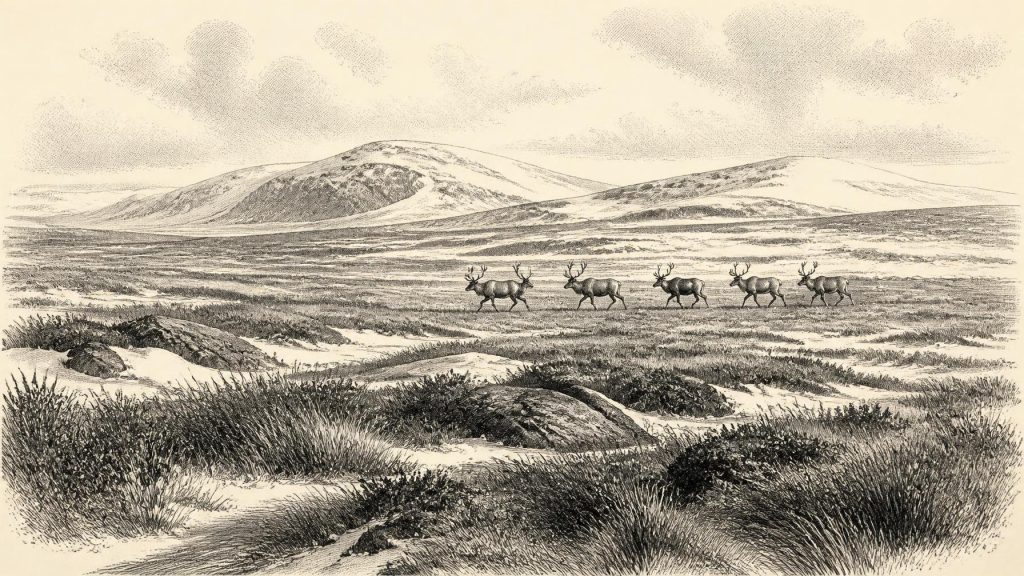
The animals represented at Castlepook support an interpretation of predominantly open country, not closed woodland. Reindeer and lemmings are particularly informative because their ecological associations point towards cold, sparse or tundra-like habitats. Giant deer, whose enormous antlers later made them icons of Irish prehistory, also belonged to this far older Pleistocene setting. Mammoth and hyena evoke an ecosystem unfamiliar in present-day Ireland, but they should not be assembled into a single imagined herd on one particular Cork hillside. The cave record shows recurrent faunal presence across a changing interval, not a painted scene from a single day.
Vegetation around Ireland would have responded sharply to temperature, moisture, seasonality, soil disturbance and advancing ice. Pollen, plant macrofossils and insect evidence from Irish late-Pleistocene deposits are valuable, but their dating and local settings vary. The safest conclusion is that expanses of treeless or only sparsely vegetated ground formed part of the landscape, with grasses, sedges, herbs, dwarf shrubs and patches of wetter ground where conditions allowed. Local shelter, slope aspect, groundwater and snow cover could have created ecological mosaics. The country was not uniformly barren: animals large and small were finding food, water and seasonal refuge somewhere within it.
There is no sound basis for describing agriculture, herding, permanent villages, fields, monuments or trade in this Ireland. The economy, in the human historical sense, cannot be recovered because there is no securely dated evidence for a resident human population at this time. Nor can historians responsibly infer social ranks, leaders, kin groups, languages, religious rites, diplomacy or warfare from animal bones alone. Political history begins here with an absence: no polity is visible, and no conflict between people can be identified.
The Human Question
That absence deserves emphasis because the deep antiquity of Castlepook has sometimes encouraged claims of a human presence in Ireland around 30,000 BCE. There is currently no accepted assemblage of stone tools, hearths, dwellings, human remains or securely butchered animal material that establishes human occupation of Ireland at this date. A modified reindeer femur from Castlepook has attracted discussion, but a mark on bone, especially from an old and disturbed cave collection, cannot by itself demonstrate butchery or settlement. Natural damage, carnivore action, excavation history and the bone’s uncertain depositional context must all be considered.
The earliest securely dated evidence of people in Ireland is much later: a butchered brown-bear patella from Alice and Gwendoline Cave, County Clare, dates to approximately 12,800–12,600 calibrated years before present. Even that evidence is a sign of human activity rather than proof of a large, enduring population. At 30,130 BCE, therefore, it is more accurate to speak of Ireland as a potential landscape for fauna than as an inhabited human homeland. Contemporary Upper Palaeolithic societies certainly existed elsewhere in Europe, with sophisticated hunting, art, ornament and long-distance connections, but it would be an error to transfer their practices automatically across the Irish Sea.
Caves, Carnivores and Preservation
Castlepook’s importance lies partly in how unusual its evidence is. Much of Ireland’s pre-maximum surface archaeology was vulnerable to later glacial erosion, flooding and sea-level change. Caves offered protected traps and repositories for bone, although not necessarily places in which animals or people lived. Spotted hyena is especially significant: the cave may have been used by hyenas, whose scavenging and denning behaviour helped create the assemblage. A cave bone collection is thus both an ecological record and a taphonomic puzzle—the result of processes that brought, altered and preserved material.
Scientific methods continue to refine that puzzle. Accelerator mass spectrometry radiocarbon dating can test individual bones where collagen survives; stable isotopes can contribute evidence about diet and environment; sediment analysis can distinguish water-laid from occupation deposits; and ancient DNA techniques may identify species or population histories where preservation permits. Each method has constraints. The most reliable reconstructions combine independently dated specimens, cave stratigraphy, regional ice-sheet evidence and comparison with Britain and continental Europe, while clearly separating observation from inference.
An Ireland Without a Chronicle
For 30,130 BCE, the central development in Irish history was environmental rather than political: the approach of the great ice-sheet phase that would profoundly reshape the island’s landforms and erase much older evidence. County Cork’s cave fauna shows that Ireland had supported a richer Ice Age mammal community than its later history might suggest. It also records vulnerability. As climate deteriorated and ice expanded, habitats and animal populations changed; some species appear to have disappeared from Ireland before the maximum cold.
The year’s proper lesson is therefore one of disciplined uncertainty. Castlepook gives Ireland an extraordinary Pleistocene archive, but not a named human society or a dated episode of Irish public life. Around the modern label of 30,130 BCE, the evidence supports a cold, open, biologically connected and increasingly glaciated Ireland, visited or inhabited by Ice Age animals and preserved unevenly in caves. Beyond that, the honest historian must allow the silence of the record to remain.
Primary Sources
- Castlepook Cave, County Cork: County Geological Site Report
- A reconsideration of the radiocarbon dating of the Marine Isotope Stage 3 fauna from southern Ireland
- The Irish Quaternary Fauna Project
- Occurrence of mammalia relicts at site Castlepook Cave
- First evidence of a Late Upper Palaeolithic human presence in Ireland
- New insights on the fauna of Ireland's Younger Dryas and Early Holocene from Alice & Gwendoline Cave
- The colonization of Ireland: A human ecology perspective
- The deglaciation of the western sector of the Irish Ice Sheet from the inner continental shelf to its terrestrial margin
- Timing and pace of ice-sheet withdrawal across the marine–terrestrial transition west of Ireland during the last glaciation
- Maximum extent and dynamic behaviour of the last British–Irish Ice Sheet west of Ireland
- Dimensions and chronology of the last ice sheet in Western Ireland
- Late Pleistocene chronostratigraphy and ice sheet limits, southern Ireland
- Trimlines, blockfields and the vertical extent of the last ice sheet in southern Ireland
- Radiocarbon constraints on the age of the maximum advance of the British–Irish Ice Sheet in the Celtic Sea
- BRITICE-CHRONO: Constraining rates and style of marine-influenced ice sheet decay
- BRITICE: A map and GIS database of glacial landforms and patterns of ice flow in the last British–Irish Ice Sheet
- The Last Glacial Maximum
- The IntCal20 Northern Hemisphere radiocarbon age calibration curve (0–55 cal kBP)
- High-resolution record of Northern Hemisphere climate extending into the last interglacial period
- Sea level and global ice volumes from the Last Glacial Maximum to the Holocene