Mammoth Cave and Maguiresbridge30387 BCE
Around 30,387 BCE, Ireland has no recoverable annual history; evidence instead derives from Late Pleistocene sediments, plants and animal bones. At Derryvree, County Fermanagh, freshwater deposits between glacial tills, radiocarbon dated broadly to Marine Isotope Stage 3, indicate ice-free or ice-marginal wetlands with cold-tolerant, treeless vegetation. Castlepook, or Mammoth Cave, County Cork, preserves fauna including mammoth, giant deer, reindeer, bears, wolves, foxes and hyaenas, accumulated over millennia. A marked reindeer femur may indicate human carcass processing, but proves neither settlement nor continuity. Subsequent ice growth transformed and buried these landscapes, leaving a fragmentary record of changing cold-stage environments across Ireland.

Dateline
30,387 BCE is not a year that can be recovered from Ireland’s archaeological record in the manner of a later historical date. No Irish document, settlement, burial, ruler or event can be assigned to it. The number is a modern calendar label applied to a point deep in the Late Pleistocene, more than 32,000 years before AD 1950. At that distance, even radiocarbon dates usually produce broad probability ranges rather than a single calendar year. The responsible history of Ireland at this horizon is therefore an account of landscapes, animal remains and buried sediments, not of named people or political events.
The period belongs to Marine Isotope Stage 3, an unstable middle part of the last Ice Age. Ireland was not simply a frozen, uniform wilderness. Ice margins, open ground, wetlands and animal habitats shifted over long intervals, while the eventual Last Glacial Maximum lay ahead. The evidence is fragmentary and local: a freshwater deposit sealed inside a County Fermanagh drumlin, and cave bones from north County Cork, are especially important. They reveal conditions in particular places and broad phases; they do not make a complete map of the island on one imagined day.
A Date Without Calendar Precision
The difficulty begins with chronology. Archaeologists conventionally report radiocarbon years “before present”, where “present” is AD 1950. Such measurements are not calendar dates because atmospheric carbon-14 levels have altered through time. They must be calibrated against independently dated records, and calibration at this antiquity carries substantial uncertainty. Nor can the conventional age of an old sample safely be translated into a precise BCE year by simple subtraction.
Derryvree townland, near Maguiresbridge in County Fermanagh, provides the closest major environmental sequence. Road works in 1969 cut into a drumlin and exposed freshwater silts and fine sands between two thick tills: glacial sediments below, a period of non-glacial deposition, then later glacial sediment above. An organic layer produced the conventional radiocarbon determination BIRM-166, reported as 30,500 ± 1,100 radiocarbon years BP. This does not date 30,387 BCE itself. It does, however, establish a broad Middle Midlandian, pre-Last-Glacial-Maximum interval in which the locality was ice-free or ice-marginal long enough for fresh water, plants and sediment to accumulate.
The most defensible temporal language is therefore approximate. The Derryvree evidence belongs to a broad late-Marine-Isotope-Stage-3 world, plausibly spanning part of the mid-to-late 30,000s in calibrated years before present. Castlepook Cave, near Doneraile in County Cork, preserves animal material from an even longer interval. These sites illuminate Ireland around the requested date, but neither is a diary entry for that year.
Fresh Water Beneath a Drumlin
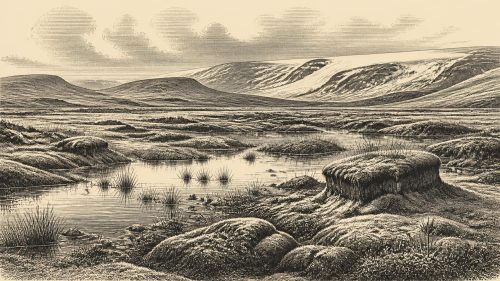
Derryvree is valuable because it preserves the aftermath of one ice episode and the approach or return of another. The organic sediments formed in a cold, open landscape rather than in the wooded Ireland familiar from later prehistory. Mosses, sedges and remains of plants associated with wet ground and shallow freshwater were recorded. These include bogbean (Menyanthes trifoliata) and alternate water-milfoil (Myriophyllum alterniflorum), while dwarf willow, mountain-avens and lesser clubmoss indicate nearby cold-tolerant vegetation. Together they support an interpretation of pools, saturated margins and low, treeless tundra-like ground.
That interpretation needs limits. A plant fossil proves that a species or its propagule reached the deposit; it does not prove that every valley in Ireland looked alike. Pollen can travel far, and sediments can be moved or reworked. Nonetheless, the combination of aquatic and terrestrial plant evidence is powerful. It shows that, during the interval represented at Derryvree, northern Ireland had local fresh water and enough summer growth for a specialised cold-climate flora. The landscape was not lifeless beneath permanent ice.
Seasonality would have governed daily conditions. Long, severe winters, repeated freezing and thawing, and a short growing season are consistent with the periglacial character of the deposit. In summer, shallow water and wet ground could support mosses, sedges and aquatic plants; in winter, frozen soils and snow would have constrained both plants and animals. Yet temperatures, snowfall and duration of open water cannot be read directly from one deposit. They remain reconstructions from species assemblages and sedimentary context, not weather observations.
Animals at Mammoth Cave
At Castlepook Cave, also known as Mammoth Cave or Doneraile Cave, the record is different. This limestone cave system became a repository for animal remains over a long stretch of the later Ice Age. More than two thousand bones have been recovered, although nineteenth- and early twentieth-century excavation methods, water disturbance and uncertain original contexts make the assemblage difficult to treat as a single living community. Its importance lies in proving that a striking range of large mammals and predators reached or lived in Ireland before the Last Glacial Maximum.
The documented fauna includes woolly mammoth, giant deer, reindeer, brown bear, wolf, Arctic fox and spotted hyaena, alongside small cold-adapted mammals such as collared and Norwegian lemmings. No single bone proves that all these species stood together on the same hillside in 30,387 BCE. Direct dates extend across many millennia, and cave accumulation has complex causes. But the collection securely demonstrates that Ireland was, at various points during this wider period, connected ecologically to north-west European cold-stage faunas.
The cave also warns against turning fossil lists into scenes of uncomplicated abundance. Spotted hyaenas could drag carcass parts into dens; water could move bones; carnivores, natural deaths and human activity may all have contributed material. A mammoth bone or reindeer limb found in a cave is not necessarily evidence that the animal died there. The careful conclusion is that these species formed part of the wider Irish Ice Age animal world, not that Castlepook was a settled hunting camp or a perfectly preserved kill site.
The Uncertain Human Trace
The question of people is the most arresting and the most restricted part of the evidence. A reindeer femur from Castlepook has been reported as roughly 33,000 years old and bears a deep mark interpreted as having been made on fresh bone with a sharp stone implement. If that reading is sustained through continuing microscopic, dating and contextual research, it indicates that people processed a reindeer in Ireland during the Upper Palaeolithic, far earlier than the island’s previously well-established terminal-Pleistocene evidence.
It does not demonstrate a permanent population, a village, or an annual hunting territory. No securely associated tool kit, hearth, dwelling floor, human burial or repeated occupation surface has been recovered from this period in Ireland. A single modified bone, however important, can show only a narrowly defined action: human handling of an animal carcass. It cannot identify the number of people involved, their language, ancestry, route of arrival, social organisation or length of stay.
For that reason, it would be misleading to people this date with imagined tribes, chiefs or rival polities. There is no evidence for government, diplomacy, law, warfare or territorial kingdoms. Nor is there evidence for farming, herding, metalworking, monument building or organised long-distance trade within Ireland. The vocabulary of later Irish history simply does not apply here. If people were present, their subsistence may have included opportunistic use of large game, hides, marrow, sinew and bone, as among Upper Palaeolithic communities elsewhere in Europe; but applying that comparison to Ireland is interpretation by analogy, not a direct Irish discovery.
Settlement, Culture and Silence
There is equally no direct evidence for a house, camp, clothing, language, ritual or art from Ireland at this horizon. This absence is unsurprising. Subsequent glaciation eroded and buried many earlier land surfaces, while fluctuating sea levels altered or submerged parts of the former coastal landscape. Organic materials decay unless conditions are exceptional. Caves and sediments survive unevenly, and old excavations did not always retain the spatial information expected today.
Still, absence must not be overstated. It does not prove that no person ever crossed into Ireland during Marine Isotope Stage 3. It proves that archaeology has not yet identified a durable record of settlement and social life. The Castlepook femur keeps the possibility of brief human presence open; Derryvree establishes that at least some Irish places could offer ice-free wetland environments. Neither supports a continuous, island-wide human occupation.
An Island Entering a Harder Phase
Regional change is the principal story. Modern reconstructions of the British–Irish Ice Sheet show substantial ice growth across Ireland and Britain after about 31,000 years ago, though the pattern varied by region and successive advances did not cover every locality at precisely the same moment. By the Last Glacial Maximum, broadly later than this horizon, ice had expanded across most of Ireland and adjoining shelves. The freshwater world at Derryvree was eventually overridden or sealed by later ice, preserving its sediments beneath the drumlin.
Thus Ireland around 30,387 BCE was neither the familiar green island nor an empty white void. The evidence supports a changing cold-stage mosaic: exposed, largely treeless ground; local freshwater basins and wet margins; seasonally viable plant communities; and, across the wider period, an extraordinary fauna of reindeer, mammoth, giant deer and predators. It may also preserve one tantalising sign that people reached this Atlantic edge. What it cannot responsibly supply is a precise annual event. The historical achievement is to recognise how much the silts, bones and ice have preserved—and how much they still leave unknown.
Primary Sources
- A Middle Midlandian Freshwater Series at Derryvree, Maguiresbridge, County Fermanagh, Northern Ireland
- Exploring the controls on the last Irish Ice Sheet’s demise
- Growth and Retreat of the Last British–Irish Ice Sheet, 31,000 to 15,000 Years Ago: The BRITICE-CHRONO Reconstruction
- The Irish Quaternary Fauna Project
- Castlepook Cave: Cork County Geological Site Report
- New Insights on the Fauna of Ireland’s Younger Dryas and Early Holocene from Alice & Gwendoline Cave
- 2022:564 – Castlepook Cave, Castlepook South, Cork
- Heritage Artefacts of County Cork
- The Exploration of Castlepook Cave, Co. Cork. With 3 Plates.
- The IntCal20 Northern Hemisphere Radiocarbon Age Calibration Curve (0–55 cal kBP)
- IntCal Publications
- IntCal: Radiocarbon Calibration Curves
- Figure 6: The Subdivision of the Quaternary Period in Ireland
- Irish Quaternary Association Publications
- Irish Quaternary Association Outreach and Education Resources
- Timing, Pace and Controls on Ice Sheet Retreat: An Introduction to the BRITICE-CHRONO Transect Reconstructions of the British–Irish Ice Sheet
- Timing, Pace and Controls on Ice Sheet Retreat: An Introduction to the BRITICE-CHRONO Transect Reconstructions of the British–Irish Ice Sheet
- Occurrence of Mammalia Relicts at Site Castlepook Cave
- Mammoth Cave, County Cork
- BSBI: Selaginella selaginoides in Fermanagh
- BSBI: Myriophyllum alterniflorum in Fermanagh